Saint-Louis: Quand les vestiges de la traite négrière s'effondrent dans l’indifférence
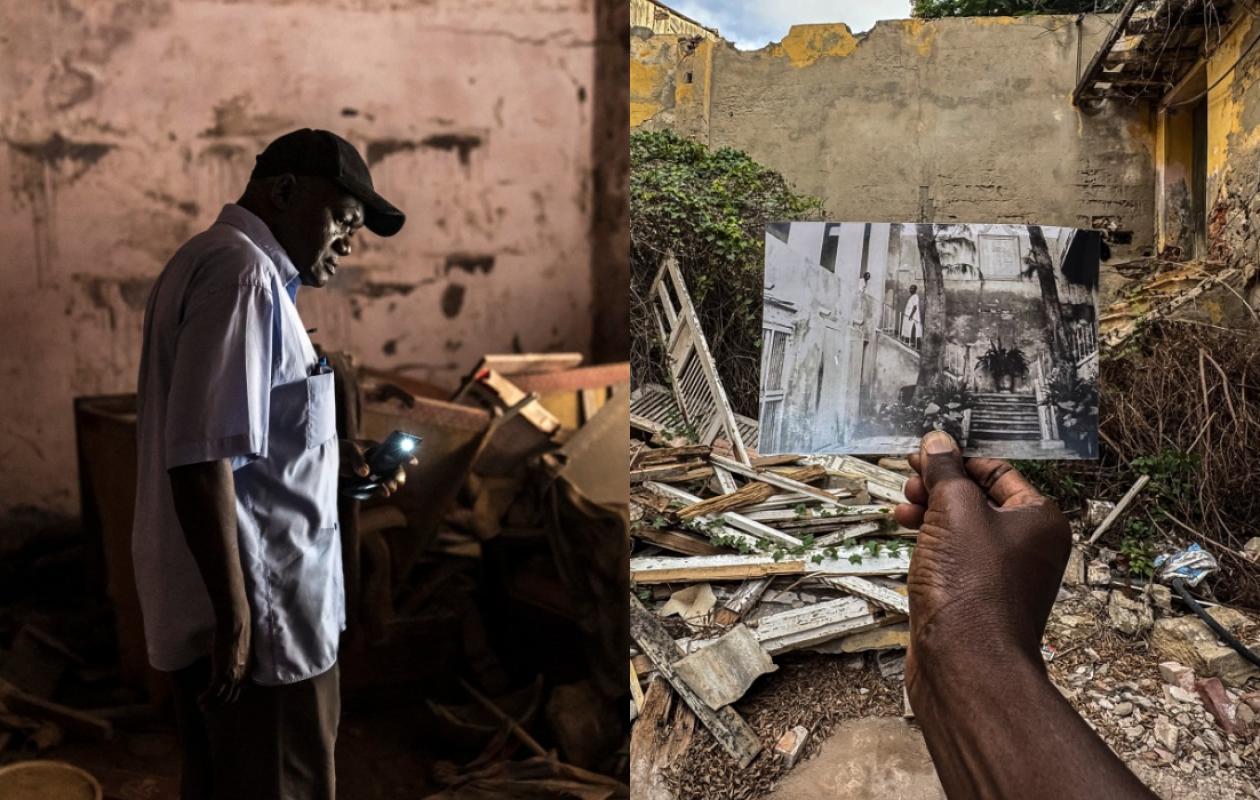
A gaping hole has formed in the balcony of a former slave warehouse after the collapse of the facade of this two-century-old, dilapidated building on the island of Saint-Louis in Senegal, a little-known site of the transatlantic slave trade whose traces are fading away, much to the dismay of historians.
The site, located in the north of the country between the Atlantic Ocean and the Senegal River, is rarely mentioned in the history of the slave trade, although it was a center where thousands of slaves passed through, according to historians interviewed by AFP.
The first trading post established by the French in sub-Saharan Africa in 1659 and the former capital of the French colonial empire in West Africa, Saint-Louis was used to hold captives. Like Gorée, another island off the coast of Dakar, which has become a symbol of the slave trade with its infamous "House of Slaves".
One of the few remaining evidence of Saint-Louis's history of slavery is a plaque on the former slave warehouse, opposite the river.
"On the ground floor, the remains of the only slave house (slave warehouse) preserved in Saint-Louis," indicates an inscription on the two-story building, with thick walls pierced by loopholes crossed by rusty iron bars.
- "Deterioration" -
"This dilapidated building is a former slave house that has remained (in Saint-Louis). It was built between 1822 and 1825 and belonged to a Bordeaux trading company (from the city of Bordeaux, in France), Maurel et Prom," explains Mamadou Diallo, a history teacher.
"In the 18th century, at least 10,000 slaves passed through Saint-Louis each year," he points out.
In Saint Louis, the main time of this trade was "the period of high waters, from May to November", from the pre-colonial kingdom of Galam (between Senegal and Mali), "with gold and captives as the main products" alongside gum and ambergris, details historian Ibrahima Seck, research director at the slavery museum of the "Whitney Plantation", in Louisiana (United States).
The Maurel and Prom company's slave quarters housed "five cells," Mr. Diallo specifies. These were "the premises where the slaves awaited the moment of embarkation" for America, according to a caption on a photo in a public museum in Saint-Louis.
Weeds have grown in the building, which is littered with rubbish and has an original wooden ceiling, and which has become the property of a Senegalese family.
"There were many slave houses in Saint-Louis, especially in the north of the island, but they are no longer found. Many were bought by families who then transformed them," said Mr. Diallo.
The current residence of the region's governor, a fort built in the 17th century, also housed slave warehouses, according to historians.
Along the island's right-angled streets stand colonial mansions, balcony buildings with cracked walls, wooden windows, rectangular or pointed, with roofs sometimes gaping open.
Former trading houses line the riverbanks, slave warehouses that "the populations, unconsciously, did not preserve", so that "almost nothing remains" of this past, notes the writer Louis Camara.
Trading companies and their local intermediaries – notably the famous "signares", wealthy black or mixed-race women who then formed alliances or temporary marriages with European traders or officers – were the main suppliers of slaves.
Thus, in 1789, mixed-race and Black people, linked to France, sent to the Estates General in Paris - an extraordinary assembly bringing together the clergy, the nobility and the rest of the population which marked the starting point of the French Revolution - grievances for the liberalization of trade, including that of slaves, then in the hands of a single company.
Saint-Louis was the scene of a slave revolt in 1779. After a "long wait of 11 months" to be transported to America, the captives "killed" a French guard and many of them were massacred, says Mr. Diallo.
Ibrahima Seck, citing the Atlas of the Transatlantic Slave Trade, a reference book on the number of slaves deported, estimates that "145,000" captives were "officially transported from Saint-Louis" where, according to him, "every old house was potentially a captivity".
- "Taboo subject" -
In Saint-Louis, "it was not a matter of a few slaves offered here and there to buyers by the owners of various private houses, but of real slave houses", emphasizes the Belgian researcher Guy Thilmans in a collective work on the slave trade, "Gorée and slavery".
According to him, the city has many "reasons to be considered a center of the slave trade, both because of the certain presence of private captivity and the loading of slaves to America", but "it lacked only a Joseph Ndiaye" (1922-2009), famous curator of the "House of Slaves" of Gorée and defender of the memory of slaves who contributed greatly to the safeguarding of the island.
After the abolition of the slave trade in April 1848, "former captives, including fugitives from the interior, were resettled in villages of freedom" around the island, according to Mr. Seck.
Historians estimate the official number of slaves in Saint Louis in April 1848 at 2,035. But their 671 owners counted 4,524 for their compensation claims.
This history of the slave trade "is completely unknown to the majority of the population of Saint-Louis who have preferred to conceal it," says Mr. Camara.
Ghana, considered the hub of the transatlantic slave trade, hosted in mid-June the first global conference aimed at translating into concrete commitments a recent UN resolution, which recognized the transatlantic slave trade as "the most serious crime against humanity".
But in Saint-Louis, the heirs of the families involved in this trafficking and those descended from them do not wish to talk about it. It is still "a taboo subject," notes Mr. Diallo.




















Commentaires (13)
Lorsque j’ai découvert l’état de délabrement et d’abandon de certains de ces bâtiments anciens, une question m’est immédiatement venue à l’esprit : où sont les autorités de cette ville, de ce pays ?
Des murs en lambeaux, des toitures affaissées, des cours envahies par des déchets de toutes sortes, avec les odeurs qui les accompagnent… J’avais le cœur serré, partagé entre un profond sentiment de honte et un terrible sentiment d’impuissance.
En 2014, j’avais séjourné avec ma famille dans un hôtel situé sur la Langue de Barbarie. Ce séjour reste un bon souvenir. Mais dès que l’on sortait de l’hôtel pour marcher un peu en direction de la ville, le spectacle devenait tout autre. Les abords du fleuve étaient déjà envahis de déchets de toutes sortes et de choses parfois si difficiles à décrire qu’on préfère ne pas les écrire.
Cette ville, qui pourrait être un lieu où il fait bon vivre, d’abord pour ses habitants, et une magnifique vitrine touristique, avec toutes les retombées économiques et sociales que cela pourrait représenter pour les populations locales, ne donne aujourd’hui, par endroits, que l’image d’immeubles décrépits et abandonnés, de monticules de déchets et d’une saleté omniprésente.
Et pourtant, Saint-Louis possède un patrimoine exceptionnel. Son histoire, son architecture, sa position entre fleuve et océan pourraient en faire l’une des plus belles villes d’Afrique de l’Ouest et une destination touristique majeure.
Mais comment en sommes-nous arrivés là ?
Notre aliénation est toujours d’actualité. Qui sommes-nous ? Que voulons-nous ? Qu’attendons-nous ?
Ces questions, que nous devrions collectivement nous poser, résonnent avec une particulière acuité lorsque l’on regarde l’état dans lequel nous laissons notre patrimoine et notre environnement.
heureusement le reste de l Afrique n est pas comme ca
Quand on se réclame souverainiste et adepte de la reprise en main de notre patrimoine qui n'est d'ailleurs pas le mien car on n'a rien foutu a Saint Louis depuis que cette ville existe, l'on se doit d'être à même de maintenir ce que le nassarane nous a laissé dans des conditions acceptables. La partie du fleuve entre l'île et la langue de barbarie mome n'en parlons pas. Une saleté inqualifiable alors que vers le continent l'anarchie la plus totale a fini de transformer le marché de SOR en Marché HLM BIS. Pathétique. On enlève tout ce le nassarane avait mis pour mettre le désordre, la saleté, l'indiscipline, l'inculture, le manque de savoir vivre et savoir être. Ma déception fût grande et ma fille à qui je chantais la beauté de cette ville m'a finalement dis PAPA pourquoi ici ils jettent tout sur le fleuve? Je la connais ma fille elle est pudique car dans son for intérieur elle se demandait pourquoi cette saleté. Je suis dur certes mais c'est à la hauteur de ma déception face à au spectacle désagréablement surprenant qui sest offert à moi
c est a cause de types comme toi que le blanc meprise les noirs
si ca se trouve il a raison
comment croit tu que votre tres grand serigne a eut la grande croix de la legion d honneur? alors que l unique autre noir a l avoir eut repose aux invalides
quand on est laches et traitres on ne peut pas se plaindre
Participer à la Discussion
Règles de la communauté
💡 Astuce : Utilisez des emojis depuis votre téléphone ou le module emoji ci-dessous. Cliquez sur GIF pour ajouter un GIF animé. Collez un lien X/Twitter, TikTok ou Instagram pour l'afficher automatiquement.
Se connecter
Commentez avec votre profil, votre photo, et soyez averti des réponses.