VBG et budget sensible au genre : Des professionnels de l’information à l’école de la DEEG
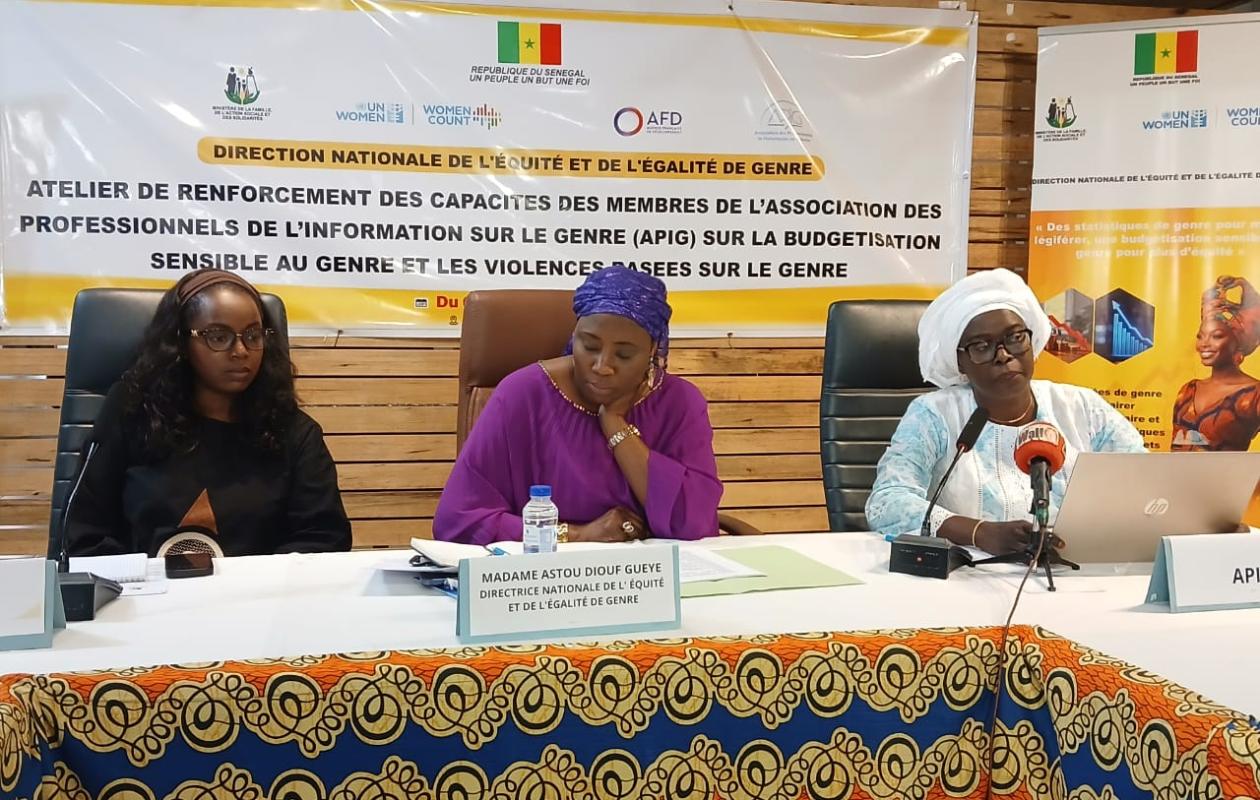
Nearly 32% of Senegalese women aged 15 and over experienced at least one form of violence in 2023. In some regions, such as Diourbel, this proportion reaches 42%. Faced with these alarming figures, the Directorate of Equity and Gender Equality (DEEG) brought together journalists to discuss the challenges of gender-responsive budgeting and gender-based violence (GBV).
For three days, media professionals are receiving training on two topics considered essential for promoting gender equality: gender-based violence and gender-responsive budgeting. Through this initiative led by the DEEG, UN Women, and APIG, the organizers hope to make the media key players in promoting gender equality and combating gender-based violence in Senegal.
Persistent inequalities in several sectors
Officially opening the proceedings, the Director of Equity and Gender Equality, Astou Diouf Guèye, led the discussions within the framework of Senegal's Vision 2050 and the National Strategy for Equity and Gender Equality. She highlighted several indicators revealing persistent disparities. In the economic sphere, the employment rate for women is 30.5%, compared to 60.3% for men. Politically, despite progress made thanks to the parity law, women represent 41.2% of members of the National Assembly, while their presence in the new government does not exceed 10%. "Balance is still far from being achieved in decision-making positions," the Director acknowledged. Gender-responsive budgeting, a concept still poorly understood by the general public, was also central to the discussions. Contrary to some misconceptions, it does not involve creating separate budgets for women and men. “It’s a governance tool that ensures every franc invested by the state effectively contributes to reducing inequalities and meeting the specific needs of women, men, girls, and boys,” explained Astou Diouf Guèye. The organizers believe journalists have a crucial role to play in popularizing these budgetary mechanisms, which are often perceived as technical. “Behind these statistics are human lives, realities, and suffering. Our collective responsibility is to transform this data into concrete actions,” concluded the Director of Equity and Gender Equality.
For Adama Diouf Ly, president of the Association of Information Professionals for Gender (APIG), this training addresses a real need for journalists to be better equipped. “You have to be well-informed before you inform. We must be able to analyze data, identify key indicators, and address these issues responsibly,” she emphasized. Ndeye Seynabou Sarr of UN Women stated, “Without reliable data, inequalities remain invisible. Without proper dissemination of information, data struggles to translate into concrete actions.” She also cautioned against certain misinterpretations of statistics, notably mentioning the controversy surrounding the figure that more than 70% of women have experienced some form of violence in their lifetime. “Violence does not mean femicide. It is important that the media master the concepts and data to avoid conflation,” she reminded everyone. “Gender is now a cross-cutting issue.” It affects health, education, the environment, the economy and governance. Gender-based violence certainly affects women and girls, but it also affects men and boys,” she stressed.
She also stressed the role of the media in preventing violence and protecting victims. "We must inform professionally, raise awareness without stigmatizing, and promote behaviors that support prevention," she said.















Commentaires (0)
Participer à la Discussion
Règles de la communauté
💡 Astuce : Utilisez des emojis depuis votre téléphone ou le module emoji ci-dessous. Cliquez sur GIF pour ajouter un GIF animé. Collez un lien X/Twitter, TikTok ou Instagram pour l'afficher automatiquement.