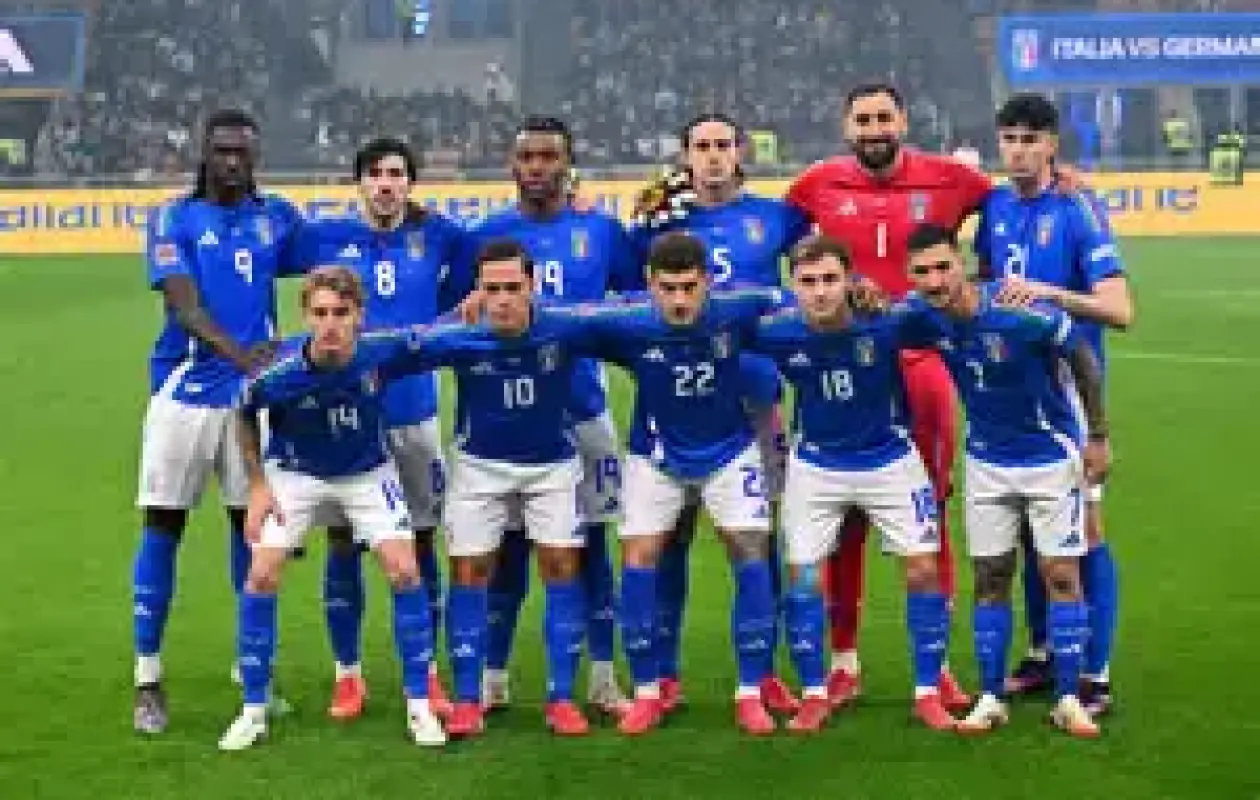
Joueurs binationaux : l’Italie et l’Allemagne changent de stratégie
Faced with increasing competition from national teams, Italy and Germany have decided to revise their approach to dual-nationality players. Roberto Mancini and Jürgen Klopp are now willing to invest in young, relatively inexperienced footballers to convince them to represent their country before they make a final decision.
Prestige alone is no longer enough. Despite their combined eight world titles, Italy and Germany must redouble their efforts to retain their talent and attract players with multiple nationalities. Since September, both nations have adopted a more proactive approach, increasing the number of young players called up who could potentially join other national teams.
For Italy, the urgency is particularly palpable. Having missed the last three World Cups, the Nazionale is looking to regain its former glory and revitalize a squad that is struggling to regenerate. Upon his return to the helm, Roberto Mancini called up 34 players in September, including nine new additions.
Among the new faces are Issa Doumbia (23), Mohamed Ali Zoma (22), Michael Kayode (22), Eddy Kouadio (20), and Alessandro Romano (20). All are eligible to represent another nation. For Mancini, it is therefore crucial not to wait too long before offering them a place in the senior squad.
"The solution is to go and find them and select them quickly, especially to avoid losing those who have dual nationality," explained the Italian coach.
Italy also wants to attract talent trained elsewhere
This strategy isn't limited to players already playing in the Italian league. The Nazionale is also looking to attract footballers who grew up in other international environments. Alessandro Romano, who came through the Swiss youth ranks, has opted to represent Italy. Meanwhile, Matteo Palma (18), who played for the German national teams, has received FIFA approval to change his sporting nationality.
In November, Mancini also called up Alphadjo Cissé (20 years old), who was eligible to represent Guinea. The Italian coach is also closely monitoring Nicolò Tresoldi (22 years old). The Club Brugge striker, who has been performing well, is still playing for the German U21 team. Mancini has reportedly even spoken directly with him to try and convince him to join the squad. Italy, which had some success with Mario Balotelli, wants to continue to be much more proactive in recruiting young talents with dual nationality.
Klopp adopts the same method with Germany
For its part, Germany also intends to avoid further setbacks. The Nationalmannschaft, however, has a long tradition of integrating dual-nationality players. Its 2014 World Cup victory relied in particular on internationals such as Mesut Özil, Sami Khedira, Jérôme Boateng, Miroslav Klose, Lukas Podolski, and Shkodran Mustafi.
But the situation has changed. In recent years, several young talents trained in Germany have chosen to represent other countries. This is notably the case for Ibrahim Maza (20 years old), who went to defend the colors of Algeria, Can Uzun (21 years old), who opted for Turkey, and Paul Wanner (20 years old), now an Austrian international.
Departures that Jürgen Klopp wants to avoid in the future. For his first international break, the former Liverpool manager has called up no fewer than 44 players. Among them is Younes Ebnoutalib (23 years old), who is also attracting interest from Morocco.
The case of Wael Mohya is even more revealing of this new approach. At just 17 years old, the Borussia Mönchengladbach attacking midfielder, despite his limited experience at the highest level, has been called up by Klopp. According to the German broadcaster ARD, the national team coach has spoken three times with the young player, who is also being courted by Morocco. Without guaranteeing him playing time, he is primarily trying to convince him to choose Germany.
The competition between the two federations perfectly illustrates this new reality. Italy and Germany are vying for Nicolò Tresoldi, proving that even the major European nations can no longer rely solely on their history and track record to attract the best dual nationals.
Now, the battle is being fought earlier and earlier, sometimes as early as the first years of a young talent's international career. This new strategy should prompt African nations to change their approach to dual-nationality players.












Commentaires (0)
Participer à la Discussion
Règles de la communauté
💡 Astuce : Utilisez des emojis depuis votre téléphone ou le module emoji ci-dessous. Cliquez sur GIF pour ajouter un GIF animé. Collez un lien X/Twitter, TikTok ou Instagram pour l'afficher automatiquement.
Se connecter
Commentez avec votre profil, votre photo, et soyez averti des réponses.