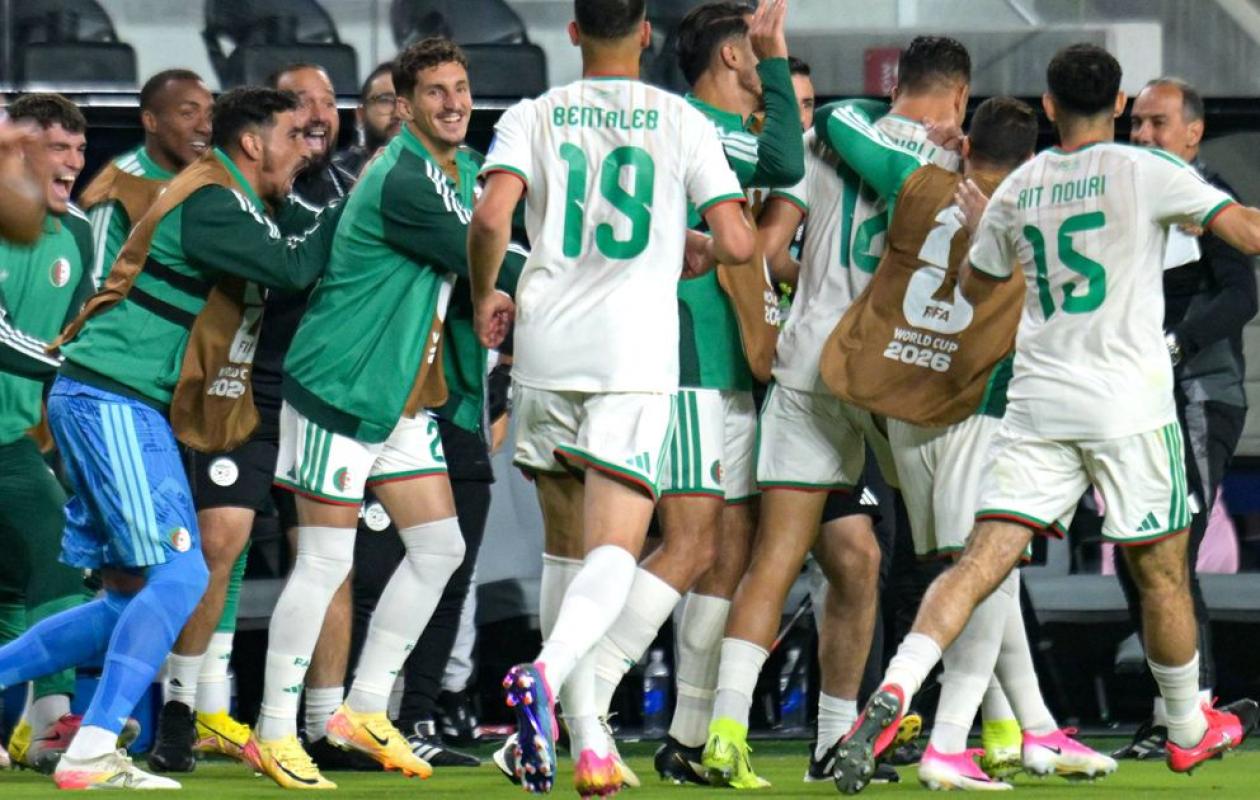
Mondial-2026: Algérie-Autriche, 44 ans après le "match de la honte"
The Algeria-Austria match on Saturday in Kansas City has a sporting stake, qualification for the round of 16 of the 2026 World Cup. But it also has a historical significance, 44 years after the "match of shame" between Austrians and Germans which proved fatal to the Algerians.
"We must inform the players about what Austria and Germany did at the 1982 World Cup. Sporting revenge is necessary." With these words, spoken to the website Dzair Tube, former Fennecs idol Lakhdar Belloumi echoed the general sentiment prevailing in his country.
None of the 26 members of the current team were born when this match, its unfolding, its outcome, and its consequences sparked controversy and then scandal. But in reality, they all know the story; they all know the wound is still raw.
Flashback. After causing a huge upset by beating West Germany (2-1) – the first victory for an African team against a European one in the World Cup – Algeria lost (2-0) to Austria, then beat Chile (3-2). To have any hope of advancing to the next round, they needed either a draw or a defeat for West Germany against Austria, or conversely, a victory by three goals in the final Group 2 match.
None of this happened on June 25th in Gijon. After Horst Hrubesch opened the scoring in the 11th minute, the players of both teams simply passed the ball around without attempting any attacks, to the jeers of the crowd. In the stands, peseta banknotes were waved in the air, and cries of corruption were heard.
Live on French television, commentator Michel Denisot denounced a "match of shame." The word "schande" was also used on German television by his ARD colleague, Eberhard Stanjek. On the Algerian side, the federation president, outraged, condemned the match as a farce.
Forty-four years after the annexation of Austria by Nazi Germany in 1938, a Spanish newspaper even went so far as to call the match an "Anschluss Match"...
Immediately after the match, West German full-back Paul Breitner erupted: "The public is stupid if they don't understand that it was only about qualifying." "That's an insult!" retorted his national team coach, Jupp Derwall, when the possibility of match-fixing was raised.
"Of course we played tactically today! But if, for that reason, 10,000 sons of the desert want to cause a scandal, it simply shows that they haven't gone to enough school. Here is a sheikh coming out of an oasis, who has the right, for the first time in 300 years, to taste the atmosphere of a World Cup, and who thinks he can now open his big mouth," fumes Hans Tschak, head of the Austrian delegation, adding racism to the insult.
Since then, tempers have cooled, but Algerian resentment remains.
"It was more like a friendly than a World Cup match. Unfortunately, Algeria paid the price. We expected these two teams to come to an agreement. After that, FIFA changed the rules to prevent any future match-fixing," former Fennecs star Rabah Madjer told AFP.
Algeria had indeed faced Chile the day before this Austria-Germany match. From the following World Cup in 1986 onwards, the last two matches of a group would be played on the same day at the same time. This schedule is still in place.
On the German side, tongues loosened over time, including that of Paul Breitner, who was much more inclined to acknowledge the facts in 2006: "at some point, each team started to manage the score".
"I understand the Algerian discontent, because it seemed as if everything was fixed. Halfway through the second period, the match had become impossible to watch. It was a real non-aggression pact," former defender Karl-Heinz Förster gushed in 2007.
"Let's just say it was a partial agreement," former Austrian goalkeeper Friedrich Koncilia tried to downplay to AFP. "The spectators realized there was a sort of 'ceasefire' between Germany and Austria – a poorly chosen term, given the number of wars currently underway... I would say rather that we had agreed not to lose by more than 2-0."
"What happened was of course painful, but we have learned from it. Suppose we had faced Tunisia, Morocco or another Arab country; if we had been in the place of Germany and Austria, we would have done the same thing," ventured former striker Salah Assad, also interviewed by AFP.
Also, because history sometimes likes to repeat itself, there is a certain irony in observing, 44 years later, that a draw on Saturday between Algerians and Austrians would allow both teams to advance to the round of 32.








Commentaires (6)
Participer à la Discussion
Règles de la communauté :
💡 Astuce : Utilisez des emojis depuis votre téléphone ou le module emoji ci-dessous. Cliquez sur GIF pour ajouter un GIF animé. Collez un lien X/Twitter, TikTok ou Instagram pour l'afficher automatiquement.