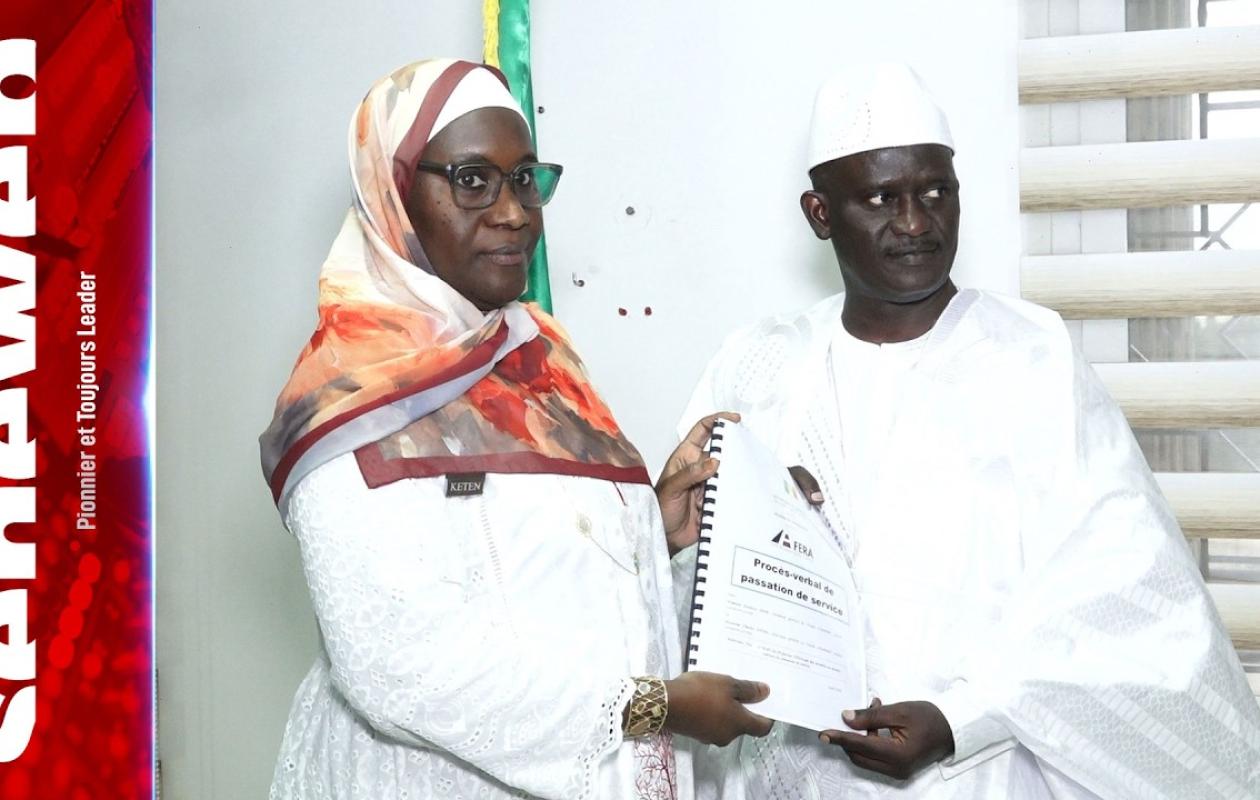
Gestion des infrastructures routières : Le Dr Cheikh Dieng prend les commandes du FERA et lance la « Vision 2031 »
After two years at the helm of the Autonomous Road Maintenance Fund (FERA), Soukeye Diop Fam handed over the reins to Dr. Cheikh Dieng. The ceremony provided an opportunity to review the outgoing administration's achievements and unveil the new leadership's key priorities, centered around the "FERA 2031 Vision."
After 26 months at the helm of the Autonomous Road Maintenance Fund (FERA), Soukeye Diop Fam officially handed over the reins to Dr. Cheikh Dieng, the institution's new Director General. In her farewell address, the outgoing Director General framed her tenure under the motto "Jubb, Jubbal, Jubbanti," presented as the guiding principle of her work: "Managing a fund requires ethics and a high degree of responsibility. We tackled this weighty task with rigor. Efficiency and transparency were our working principles, and Jubb, Jubbal, Jubbanti was the guiding principle of all our actions," she declared.
Among the main projects discussed is the refocusing of FERA on its core mission and the financing of road maintenance. Upon her arrival in June 2024, the outgoing Director General stated that she found "an accumulation of FERA arrears for road maintenance in 2022 and 2023." This situation, she explained, was linked to a redistribution of resources towards local authorities, which had "considerably reduced room for maneuver" and led to a deterioration of the road network. The condition of paved roads, rated "good to average," thus fell from 84% in 2021 to 78.2% in 2025. "Our approach has been to refocus FERA on its primary mission of financing road maintenance and mobilizing resources. We found FERA with debts; today, we are leaving behind a financially sound fund that will enable it to achieve its objectives, particularly for 2026," she affirmed.
Soukeye Diop Fam's report also highlights the modernization of the internal organization. A new organizational chart was adopted to better align the institution's structure with its missions and optimize human capital. The digitalization of processes is another key achievement. The implemented management information system has significantly contributed to information flow, file tracking, archiving, and the security of internal and external communications.
Taking the floor in turn, the new Director General of FERA, Dr. Cheikh Dieng, framed his mandate within a long-term perspective with the presentation of the "FERA 2031 Vision." For him, the challenge is no longer simply to build more, but to ensure that existing infrastructure continues to sustainably generate the expected benefits. "It's about shifting from a construction-driven approach to one of asset enhancement," he stated.
At the heart of the new Director General's project is the "FERA 2031 Vision," a document presented as a strategic framework intended to be discussed and enriched by the Fund's managers and staff. This vision is based on a paradigm shift: moving from a logic primarily focused on construction to one of valuing and preserving existing heritage. The Director General thus proposes a "doctrine of the preservation economy," founded on three convictions: preservation is less expensive than reconstruction, maintenance is an investment, and data must become a strategic asset to inform public decision-making.
He also announced that the "FERA 2031 Vision" is structured around six ambitions: to make road infrastructure a fully valued strategic asset, to build a national reference system for heritage management, to make data a driver of public decision-making, to sustainably integrate climate resilience, to establish a culture of performance and to position Senegal as an African reference in heritage preservation.
To realize this ambition, the new Director General presented four priority areas that will form the foundation of his plan for the first 100 days. The first concerns cleaning up the accounts and securing resources. Cheikh Dieng specifically mentioned a debt of 30.8 billion FCFA that he intends to reduce through better collection of the Road User Tax (TUR) and the diversification of funding sources. The second area focuses on modernizing governance and tools, including the implementation of an integrated asset management information system and the establishment of multi-year planning. The third aims to strengthen human capacity with the creation of an Information Systems Department and the initiation of a dialogue on the salary scale. Finally, the fourth area is based on a more collaborative governance model, particularly through strengthened coordination with AGEROUTE (the national road agency) and local authorities.
Speaking directly to FERA's managers and staff, the new director general sought to reassure them about his governance method: "I am not here to disrupt what is working. I am here to build with you on what has already been achieved," he declared, pledging to work in open and loyal collaboration with the Board of Directors.
He also noted that Senegal's road network, valued at over 3 trillion CFA francs and comprising 16,500 km of classified roads, represents a strategic asset that facilitates more than 90% of trade. "My commitment to meeting this challenge with you is absolute. Together, we will build a modern, efficient, transparent, and resilient FERA. The FERA 2031 Vision is just a starting point. We will build and implement it together," he declared.










Commentaires (2)
Participer à la Discussion
Règles de la communauté
💡 Astuce : Utilisez des emojis depuis votre téléphone ou le module emoji ci-dessous. Cliquez sur GIF pour ajouter un GIF animé. Collez un lien X/Twitter, TikTok ou Instagram pour l'afficher automatiquement.
Se connecter
Commentez avec votre profil, votre photo, et soyez averti des réponses.