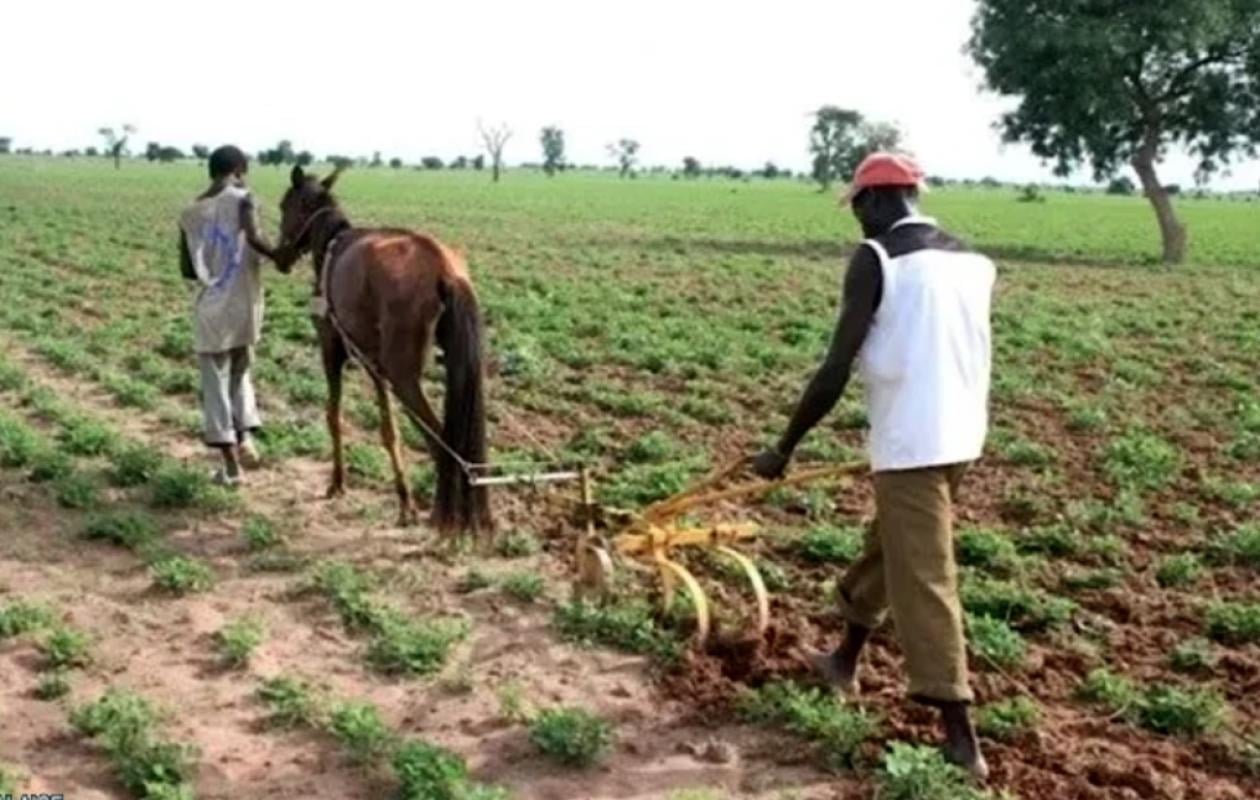
Campagne agricole à Kédougou : les intrants au vert, les pluies inquiètent
The 2026-2027 agricultural season is progressing in Kédougou, but not without concerns. While fertilizer and seed stocks are generally at satisfactory levels, rainfall remains the primary concern. As of August 5th, eleven of the region's fifteen rain gauge stations are reporting a deficit compared to last year.
In Kédougou, producers now have a good portion of the inputs needed to start the season. But water is still lacking in several areas.
For peanuts, 466.30 tonnes of certified seeds of the 73-33 R2 variety have been received out of the 485 tonnes planned. This represents a planting rate of 96.14%. Distribution is also progressing well: 415.40 tonnes have already been distributed, corresponding to a rate of 89.08%.
Maize, cassava, fonio: contrasting situations
For Swan R2 corn, planting has reached 90%, with 72 tonnes received out of the 80 tonnes planned. However, distribution is still lagging: only 15 tonnes have been sold, representing 20.17%.
Cassava, on the other hand, shows better results. The needs corresponding to the 80 hectares planned have been fully met. Implementation rate: 100%. However, no sales have yet begun.
Fonio and sorghum, however, remain on hold. No plantings had been recorded for these two crops as of August 5th.
Rice: availability is improving
In the rice sector, three out of five varieties are already available: BG 90-2, Sahel 108 and Nerica L19.
For the BG 90-2, 4 tonnes out of the 8 planned have been received. And they have all been distributed.
Sahel 108 has received 387 tonnes out of a planned 438.76 tonnes, representing a deployment rate of 88.20%. However, only 113.02 tonnes have been distributed so far.
Nerica L19 follows the same dynamic: 104 tonnes received out of 118, i.e. 88.14%, of which 50.5 tonnes have already been sold to producers.
Fertilizer: almost everything is in place
On the fertilizer front, the figures are significantly more reassuring.
The 6-20-10 project has reached 100% implementation: the planned 294 tonnes have been received. More than half, or 152.55 tonnes, have already been distributed.
For the 15-15-15, 595 tonnes out of 605 are available, or 98.35%. Distribution is particularly advanced with 503.40 tonnes delivered, or 84.61%.
Urea also shows a high level of availability. 363 tonnes out of 378 have been received, representing 96.03%. Producers have already received 263.30 tonnes, corresponding to a transfer rate of 72.53%.
In other words, in terms of fertilizers, Kédougou is rather well supplied.
The fall armyworm under surveillance
The battle against pests also continues. The fall armyworm has been reported in the departments of Saraya and Salémata.
To contain the threat, the Plant Protection Directorate has strengthened its control measures. The three departments each received 40 liters of Sultan 480 EC, totaling 120 liters for the entire region.
Salémata also received 50 sachets of Emacot.
For the time being, the damage remains limited and the situation is considered to be under control by the technical services.
The real problem: the rain
It is in the area of climate that concerns are greatest. As of August 5, eleven of the fifteen rain gauge stations in the region recorded less rain than last year.
The most concerning case is that of Fongolimbi, which has a deficit of 257.1 mm. In Kédougou Météo, the shortfall reaches 188.7 mm. In Ethiolo, it is 163.5 mm.
One notable exception: Oubadji, which shows a surplus of 218.4 mm compared to last year.
The comparison with the 1991-2020 rainfall average is hardly more reassuring. Only Salémata, Saraya and Bembou recorded surpluses, of 104 mm, 128.2 mm and 106.5 mm respectively.
Elsewhere, the deficit persists. It notably reaches 176.5 mm in Ethiolo.
Late wintering, break in Salémata
Another warning sign: the wintering setup was late in the region.
A break in rainfall was observed in the department of Salémata between July 30 and August 5.
This situation could complicate the rest of the campaign, particularly in areas where crops are still in the early stages of development.
Crops are progressing nonetheless.
The first waves of peanut and maize planting have already reached the generative stages. The other waves are mostly at the emergence or vegetative development stages.
Everything now depends on the regularity of rainfall. Because while seeds and fertilizers are available, the water factor remains impossible to replace.
A campaign under surveillance
In Kédougou, the paradox is striking: the inputs are available, but the rain is not forthcoming everywhere. The 2026-2027 growing season thus begins with encouraging indicators for seeds and fertilizers, but with weather conditions that demand caution.
The coming weeks will be crucial. A return to regular rainfall could allow crops to catch up. Conversely, a continued rainfall deficit could quickly transform this promising season into a risky one.
















Commentaires (0)
Participer à la Discussion
Règles de la communauté
💡 Astuce : Utilisez des emojis depuis votre téléphone ou le module emoji ci-dessous. Cliquez sur GIF pour ajouter un GIF animé. Collez un lien X/Twitter, TikTok ou Instagram pour l'afficher automatiquement.
Se connecter
Commentez avec votre profil, votre photo, et soyez averti des réponses.