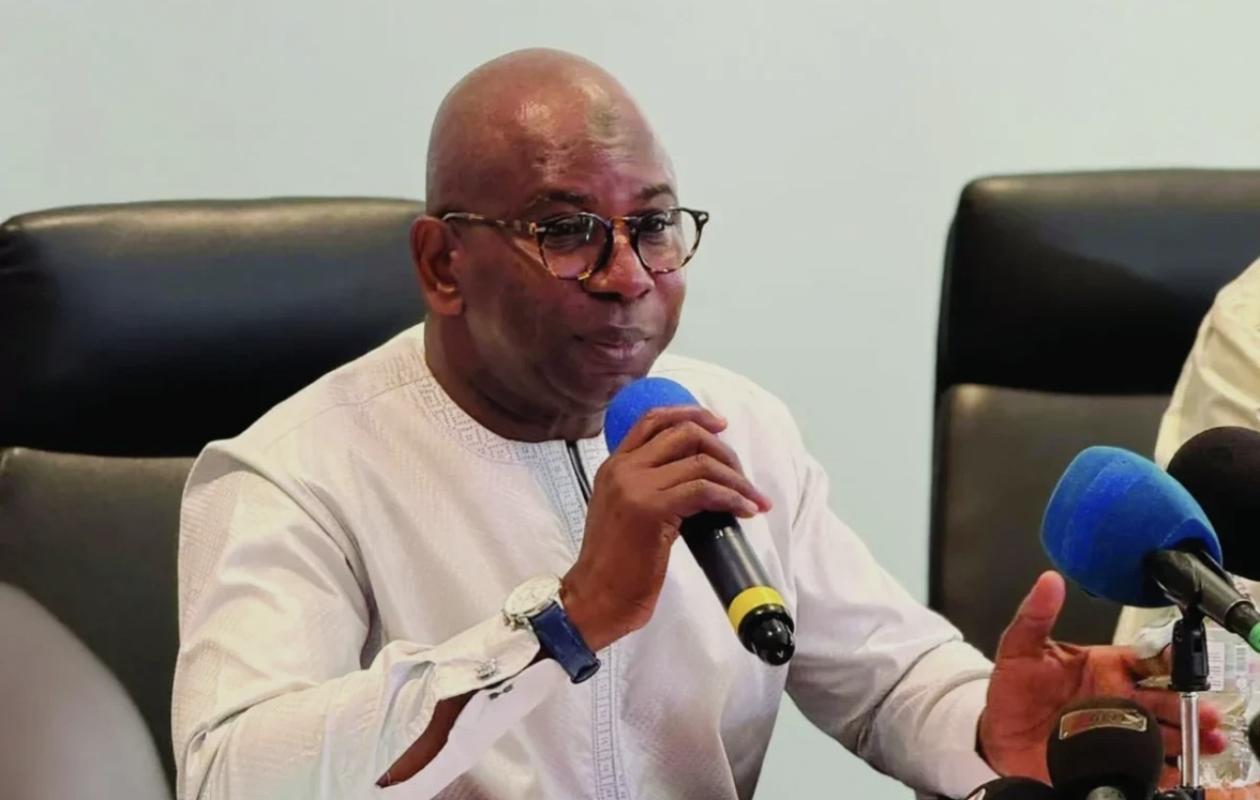
« On n’a pas le choix » : Guirassy défend l’orientation vers les séries scientifiques
Faced with resistance to directing more students towards science-related fields of study, the Minister of National Education, Moustapha Guirassy, stands by his decision. He emphasizes the planned support measures, the strengthening of teacher training, and the need to place science at the heart of the education system.
The proposal to direct more students who passed the BFEM (Brevet de Fin d'Études Moyennes) towards science-based tracks is not universally accepted. School administrators and parents have expressed reservations, particularly when the students in question do not wish to continue in these fields. However, for the Minister of National Education, Mustapha Guirassy, this reorientation is necessary to meet Senegal's educational needs.
Invited to the RTS program "Point de vue", the minister defended this measure, which he places within a broader policy of promoting mathematics, science and technology.
"We can no longer remain in this comfort zone because we are poisoning the nation," he said, arguing that the country cannot afford to continue to favour career paths that do not adequately meet its needs for scientific and technical skills.
Mustapha Guirassy rejects the idea that the decision was made without prior consideration. According to him, the guidelines are based on the work of experts and the regional education authorities (IA), who rely in particular on students' academic records and their experience with the education system.
Teacher training, infrastructure: support measures
For the minister, the increase in the number of students directed towards science streams is only one aspect of a broader strategy. He cites in particular the evolution of teacher training, the construction of colleges specializing in mathematics, science and technology, as well as the transformation of the 30 existing science blocks.
Mustapha Guirassy also mentioned the introduction of a mathematics assessment in teacher training at the CREM level, in order to strengthen the place of this discipline from the initial training.
He also announced a national competition, presented in the interview under the name "MASTEC," aimed at students from CM1 (fourth grade) to Terminale (final year of high school). This initiative aims to democratize access to science and mathematics from the earliest years of schooling.
Teacher recruitment must also support this approach. The minister states that particular attention has been paid to profiles specializing in mathematics, science, and technology within the framework of recruitment efforts undertaken by the state.
National languages used
Another approach championed by Mustapha Guirassy: learning science and mathematics using national languages.
The minister believes that academic performance can be better when children learn in their mother tongue or first language. He cites, in this regard, Senegal's results in the CONFEMEN Program for the Analysis of Education Systems (PASEC) assessments.
The gradual introduction of national languages into learning, in elementary and secondary school, should thus allow students to better understand scientific concepts and to reconnect with mathematics.
The minister also refers to the development of ethnoscience and ethnomathematics, approaches that make it possible to bring scientific knowledge closer to cultural realities and local knowledge.
Regarding concerns about a possible increase in the failure rate, he calls for trust in teachers and the education system, while emphasizing the importance of support and psychological guidance mechanisms for students.
"We have no choice."
For Mustapha Guirassy, the reservations expressed about this policy should not hinder the efforts undertaken to strengthen scientific sectors.
While acknowledging that he understands certain concerns, he deplores what he considers overly negative rhetoric that risks perpetuating inaction. The minister is particularly worried about the decline in science classes in some high schools, a situation he views as worrisome for the country's future. "We have no choice," he insisted, calling on parents, teachers, and school administrators to support this shift.
In his view, the development of Senegal necessarily depends on science, technology and the training of skills capable of meeting economic and social challenges.
"The attention crisis" at the heart of the school year
This promotion of science is part of the theme chosen for the school year: "From the crisis of attention to the decline of science".
Mustapha Guirassy describes the attention crisis as a profound, silent, and dangerous phenomenon. He specifically points to the role of screens and social media, citing TikTok, WhatsApp, and Facebook, which can distract students from their learning.
But, according to him, the problem goes beyond digital usage. It also concerns citizens' ability to focus on collective issues, mental health, food, and the needs of their communities. "Today, this attention crisis is leading to collective distraction. And almost all of us are distracted," he stated.
The minister is therefore calling on teachers, school leaders, parents and school partners to make this issue a priority.
For him, the link between the attention crisis and the decline of science is direct: when students turn away from learning and scientific fields lose their attractiveness, it is the country's ability to prepare for its future that is weakened.
“Attention is the starting point, it’s the beginning of everything. When you don’t pay attention, in the end, you lose everything,” concluded Mustapha Guirassy, calling on Senegalese schools to reconnect with the meaning of learning and to put science back at the center of their priorities.















Commentaires (17)
Un peuple bavard qui fait droit, sociologie, philosophie, lettres modernes anciennes et mortes et on veut se développer...
Et pourtant c'est le même chose que le Sénégal a hérité du colon. Et les conséquences sont là dans le monde politique et médiatique. Dès que vous parlez de développement sans la France, c'est tout un monde de littéraires au cerveau lavé à l'eau de javel qui se lève contre vous, hurlant que c'est impossible.
comment dit-on en wolof le Le théorème de Pythagore ? " dans un triangle rectangle, le carré de l'hypoténuse est égal à la somme des carrés des deux autres côtés : si ABC est rectangle en A, alors BC2 = AB2 + AC2"
On n'apprend pas les sciences juste pour avoir un métier. Comment expliquez-vous qu'au Sénégal qu'il y ait autant d'abroutis, des gens incapables de mettre en relation plusieurs informations pour expliquer un fait ou un phénomène et prendre une décision en autonomie ?
Ce n'est pas seulement une question d'analphabétisme, c'est aussi et surtout, une question de manque de culture scientifique, une méconnaissance de la démarche scientifique.
Quand on a une culture scientifique, on n'est difficilement embobinable, on explique pas les faits et les phénomènes par notre propre opinion ou par l'opinion d'un autre, mais par des hypothèses que l'on vérifie avant de se positionner dans un sens ou l'autre.
Ceux qui disent que les élèves risquent d'abandonner si on les oblige à faire les sciences et techniques ne savent pas où se trouve le problème. L'enseignement des sciences et techniques est totalement théorique au Sénégal. S'il y a du matériel et que les savent comment l'utiliser en classe en emmenant les élèves à manipuler eux même aidés par l'enseignant, ils vont aimer. Le problème se trouve là.
Il nous faut dès maintenant des labos qui font de la recherche assez pointue. Des entreprises qui conçoivent et fabrique des machines locales de qualité comparable aux importées et qui sont innovants !
Participer à la Discussion
Règles de la communauté
💡 Astuce : Utilisez des emojis depuis votre téléphone ou le module emoji ci-dessous. Cliquez sur GIF pour ajouter un GIF animé. Collez un lien X/Twitter, TikTok ou Instagram pour l'afficher automatiquement.
Se connecter
Commentez avec votre profil, votre photo, et soyez averti des réponses.