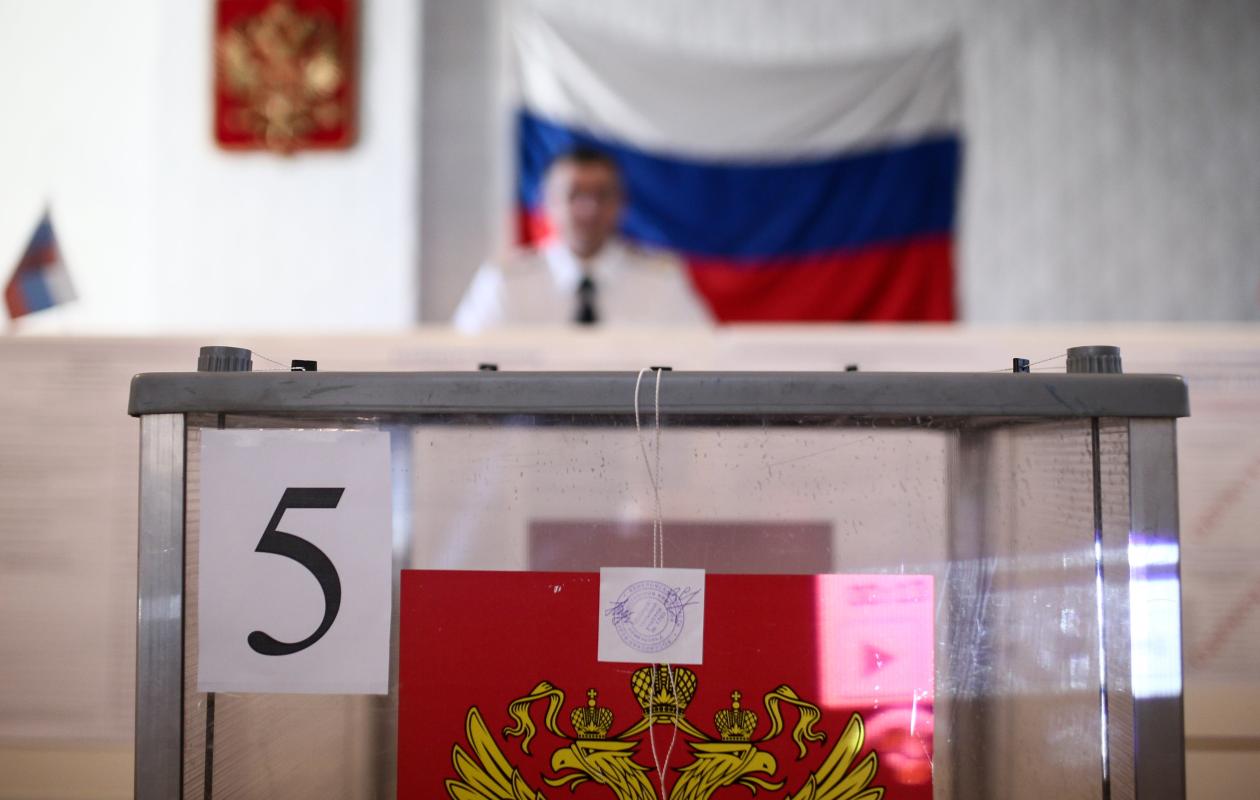
Les Russes aux urnes pour des législatives, en pleine guerre en Ukraine
Russian voters go to the polls on Friday on the first day of parliamentary elections running until Sunday, which Vladimir Putin's United Russia party is expected to win, more than four years after the start of the war in Ukraine.
The vote to renew the 450 seats of the Duma, the lower house of the Russian Parliament, is scheduled to last until Sunday at 6:00 PM GMT and the first results are expected shortly thereafter.
These parliamentary elections are the first since the start of the large-scale offensive launched by Moscow in Ukraine in February 2022. They are also being held in the territories of eastern Ukraine occupied and annexed by Russia.
The vote will allow the Kremlin to get an idea of the mood of the Russian people, as diplomatic initiatives to end the deadliest conflict in Europe since World War II have all failed so far.
While the outcome of these legislative elections is hardly in doubt, the participation and score of alternative parties will be scrutinized by analysts, in a country where the expression of dissent is severely repressed by the government.
The European Union denounced the elections as taking place in a climate of "systematic and institutionalized repression," while a body of Russian opposition figures at the Council of Europe described the vote as a "sham."
Russian voters and analysts expect United Russia, the president's party which already held a majority in the outgoing Duma, to win the election and continue to dominate the legislative body.
Facing United Russia, only formations supporting Vladimir Putin and the continuation of the conflict in Ukraine to varying degrees - the communists of the KPRF, the nationalists of the LDPR, the conservatives of Just Russia and the liberals of the New People party - were allowed to compete.
Yabloko, the only party openly opposed to the war in Ukraine, was initially allowed to participate in the election before being barred from doing so by the courts in August.
Met outside a polling station in central Moscow, Natalia, a 36-year-old lawyer, told AFP that she voted for United Russia candidates because she aspires to "stability and a peaceful life." "I think people are satisfied," she added.
Another voter, 55-year-old Lioubov, fully supports the "special military operation," the current term for the war in Ukraine. However, she is critical of certain social policies, regretting the increase in the retirement age.
In a brief televised address Wednesday evening, Vladimir Putin urged his fellow citizens to vote to "support (the) fighters" engaged in Ukraine and show that Russians are "united".
Vladimir Putin, in power for more than a quarter of a century, voted electronically on Friday afternoon, according to images from state television.
"Putin likes to compare his political situation to what is happening in European countries," explains Tatiana Stanovaya of the Carnegie Russia-Eurasia Center, banned in Russia as an "undesirable" organization.
"He can say: Look, we had an election. I have considerable support from the Russians. We are all united. So for him it is something very important, on a personal, emotional and political level," she told AFP.
Because, and this is the crux of the matter, the election will serve as a marker of the population's frustration with a conflict that has caused hundreds of thousands of deaths and injuries and continues to undermine the daily lives of Russians, even those who live hundreds of kilometers from Ukraine.
Kyiv is ramping up long-range strikes against energy infrastructure and private companies, including e-commerce giants Wildberries and Ozon, causing civilian deaths, fuel shortages and billions of rubles in material damage.
Excluded from the vote, the opposition in exile called on all "Russians opposed to the war" to vote against Vladimir Putin's party on the same day at the same time, September 20 at noon, to show their numbers.
Another issue weighing on these elections is the fear of a new mobilization modeled on the "partial mobilization" of 300,000 reservists in September 2022.
Since Ukrainian President Volodymyr Zelensky stated that this measure would be announced "in the fall" after the parliamentary elections, his Russian counterpart and his entourage have repeatedly refuted this "scenario," which is very unpopular even in ruling circles in Moscow.


















Commentaires (1)
Participer à la Discussion
Règles de la communauté
💡 Astuce : Utilisez des emojis depuis votre téléphone ou le module emoji ci-dessous. Cliquez sur GIF pour ajouter un GIF animé. Collez un lien X/Twitter, TikTok ou Instagram pour l'afficher automatiquement.
Se connecter
Commentez avec votre profil, votre photo, et soyez averti des réponses.