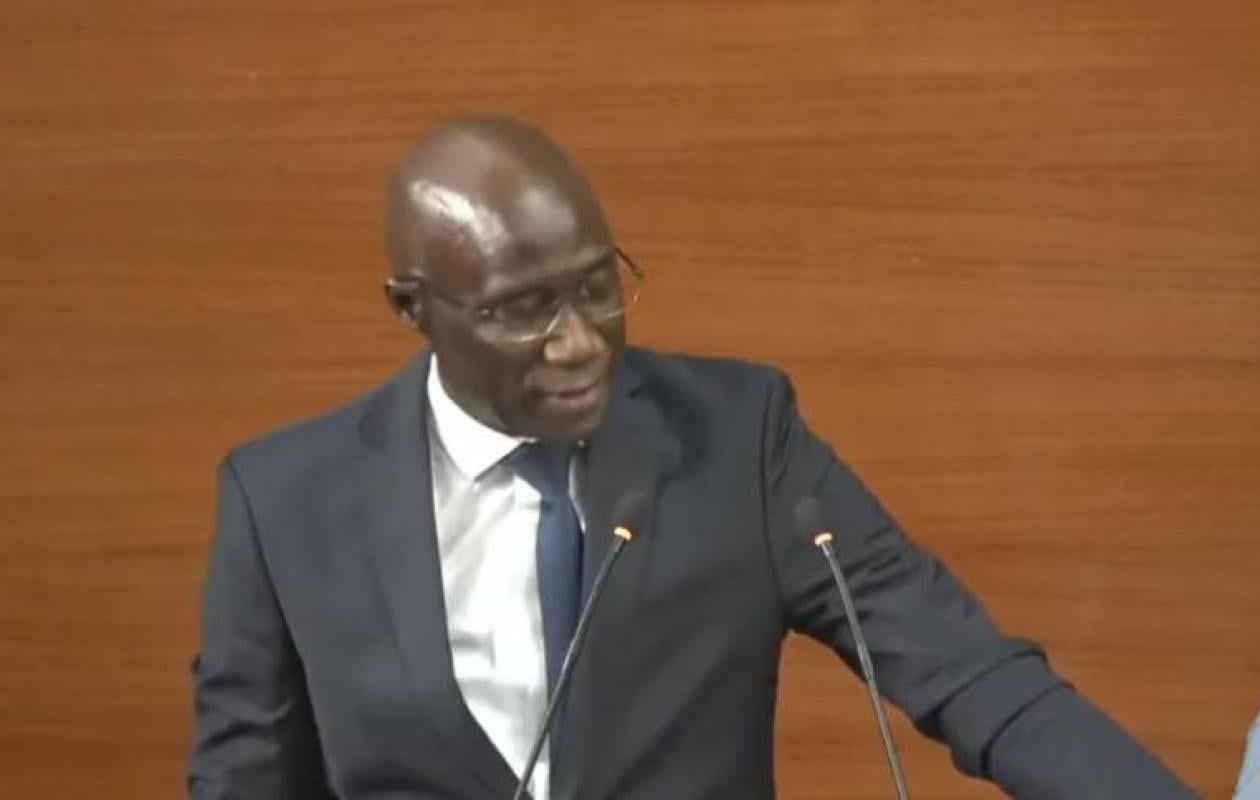
Conseil constitutionnel, directive UEMOA, Cour des comptes : Le garde des Sceaux déroule son argumentaire pour sécuriser juridiquement le dispositif
Before the members of parliament gathered in plenary session this Thursday, October 1, 2026, Moussa Sarr did not simply defend two government amendments. The Minister of Justice, Keeper of the Seals, delivered a veritable legal demonstration to justify the Executive's position on the regulation of special credits or funds.
From the outset of his speech, the minister placed the debate within an institutional perspective. He reiterated that the stated objective of the text is to "strengthen transparency in the management of public funds and consolidate citizens' trust in the institutions of the Republic."
But for Minister Sarr, this desire for transparency could not be separated from an equally important requirement: the legal security of the system.
Constitutional Council , WAEMU and Court of Auditors: a three-part demonstration
The Minister of Justice first relied on decision no. 7/C/2026 of the Constitutional Council issued on August 25, 2026. He recalled that the previous bill relating to special credits had been declared inadmissible, in particular because the creation of an autonomous category of public credits and the determination of their legal regime fell under the organic law relating to finance laws.
According to the minister, the new text specifically addressed this requirement by directly amending Organic Law No. 2020-07 concerning finance laws. However, this course correction was not sufficient, in his view.
Attorney Moussa Sarr then identified three difficulties in the new wording. The first concerns the linking of special appropriations or funds to the endowments of constitutional institutions. According to his analysis, isolating them would amount to detaching them from a whole that the organic law treats as indivisible.
The second difficulty lies in the system's compliance with Directive No. 06/2009/CM/UEMOA. The minister believes that the special appropriations do not have sufficient budgetary specificity to justify a system separate from the allocations already planned.
Finally, Mr. Moussa Sarr raised the issue of the allocation process. Who is responsible for authorizing this new allocation? He believes that the lack of a clear answer to this question could create a "legal vacuum" when the measure is implemented.
Two amendments to lock in the system
It was on this legal framework that the minister built his defense of the government's two amendments. The first, concerning Article 14, aimed to remove the final bullet point dedicated to special appropriations or funds and to link these expenditures to the allocation of constitutional institutions. The government also proposed replacing the reference in the original text with a reference to Article 67, which governs the conditions for implementing the various allocations.
The second amendment concerned Article 70. Mr. Moussa Sarr explained that it was intended, in particular, to restore the role of the Finance Committee in the control exercised during the annual management and to remove a control power introduced by the new text which the government considered likely to encroach on the powers of the Court of Auditors.
The minister also advocated for aligning the ministerial hearing procedure with the National Assembly's Rules of Procedure. On this point, his message was clear: the government amendments, according to him, were not intended to weaken transparency, but rather to place it within a legally sound framework.
“The government does not see transparency as a constraint, but as a lever for consolidating the rule of law and strengthening citizens’ trust in institutions,” he declared. He added that this transparency must be organized “with discernment,” respecting the hierarchy of norms, institutional balances, and the protection of the nation’s best interests.
The final card: the blocked vote
Attorney Moussa Sarr finally unveiled another argument from his legal arsenal: the blocked vote. On behalf of the government, he asked the National Assembly to hold "a single vote on the text under discussion," considering only the amendments proposed or accepted by the government. The minister referred to Article 82, paragraph 4, of the Constitution and Article 87, paragraph 2, of the National Assembly's Rules of Procedure. He presented this procedure as a mechanism designed to guarantee the coherence of the text and the effectiveness of government action, asserting that the Executive intended to use it "solely in the interest of the legal coherence of the system and the effectiveness of state action."
He also argued that the request was a right and that the Assembly had to comply with it since the government made it, relying on Constitutional Council Decision No. 6/C/2026 of July 9, 2026.
The subsequent debates, however, held a different outcome for this demonstration. The deputies ultimately rejected the government's amendments before adopting the single article of the proposed organic law. But during his speech, Mr. Sarr laid out, point by point, the Executive's perspective: constitutional conformity, respect for the EU framework, the division of powers between institutions, and the legal certainty of the execution of special appropriations.















Commentaires (0)
Participer à la Discussion
Règles de la communauté
💡 Astuce : Utilisez des emojis depuis votre téléphone ou le module emoji ci-dessous. Cliquez sur GIF pour ajouter un GIF animé. Collez un lien X/Twitter, TikTok ou Instagram pour l'afficher automatiquement.
Se connecter
Commentez avec votre profil, votre photo, et soyez averti des réponses.