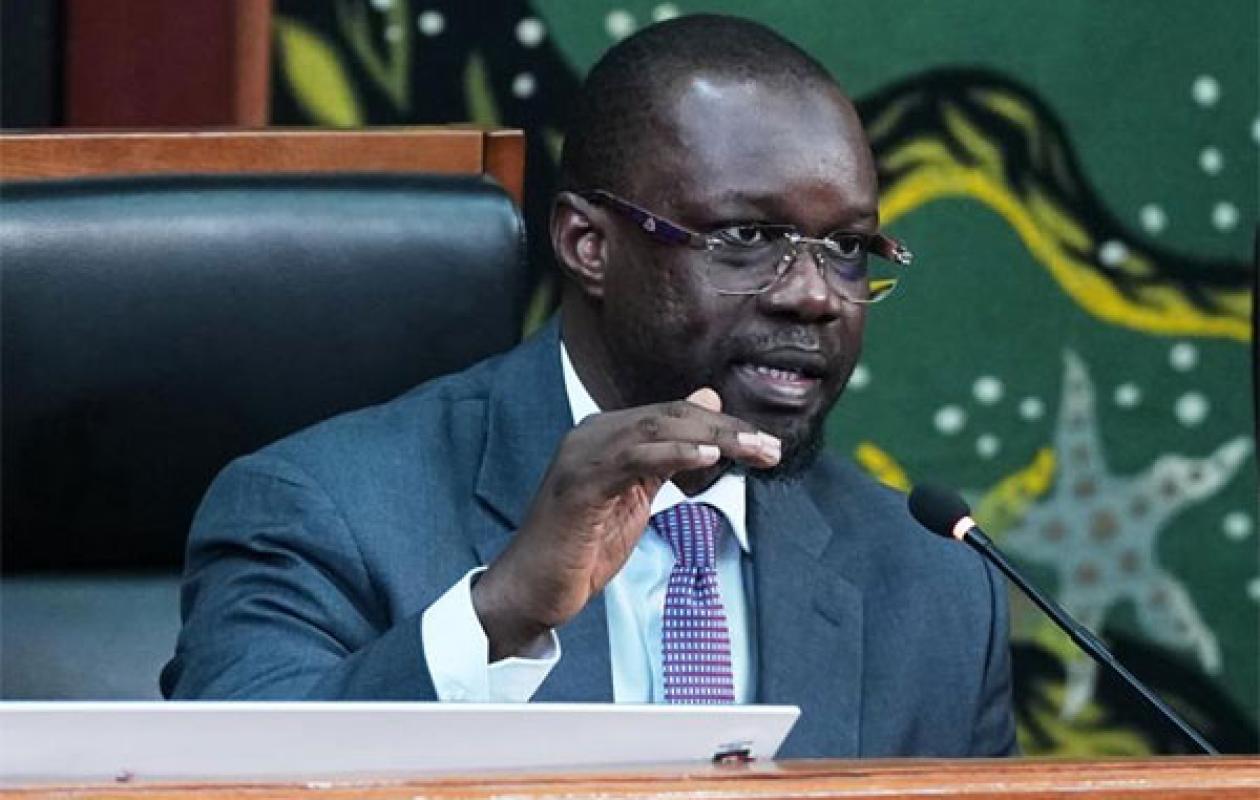
Habilité du Bureau, 5 textes et 6 commissions d'enquête : La réponse d'Ousmane Sonko aux contestataires
The debate surrounding the National Assembly Bureau's authority to convene an extraordinary session did not escape Ousmane Sonko's attention this Monday morning at the National Assembly. Faced with the information and interpretations circulating since the session was convened, the Speaker of the National Assembly emphasized the legal framework governing the institution's operations, while denouncing what he considers to be "conflations."
“Since the convening of this extraordinary session, a lot of information has been leaked that is not in line with reality, with the truth of the texts,” he said.
For Ousmane Sonko, the functioning of the National Assembly is governed by two fundamental texts: the Constitution and the internal regulations of the institution, enshrined in Organic Law No. 2025-11 of August 18, 2025. It is precisely Article 7 of this Organic Law that the President of the National Assembly invokes to respond to those who contest the Bureau's authority to convene an extraordinary session.
“The National Assembly is also meeting in extraordinary session with a specific agenda,” he noted, before clarifying that the initiative can come from several sources. The extraordinary session can thus be convened by a decision of the Bureau of the National Assembly, upon a written request from more than half of the members of parliament addressed to its president, or by a decision of the President of the Republic, either alone or on the proposal of the Prime Minister.
“Some wanted to make people believe that the Bureau was not authorized to convene an extraordinary session,” notes Ousmane Sonko, who thus refers the debates back to the content of the texts that organize parliamentary work.
The Speaker of the National Assembly also specified the texts that must be examined during this extraordinary session. These include three bills initiated by the government and two bills introduced by members of parliament.
Among the items on the agenda are draft law no. 15-2026 on the Labour Code, draft law no. 16-2026 on the Social Security Code, draft law no. 25-2026 on the protection of critical information infrastructure and digital security, as well as draft laws no. 33-2026 amending article 37 of the Constitution and no. 34-2026 on the legal regime of special credits.
The two bills will be subject to an emergency procedure, at the request of their authors. The detailed timetable for the work must be determined by the Conference of Presidents.
The extraordinary session will also have to examine six proposed resolutions establishing parliamentary commissions of inquiry. The planned investigations focus in particular on shortcomings identified in land management, the sale of buildings belonging to the State's built heritage, and the use by the Senegalese government of PRS-type financial mechanisms.
The MPs also wish to examine alleged irregularities in the awarding and execution of contracts for the "One Student, One Computer" program, revenue shortfalls and the management of tax exemptions, as well as the conditions for issuing and renewing fishing licenses. But here again, Ousmane Sonko warns against confusion regarding the timeline.
The President of the National Assembly insists on an essential distinction: the commissions of inquiry are not required to carry out their investigations within fifteen days of the extraordinary session.
"It was never said that the parliamentary inquiry committees would meet and do the work within fifteen days," he clarifies.
The current session must first allow the plenary to ratify the resolutions establishing these committees. Once this step is completed, the committees can begin their work. Rule 55 of the Rules of Procedure stipulates that a committee of inquiry may not include more than eleven members, appointed in proportion to the parliamentary groups. Non-affiliated members are also included.
After ratification of the resolution by the plenary session, by an absolute majority of the members present and without debate, the committee elects its bureau, composed of a chairperson, two vice-chairpersons, and a rapporteur. Crucially, Article 58 sets the maximum duration of their work at six months from the adoption of the resolution establishing them.
“They have six months, six months at most, to do their work and submit the report to the Bureau of the National Assembly,” Ousmane Sonko reminds us.
These six months are not limited to parliamentary sessions. Inquiry committees can continue their work both during and outside of parliamentary sessions. Through these clarifications, the President of the National Assembly seeks to dispel confusion surrounding the extraordinary session: fifteen days to examine the items on the agenda, but up to six months for inquiry committees to conduct their investigations and produce their reports.
“I wanted to make these clarifications to avoid certain misconceptions,” he concluded.










Commentaires (8)
Yaa sonal sénégalais yi dé !
Nitou fitneu mooye Ousmane Sonko. Depuis 2021 il empêche le Sénégal de respirer. Basta!
Participer à la Discussion
Règles de la communauté
💡 Astuce : Utilisez des emojis depuis votre téléphone ou le module emoji ci-dessous. Cliquez sur GIF pour ajouter un GIF animé. Collez un lien X/Twitter, TikTok ou Instagram pour l'afficher automatiquement.
Se connecter
Commentez avec votre profil, votre photo, et soyez averti des réponses.