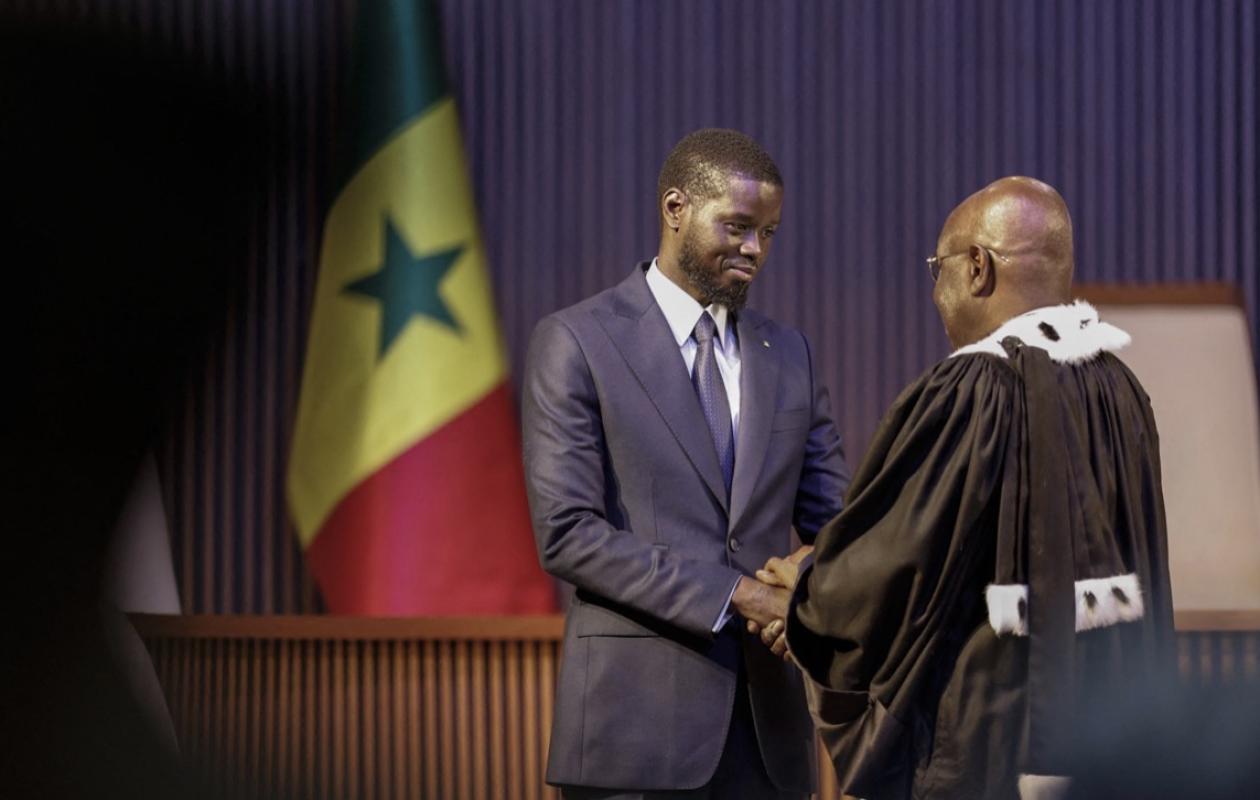
Mandat présidentiel : Pourquoi le retour du septennat se heurte à un mur juridique
The debate on the length of the presidential term has resurfaced on the Senegalese political scene. Initiated by Minister Arona Coumba Ndoffene Diouf, the idea of moving from a five-year term to a seven-year term is now finding a favorable echo among other leaders of the Kiiraay – Les Patriotes Républicains party , such as the religious leader Cheikh Ibrahima Diallo and Baye Mayoro Diop, recently appointed Director of the Regional Center for University and Social Services (CROUS) of the Alioune Diop University of Bambey.
Supporting this initiative, Baye Mayoro Diop believes that a country like Senegal "cannot continue to afford the luxury of spending hundreds of billions and wasting time every five years organizing elections." According to him, "Minister Arona Coumba Ndoffene Diouf is quite right; the five-year term of the President of the Republic, as stipulated by the Constitution, does not reflect the economic realities of our country."
Openly advocating for a popular consultation, Baye Mayoro Diop insists on the need to mobilize national resources: “It is absolutely essential that the Senegalese people address this crucial issue of the presidential term length, in relation to the country's socio-economic difficulties, genuine democracy, development, and the mobilization of national energies.” He adds: “I propose that we organize, come what may, a referendum on increasing the presidential term from five to seven years,” while maintaining that “the people must, at all costs, be able to express their views on constitutional choices that will have a lasting impact on their future.”
This offensive to restore the seven-year presidential term immediately provoked strong disapproval within civil society and the legal world.
For his part, the executive director of COSCE, Moundiaye Cissé, strongly rebuked the project's initiators. Seeing it as "a complete farce" and "a major political blunder," he reiterated that questioning the five-year term endorsed by the population constitutes "an insult to the Senegalese people" and reflects a profound lack of respect for popular sovereignty and the democratic achievements of Senegal.
The legal community is equally categorical. On the social network X, lawyer Babacar Ba, coordinator of the Forum of the Justiciable (FJ), expressed outrage at the proposal to extend Bassirou Diomaye Faye's term. He denounced "a toxic debate that directly threatens national cohesion and constitutes a serious attack on institutional stability," calling for judicial rigor: "Those who instigated this destructive idea must be prosecuted for disturbing public order."
The opposition is also being voiced within the media world itself. Bachir Fofana, a journalist and columnist, felt compelled to distance himself by responding to the supporters of the seven-year term.
From a purely constitutional law perspective, any attempt to modify the presidential term length through parliamentary or referendum means faces a major legal obstacle. Since the 2016 constitutional referendum, the Senegalese Constitution has incorporated rigorous mechanisms of inviolability, commonly known as "eternity clauses."
Under the Constitution, the length of the presidential term is enshrined in law, just like other inviolable pillars of the Republic. Article 103 of the Constitution explicitly states in its final paragraph: "The republican form of the State, the method of election, the term and the number of consecutive terms of the President of the Republic may not be subject to revision."
This provision clearly means that "the term of office (currently set at 5 years) is legally immune from constitutional revision." Consequently, "neither the President of the Republic, nor the National Assembly, nor the people consulted by referendum have the legal authority to modify a provision enshrined in Article 103." Thus, holding a referendum to extend the term from 5 to 7 years would first require circumventing Article 103, a maneuver that legal doctrine and constitutional jurisprudence consider a breach of republican legality. Without a complete overhaul of the constitutional order through a new Constitution, any modification of the term of office remains legally impossible.













Commentaires (43)
Quant au coût des élections, soyons sérieux : une petite partie des caisses noires, des dépenses inutiles et de l’argent public détourné suffirait largement à les financer. Ce ne sont pas les élections qui ruinent nos pays, mais la mauvaise gouvernance, le gaspillage et l’impunité. Allonger les mandats ne rend pas les institutions plus solides ; cela donne simplement plus de temps aux mauvais dirigeants pour prolonger leurs erreurs.
La France a renoncé au septennat pour adopter le quinquénnat. La norme dans le monde, c'est 5 ans.
Le parti largement majoritaire à l'Assemblée Nationale rigole. Ce projet de modification de la Constitution ne sera JAMAIS présenté à l'A. N.
Des raisons économiques ne peuvent pas justifier un passage du quinquennat au septennat.
Tout ceci finira par créer un imbroglio et des situations conflictuelles.
Lorsque pastef initie des réformes constitutionnelles, on crie au scandale.
Cette proposition de passer du quinquennat au septennat ne vise en réalité que le prolongement du mandat de Diomaye qui n'a pas le temps avec lui.
La constitution n'est pas un livre avec lequel on peut jouer en fonction de ses humeurs.
Laisser un voleur 5 ans au pouvoir est déjà trop à plus forte raison l'y laisser 7 ans. Celui qui n'est pas capable de concevoir un projet politique et économique viable sur 5 ans ne doit pas être élu président de la République.
Pauvres homme noir tjrs ds l imaginaire qd les autres parlent de nvlles puces ou IA.
Il faut changer la durée du mandat présidentiel pour aller à 7 ans. On en verra tout le bénéfice sur la qualite de vie de nos compatriotes.
On n'a pas une économie qui permet de realiser quelque chose de consistant et durable en 5 ans
Participer à la Discussion
Règles de la communauté
💡 Astuce : Utilisez des emojis depuis votre téléphone ou le module emoji ci-dessous. Cliquez sur GIF pour ajouter un GIF animé. Collez un lien X/Twitter, TikTok ou Instagram pour l'afficher automatiquement.
Se connecter
Commentez avec votre profil, votre photo, et soyez averti des réponses.