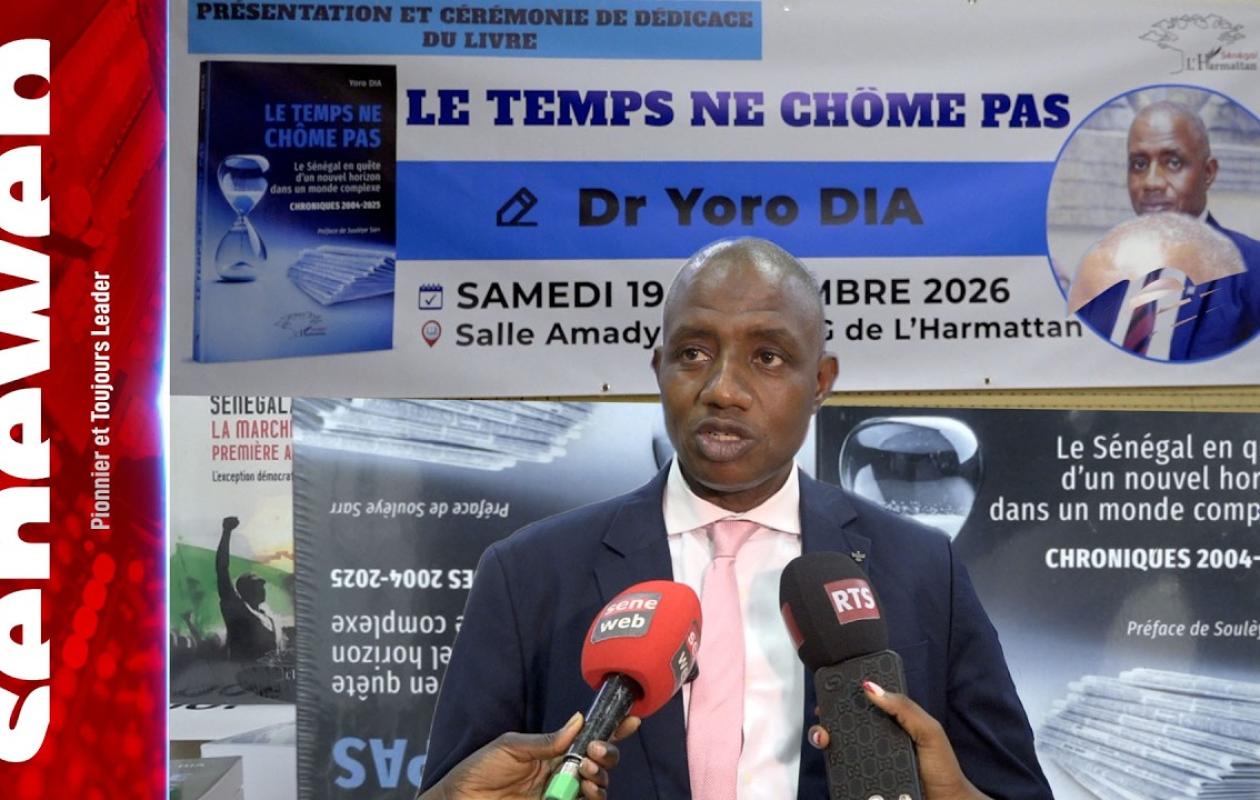
Yoro Dia sur l’alternance de 2024 : « L’économie n’a jamais été une priorité »
Two years and almost six months after the 2024 political transition, Yoro Dia believes that the economy has still not been placed at the heart of Senegal's priorities. During the presentation of his new book, "Le temps ne chôme pas" (Time Doesn't Sleep), this Saturday, September 19, 2026, at the Harmattan Senegal offices, the political scientist asserts in his work that "the economy has never been a priority."
According to the former Minister and Spokesperson for the Presidency of the Republic, this situation is largely due to the prominence given to institutional, electoral, and judicial issues in the political debate. "We are not focusing enough on the economy, and there is still no consensus on the vision," he laments, adding that "in two years and six months, the country has actually regressed." Mr. Dia believes that Senegal has not sufficiently capitalized on its new economic advantages and that the lack of consensus around an economic vision is a major problem.
For him, the country must now leverage its comparative advantages, particularly its political stability, its administration, its human resources, and its geographic location. The goal, according to Yoro Dia, is to make this stability an engine of development. "We must make the democratic exception the economic exception," he insists.
“99% of their energy” devoted to institutions
Yoro Dia believes that the political class devotes a disproportionate amount of its energy to institutional and electoral issues. "The Senegalese political class devotes 99% of its energy to seeking solutions to a problem that does not exist," he argues.
He cites in particular the recurring debates on institutions and elections. In his view, "these issues should fall primarily under the purview of the Directorate General of Elections, but not the political elites who should be more concerned with major issues," he asserts.
Indeed, according to the political science specialist, Senegal already has a sufficiently robust institutional system to allow for political transitions. "When you can elect a president of the Republic on March 24th and install him on April 1st, it means that the country does not have an institutional problem, the country does not have a problem with its Constitution," he argues.
"In 2024, when we have oil and gas, when you arrive, you accelerate."
The former minister believes that the arrival of oil and gas in 2024 should have been a catalyst for accelerating the country's economic development. "In 2024, when you have oil and gas, when you arrive, you accelerate," he asserts.
He believes this new situation should have spurred Senegal to accelerate its progress toward development. But, according to him, political priorities have remained largely focused on issues of justice, audits, and reforms. "We've returned to the Sisyphean democracy," he laments, echoing an expression used in his previous book to describe what he calls an "eternal cycle" after each election.
Throughout the 444 pages of the book "Time Doesn't Sleep", the consultant calls on political actors to break out of the cycle of institutional and electoral debates to place the economy at the center of political action and debate.











Commentaires (16)
C’est dans cette seule mesure qu’on peut prêter du crédit à ses analyses. Même si le Pastef a commis des erreurs et déçu sur un certain nombre de choses.
Mais Yoro dia est obsédé par la critique du régime.
Si vous êtes systématiquement partisan on cesse de vous lire.
Apparemment tous les six mois il écrit un livre.
Il y a un problème de fond dans notre société : chacun se prend pour plus compétent qu’il n’est et pour dire les choses vertement, prend ses compatriotes pour des imbéciles à qui on fait gober n’importe quoi.
Le Sénégal est un pays peuplé en grande partie d’escrocs en col blanc, de gens qui prétendent savoir.
Yoro, il lit des choses et les répète.
La faiblesse analytique de l’ouvrage : Il fait l’impasse de l’état des lieux hérités en 2024; Une totale abstraction de la réalité concernant les agrégats macroéconomiques
Le service de l’énorme dette contactée par le régime précédent (2012-2024) absorbe un quart (25 %) de l'ensemble des recettes fiscales nationales; En outre, Le renchérissement des crédits dû à cette situation difficile laisse très peu de marges de manœuvre au nouveau régime en place.
Le secteur du bâtiment et des travaux publics (BTP) est totalement grippé et les entreprises sont en crise de trésorerie.
Nous faisons face à une quasi détresse financière qui limite le champ d’action des nouvelles autorités qui s’emploient de leur mieux possible à tenir le Cap.
Comme jadis Latif Coulibaly.
Depuis que nous assistons à l’existence d’ un grand nombre de Docteurs en droit, communication le senegal est devenu compliqué. Ay fenkat aki doff youy xalat sank Senegal.
Participer à la Discussion
Règles de la communauté
💡 Astuce : Utilisez des emojis depuis votre téléphone ou le module emoji ci-dessous. Cliquez sur GIF pour ajouter un GIF animé. Collez un lien X/Twitter, TikTok ou Instagram pour l'afficher automatiquement.
Se connecter
Commentez avec votre profil, votre photo, et soyez averti des réponses.