« La mer, c’est notre entreprise » : Quand la mangrove fait vivre les femmes de Mar Lodj
"The sea is our business." This phrase by Mariama Diome, president of the local women's union of Marsalou, sums up in itself the close link that unites the island communities with their environment.
In Mar Lodj, the sea and the mangrove are not just a natural heritage to be preserved. Above all, they represent a source of income, food and livelihoods for many families.
For women, who are particularly active in processing fish products, mangrove degradation has direct consequences on their daily lives. The reduction in available resources translates into a decrease in products to process and, consequently, a weakening of economic activities.
“We have lost some of the seafood and resources we depended on,” says Mariama Diome.
This situation has gradually made people aware of the need to protect their environment.
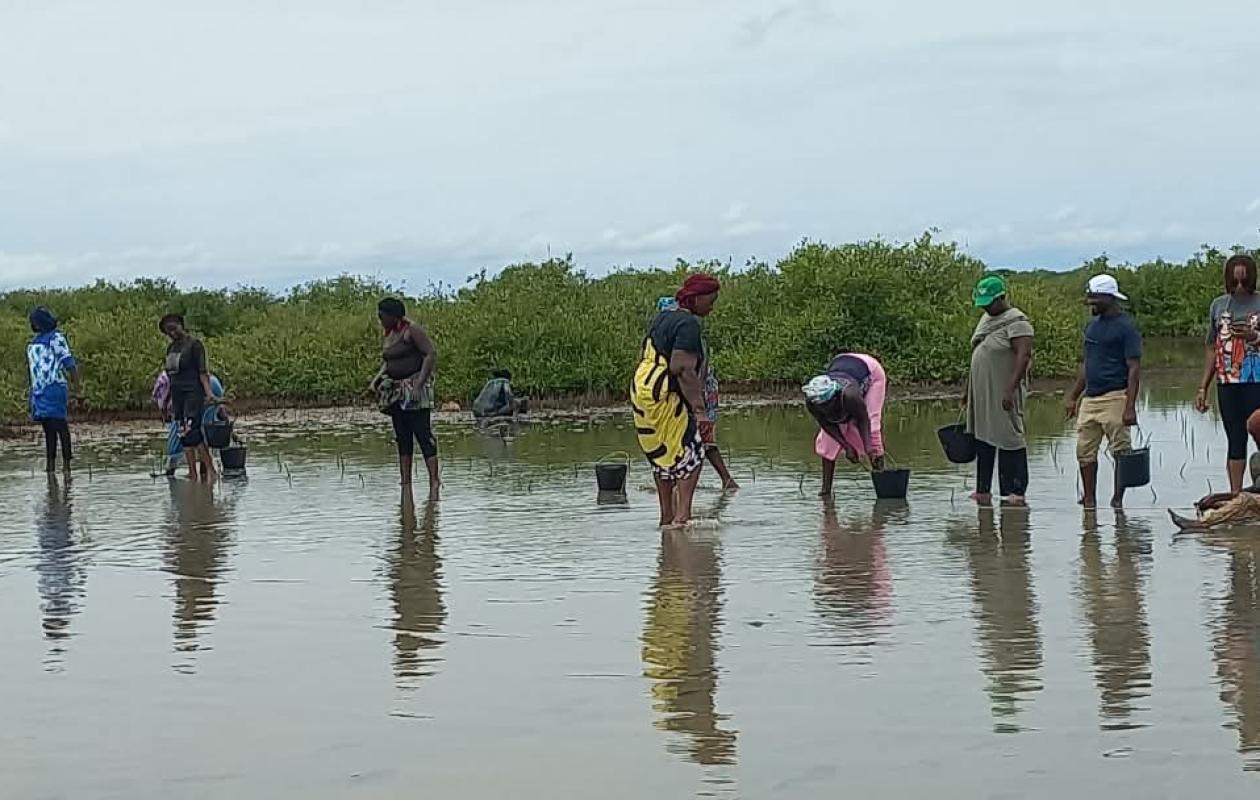
Thus, on Wednesday, September 9, 2026, 12,740 propagules have already been planted by the women of the four Mar ( Marlod , Marsolou , Mar Lodj , Marouane and Marfafoko ).
The women of these four islands are relying on mangrove restoration to strengthen their resilience, demonstrating their commitment to restoring their natural environment.
Indeed, in the Saloum Delta, mangrove restoration is essential for preserving natural resources and strengthening community resilience to the effects of climate change. On Marlodj Island, women are actively working to regenerate this ecosystem, upon which a large part of their economic activities depends.
For Mariama Diome, president of the local women's union of Marsalou, this initiative responds to an environmental emergency, but also an economic one: "We see only benefits in it. The sea is our business," she emphasizes.
“The progressive degradation of the mangrove and the environmental changes observed in recent years have direct consequences on our livelihoods. We are mobilizing to reforest the mangrove because we have seen the consequences of environmental changes on our activities. We have lost some of the seafood and resources on which we depended,” explains Mariama Diome.
It goes without saying that, beyond its environmental role, the mangrove is a vital source of income for women in the Saloum Delta. It provides breeding and development areas for numerous fish species, upon which the processing activities carried out by the women depend.
It is precisely on this relationship between the environment and the local economy that the project led by the NGO SINDEV is based. According to Fatoumata Mbodj, director of advocacy and project manager within the organization, the initiative aims to strengthen the resilience of women in the Saloum delta to climate change, in a context also marked by the exploitation of the Sangomar oil field.
"The goal of the project is to enable women to strengthen their resilience by restoring and protecting the mangrove," she explains.
The choice of this ecosystem is not accidental. The mangrove plays a major role in protecting biodiversity, capturing CO₂, and producing fish stocks. Oysters, scallops, shrimp, and other species constitute a significant portion of the resources harvested and processed by the women.
“Protecting the mangrove, restoring the mangrove, means being able to allow them today to benefit from these fishing resources,” emphasizes Fatoumata Mbodj.
Reintroducing a species to combat salinization
This year, reforestation efforts also focused on an endangered species, Avicennia africana. This species differs from the mangrove in its size and the way it is planted.
In traditional mangrove restoration operations, women use propagules, which are planted directly in areas designated for reforestation.
Avicennia, a species of mangrove tree which is the subject of specific work in nurseries.
This time, the process begins with seed collection. The women gather mud directly from the mangrove. This material is then carefully sorted before being used as a substrate for the seedlings.
The prepared mud is placed in small bags, into which the women place the Avicennia seeds. These bags are then grouped in nurseries where the seeds can germinate and produce seedlings before being reintroduced into the mangrove.
However, the work does not stop at sowing. The young plants must be protected against a threat that is particularly present in their environment: crabs.
"Avicennia plants are a favorite food of crabs," they explain on site. To prevent the young shoots from being devoured before they reach a sufficient size, the nurseries are wrapped and protected with gauze fabric, which forms a barrier while allowing the plants to continue developing.
A first Avicennia nursery has been established with the help of women from the four islands. The nursery's development will be monitored for three months before the plants are reintroduced into their natural environment.
According to Fatoumata Mbodj, advocacy director and project manager at the NGO SINDEV, this approach is part of a project to support the resilience of women in the Saloum delta in the face of climate change, in the context of oil exploitation in Sangomar.
“This species will allow us to combat the effects of climate change in the area. In the Saloum Delta, the advancing sea and the progressive salinization of agricultural land pose increasing threats to communities. The reintroduction of this species should help to address these challenges,” explains Ms. Mbodj.
The initiative also benefits from the technical support of the water and forestry services.
"Resources are gradually returning."
On the ground, the first signs of regeneration are already fueling the hopes of the local population. For Mariama Diome, the efforts undertaken are beginning to bear fruit.
"Since we started reforestation, we have seen that resources that were disappearing are gradually returning," she rejoices.
For women, this development is an encouragement to continue the restoration and protection of the mangrove. Because behind the preservation of an ecosystem lies the economic future of many families.
The president of the local women's union is convinced: "We must continue to maintain and protect the mangrove. If we restore it today, we will preserve resources for future generations."


















Commentaires (0)
Participer à la Discussion
Règles de la communauté
💡 Astuce : Utilisez des emojis depuis votre téléphone ou le module emoji ci-dessous. Cliquez sur GIF pour ajouter un GIF animé. Collez un lien X/Twitter, TikTok ou Instagram pour l'afficher automatiquement.
Se connecter
Commentez avec votre profil, votre photo, et soyez averti des réponses.