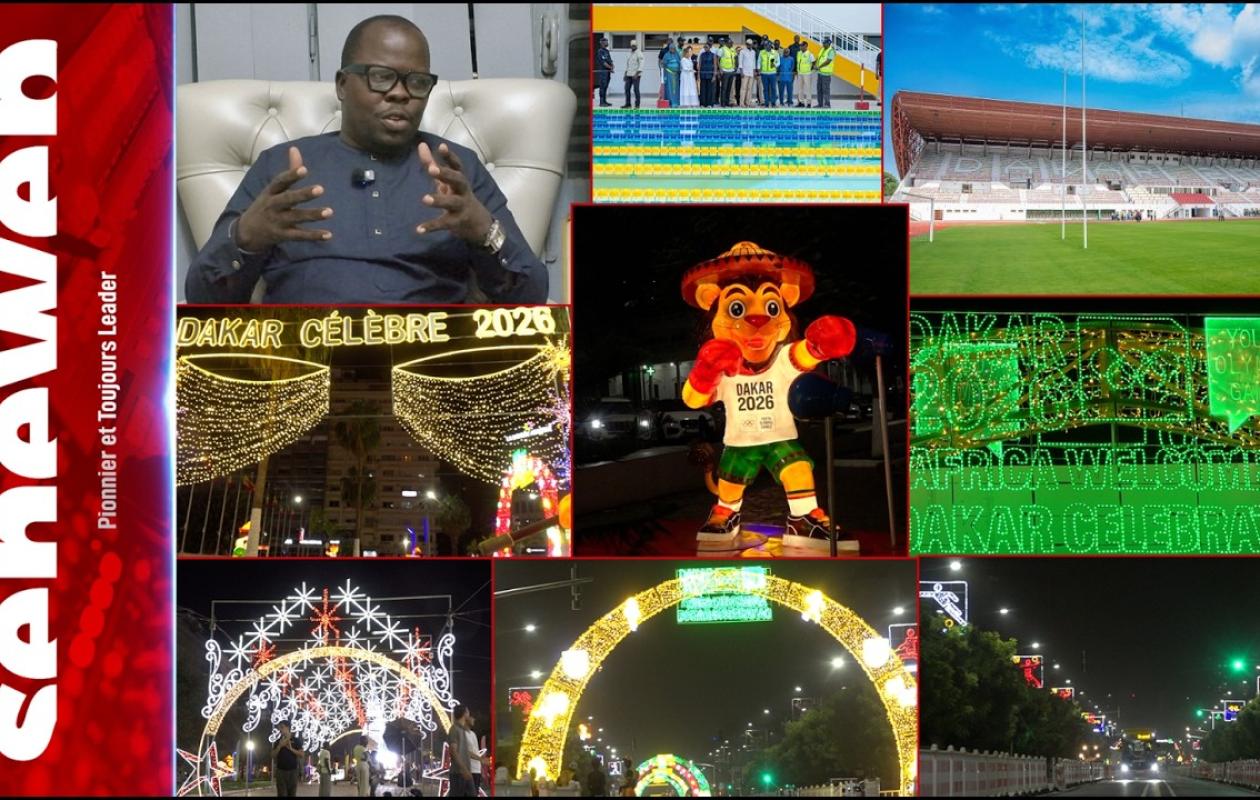
[JOJ] Bassirou Samb : « Ce que la ville de Dakar a investi est dix fois supérieur aux 5 milliards évoqués »
On the eve of the opening of the first Olympic Games held on African soil, the City of Dakar is finalizing its last details. In this candid interview, Bassirou Samb, Deputy Mayor for Youth and Recreation, reviews the municipal projects underway. From celebration sites at Place de la Nation and Parcelles-Assainies, to the renovation of the Olympic swimming pool and the Iba Mar Diop stadium, traffic management, and budget transparency, the elected official addresses concerns, reframes the debate on the true cost of the event, and reveals that the capital's financial commitment far exceeds the initially reported 5 billion CFA francs.
With just days to go before the opening of the Dakar 2026 Youth Olympic Games (YOG), the Senegalese capital is putting the finishing touches on its preparations. Urban animation, infrastructure rehabilitation, mobility, sporting legacy, economic benefits, and transparency of spending: in this exclusive interview, Bassirou Samb, Deputy Mayor of Dakar in charge of Youth and Recreation and President of the Municipality's Organizing Committee for the YOG, vehemently defends the capital's commitments. He announces the development of several celebration sites, the holding of three major fairs, and a vast program of activities designed to extend the Games' reach beyond the sports venues. While acknowledging that the full mobilization of Dakar residents is the major challenge, the elected official categorically states that the City's financial contribution far exceeds the 5 billion CFA francs mentioned in the public debate.
With just days to go before the opening of the Dakar 2026 Youth Olympic Games, authorities assure everyone that the infrastructure is ready. Beyond the official statements, what is the actual state of preparation today? Is Dakar truly ready to welcome the world?
Yes, I can confidently say that Dakar is ready. The capital has donned its finest attire to host this major global event. However, it's important to clarify everyone's responsibilities. The City of Dakar was tasked with designing and implementing the urban entertainment plan. We developed a comprehensive program that included dance performances, traditional regattas, sporting events in the neighborhoods, and various initiatives designed to build excitement before and during the competitions.
The branding is now virtually complete across all sectors. The Games' visibility is evident at roundabouts and along major avenues, through flags and communication materials. Everything in our specifications has been fulfilled. The other aspect concerns urban development. In the Medina and throughout the relevant district municipalities, the construction projects have been completed and accepted. At Independence Square, although it is not one of the competition venues, we deemed it essential to rehabilitate this symbolic landmark of national history. This space, expected to attract numerous tourists and visitors, has been completely renovated and then inaugurated by the Mayor. In light of its commitments, the municipality has delivered on its promises.
What are the final projects or challenges that remain to be completed, and can you guarantee that everything will be operational on time?
I've just come from an organizing committee meeting where we meticulously reviewed all the arrangements. All municipal departments are up-to-date and operational. We've taken the initiative to create secondary celebration sites so that the festivities aren't limited to just the stadiums and competition venues. The largest site will be set up at Place de la Nation. We'll be setting up an institutional fair there, demonstration and introductory areas for sports less familiar to the general public, as well as concerts and parades. Another site will be created at Acapes in Parcelles-Assainies, with a showcase dedicated to traditional wrestling. Grand Yoff will also host celebration spaces organized by the City.
The Games also have a crucial economic dimension. That's why the municipality is organizing three major fairs: the first, at Place de la Nation, will bring together institutions and partners; the second, located in the Municipal Building, will be dedicated to young entrepreneurs and women artisans; and finally, the City Hall gardens will host a culinary fair showcasing continental gastronomy, where each host country will present its specialties daily. Furthermore, we have invited delegations of young people from 20 African countries to give them this experience in the heart of the capital.
What are the main challenges to overcome before kick-off?
The major challenge today lies in mobilizing the public. It's about getting every resident of Dakar to embrace the event. We will be welcoming approximately 4,000 guests of all nationalities. Dakar must live up to its status by showcasing Senegalese hospitality (teranga) . Every citizen must act as an ambassador. This is the solemn appeal made by the Mayor, and which I reiterate to our youth.
After the departure of the delegations and visitors, what will concretely remain in the daily lives of Dakar residents?
This is a fundamental question. Legacy is measured both in tangible and intangible terms. This is a historic event, as the African continent has never before hosted the Olympic Games. Senegal and Dakar are leading the way. The success of this edition will determine Africa's capacity to host other major international sporting events. From a tourism perspective, the benefits are immediate: as I speak, almost all hotels are fully booked, providing a valuable economic boost. In terms of infrastructure, the Olympic swimming pool has been completely renovated to international standards, as has the Iba Mar Diop Stadium. Several other local facilities have also been refurbished. These investments will remain part of Dakar's heritage long after the Games have concluded.
So, what system is being considered to ensure the management and sustainability of these renovated infrastructures?
I am taking this opportunity to make an urgent appeal to the State. The Olympic swimming pool has always been managed by the City of Dakar, and we strongly urge that its management continue to fall under municipal control. Similarly, we wish for the Iba Mar Diop Stadium to be returned to the City. These high-level facilities require rigorous and continuous maintenance to allow our young athletes to train in optimal conditions and win international medals. The facilities built for skateboarding, football, and other street sports adhere to the same requirement for sustainability.
Traffic and urban mobility are a major concern for users. How does the municipality plan to maintain smooth traffic flow during the Games?
An event of this magnitude inevitably creates operational constraints. I ask for the understanding of all our citizens. For fifteen days, the world's eyes will be on Dakar. Traffic restrictions will primarily target areas adjacent to the competition venues and routes reserved for transporting official delegations. The City and government services are increasing communication efforts so that everyone can plan their travel accordingly.
Is there a traffic plan or specific instructions for economic actors and workers?
The Ministry of Infrastructure and the transport regulatory authorities have published an official mobility guide that should be consulted carefully. A large-scale information campaign is underway. This is a temporary, two-week effort to present an exemplary image of our country to our visitors.
What is the exact financial contribution of the City of Dakar to the organization of these Youth Olympic Games?
The City has made a massive financial effort, far exceeding what is sometimes reported. If we add up the projects completed this year in terms of roads, landscaping, branding , and the rehabilitation of sports fields, the municipal contribution far surpasses the 5 billion CFA francs mentioned in the public debate. The City's commitment is actually nearly ten times greater than this initial figure. In due course, a comprehensive and transparent financial report will be presented to the citizens.
How will citizens be able to control the proper use of these public funds?
We operate within a strict republican framework with rigorous oversight bodies. The City Council approves budgets, authorizes spending commitments, and monitors project implementation. Beyond these institutional checks, the City has developed digital information platforms that allow every citizen to transparently track achievements and resource allocation.
How does the City ensure that these Games will also benefit young people from underprivileged neighborhoods?
This is the core of our roadmap. We are implementing a comprehensive program to develop sports infrastructure at the local level. The municipality is installing synthetic turf fields and basketball courts in the heart of the district municipalities to guarantee universal access to sports. Furthermore, on the diplomatic front, Dakar has joined the World Union of Olympic Cities, which strengthens our decentralized cooperation and enhances our attractiveness.
Are there any socio-professional support or training programs linked to this event?
Absolutely. Through our sports equipment and promotion program, developed in partnership with the History Development Foundation, many young people in Dakar benefit from skills training in sports-related professions. Furthermore, the City's Sports Department funds annual training and refresher courses for referees, enabling dozens of young people to obtain official certifications. In this way, we are structuring a genuine sports economy on a metropolitan scale.
Can you give us a concrete commitment for the launch of the festivities?
The results are already visible throughout the metropolis. The City of Dakar invites everyone to join them this Friday, October 30th, at Place de la Nation. Alongside the closing ceremony of the Olympic torch relay, we will officially launch our cultural and festive activities with the grand opening of the "Penthioum Dakar" season.











Commentaires (10)
A part le Stade Iba Mar Diop et le la piscine olympique (je ne sais même pas si cela fait parti des investissements dont il parle), je vois vraiment pas d'autres investissements sérieux. Tout le reste, on dirait décorations Noël des jeux de lumières en veux-tu en voilà
Quelques indicateurs permettent de mesurer la situation :
- Trafic aérien : l'Aéroport international Blaise-Diagne (AIBD) annonce environ 2,94 millions de passagers en 2025, soit une progression limitée de 0,46 % par rapport à 2024.
- Transit aérien : recul de 15,9 %, notamment dans un contexte de réorganisation du réseau d'Air Sénégal.
- Mouvements d'avions : baisse de 9,73 %.
- Tourisme international : les statistiques fiables sur le nombre réel de touristes restent insuffisantes.
Participer à la Discussion
Règles de la communauté
💡 Astuce : Utilisez des emojis depuis votre téléphone ou le module emoji ci-dessous. Cliquez sur GIF pour ajouter un GIF animé. Collez un lien X/Twitter, TikTok ou Instagram pour l'afficher automatiquement.
Se connecter
Commentez avec votre profil, votre photo, et soyez averti des réponses.