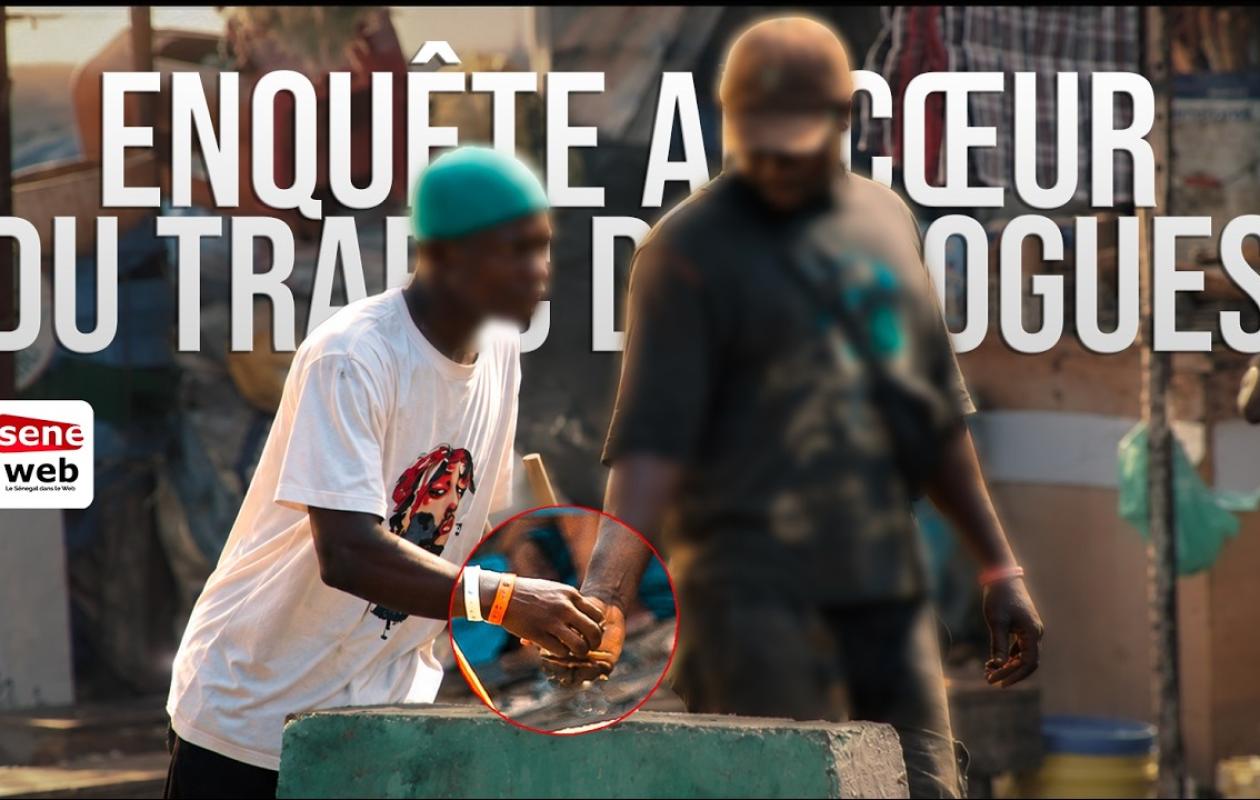
[Enquête] Kush, Fentanyl et MDMA : Plongée au cœur du « Zombieland » de la Médina
Fentanyl-laced kush, ecstasy pills, MDMA delivered to your door, and deadly codeine mixtures: Dakar is under unprecedented assault from a destructive chemical epidemic. Once a mere transit zone, the Senegalese capital has become a hub for the production and consumption of these drugs at low cost. From the labyrinthine streets of the Medina—transformed into a veritable "Zombieland"—to the squatted rooftop of the Tilène market, and even to the lounges of the jet set, Seneweb has infiltrated the synthetic drug trafficking networks. This is an X-ray of a scourge that is hitting young people and women particularly hard, overwhelming healthcare services, and pushing the legal system to its limits.
The trap closed silently on Dakar. Then, it exploded in the middle of the street. Once a mere transit route for traditional drugs (Indian hemp, cocaine) destined for Europe via land corridors across the Sahel, the Senegalese capital now faces the emergence of a deadly local market, marked by the proliferation of Kush and other highly addictive and destructive synthetic molecules. Now, drugs are no longer just transiting. They are manufactured, adapted to small budgets, and consumed locally. The trafficking is controlled by a network of foreigners—according to several sources—often relying on a sprawling system of Senegalese relays and intermediaries that serves as its anchor.
Toxic mixtures soaked in Fentanyl or other opioid painkillers like Nitazene — whose potency is said to exceed 50 times that of Fentanyl and 500 times that of morphine according to medical sources — diverted opioid tablets sold indiscriminately for a handful of coins in Dakar and its suburbs: the chemical epidemic is infiltrating the most unexpected neighborhoods, suffocating health structures and posing an unprecedented security challenge to law enforcement, who are trying to contain its alarming proportions.
To gauge the scale of the trafficking and the harmful effects of consuming these new, cheap drugs with their amplified effects, we ventured into the extended 25th Street (X20 and X18) in Dakar's Medina. Under the blazing October sun, the small neighborhood bordering the Tilène market teemed with activity on this early Friday morning. However, the shop fronts and family compounds were no longer animated by the usual bustle of traditional vendors, but lined with disjointed, motionless figures with vacant stares. They are called the "Kush zombies." Their presence has become commonplace for residents tired of voicing their frustration.
The Medina, Dakar's "Zombieland"
In broad daylight, five kilometers from the presidential palace, under the helpless gaze of passersby and residents, the trade operates with complete impunity and a nonchalance bordering on intimidation. For 1,000 CFA francs, users obtain their supply in seconds. With a mechanical, almost invisible gesture, the exchange takes place. The scene unfolds on a knife's edge. Calculated trajectories, eyes almost averted, the small white leaf containing the Kush passes from one palm to another. After only a few minutes of consumption, the effect is immediate. The drug plunges the user into a deep sedation, marked by a hunched or frozen posture.
“It’s the zombie effect,” explains Moustapha, a resident of 25th Street who, along with his friends, has been fighting for several months to eradicate this scourge that is plaguing their neighborhood. “These scenes have become commonplace for us. We film them every day. It’s Kush. They smoke it and remain frozen in place for minutes, not knowing where they are. This drug doesn’t come from Senegal. Sierra Leoneans and Guineans brought it here. Senegalese people don’t manufacture it, but they consume it,” he explains.
These traffickers from neighboring countries, who have set up their cartel on 25th Street, pose a real threat to local residents. "We can't sleep anymore, neither day nor night. They sit on our doorsteps, smoke their poison, insult us, and attack us. It's become unbearable," says a shopkeeper, at her wit's end, who has been receiving threats and requested anonymity. "I don't even dare go out at night to walk the streets anymore," she confides.
This investigation, conducted by Seneweb at the heart of the drug trade, reveals another reality: the clandestine and illegal occupation of certain public buildings. At the Tilène market, activist and TikTok content creator Lawder guides us through the labyrinthine upper floor of the marketplace. Far from the vegetable stalls, these squatter-traffickers have transformed the market's roof into a veritable clandestine living space. They sleep there, relieve themselves there, and consume drugs there. "This is their headquarters, their living space, and their laboratory for storing and packaging Kush," laments Lawder, who calls on the authorities to put an end to the unhealthy activities of these traffickers.
On August 4th, police conducted a major operation at the Soumbédioune site and tunnel. This action led to the discovery of 13 packets of Kush and the arrest of more than twenty traffickers. However, these numerous police raids, which resulted in the seizure of significant quantities of synthetic drugs (20.22 kg of Kush, 4,133 doses of Kush, and 34,000 Tramadol tablets seized by police), have clearly not stopped the trafficking. This trade is spreading to other neighborhoods of Dakar in a more insidious way, as evidenced by the numerous arrests of celebrities and television actresses for possession or trafficking of synthetic drugs.
A worrying feminization of consumption
“I’ve been in this business since 2017. I sell MDMA and Kush. The product often comes from neighboring countries like Guinea, Sierra Leone, or Mali, transported by truck or land. I can make between 200,000 and 300,000 CFA francs a day. My clients are varied: wealthy people, young people, but mostly women,” confides a dealer who agreed to answer our questions, speaking on condition of anonymity. As if to confirm his words, his phone rings; on the other end of the line is a regular customer: “Do you have any MD [MDMA]?” she asks him. “Come deliver it to me. We’ll get high and smoke together.”
“We also offer mixtures like soda with pills. Young girls love it. The market is huge and very profitable,” he confides, confirming the increasing feminization of his clientele. This is a very dangerous phenomenon that also worries psychiatrist and addiction specialist Dr. Oumar Mamadou Samba. According to him, whether at the Dakar Addiction Treatment Center (CEPIAD, created in 2014) or the psychiatric ward of Fann Hospital, “requests for consultations from women for synthetic drug addiction are increasingly numerous, despite socio-cultural constraints.”
Currently, the doctor confides, "Kush is one of the most commonly used synthetic drugs among our patients. It's a cannabinoid mixed with various toxic substances. Its effects are formidable: extreme sedation, loss of consciousness, hallucinations, amnesia, and sometimes respiratory arrest. We're seeing a real epidemic of addiction among young people. And the difficulty in treating it lies in the fact that we don't know all the components of this drug."
According to him, alongside Kush, new practices are emerging and increasingly encouraging women to consume drugs, especially in the nightlife and jet-set scene: this is the emergence of the Lean drink , also known as the Purple drink . It's a mixture of soda, codeine syrup, and pills, reveals the addiction specialist, who calls for increased awareness and security measures at borders.
The judicial system put to the test
From a legal standpoint, Senegal has a particularly harsh repressive apparatus. The Latif Guèye Law punishes international drug trafficking with sentences ranging from 10 to 20 years of imprisonment, excluding any possibility of probation for traffickers. However, experts agree on the urgent need to adapt this law in light of the constant evolution of chemical molecules.
“Senegal is a strategic transit zone due to its geographical location, its 700 km of coastline, and its port and air infrastructure. The Latif Guèye law of 2007 severely increased penalties for drug trafficking, ranging from 10 to 20 years of imprisonment. However, the fight must adapt to the rapid evolution of synthetic drugs, whose chemical compositions are constantly changing,” analyzes journalist and legal columnist Daouda Mine.
While awaiting this revision of the texts, the chemical epidemic continues to gain ground.




















Commentaires (35)
Cet éveil des consciences qui sauvera une grande partie de la jeunesse sénégalaise, est l’œuvre d’un homme qui, par un cruel paradoxe, de vouloir faire semblant de jouer L'ÉQUITÉ dans des différents avec des étrangers se retrouve aujourd’hui incarcéré en attente de jugement pour en avoir été l’initiateur.
Et parmi ces étrangers qui sillonnent la ville postés à chaque carrefour avec leurs chariots pousse pousses à café ne se contentent pas seulement de vendre du café ; en réalité, pour un grand nombre d'entre eux pour mieux dissimuler l'activité, impliqués dans une autre criminelle bien plus lucrative : ils font office de trafiquants et de distributeurs de stupéfiants. Des réseaux criminels d’importation de drogue à grande échelle ont exploité ce créneau, transformant ces chariots en points de vente au détail à travers toute la ville. Cette réalité a été mise au jour, non pas par les organismes officiels compétents, tels que la police (via Office Central pour la Répression du Trafic Illicite des Stupéfiants (OCRTIS).) ou la gendarmerie, mais grâce à KEYLOR, un lanceur d’alerte très suivi, qui a révélé leurs agissements.
Cette politique a donné d'excellents résultats au Ghana, au Rwanda et au Bénin où la criminalité a chuté de façon spectaculaire. Ces pays-là respirent et on peut presque s'y balader nuit et jour en toute sécurité
Les Gin et whisky de mauvaise qualité et addictifs qui coûtent 1000 frs la bouteille sont en train de faire des ravages chez nos jeunes. Ils deviennent alcooliques après quelques mois de consommation et les transforment en location humains avant de les abattre. C'est vendu partout dans les quartiers.
L'état doit interdire la vente ces alcools.
Une vraie bêtise, ces notions de nandité et utilisation de stupéfiants. 😢😢
Triste
Les pays ou il y a le plus de mort par drug overdose et de consommatin de drogue sont les pays non musulmans tels les Etats Unis le Canada l Australie et l Europe. L Arabie Saoudite pays qui vivait dans l ignorance jadis avant l arrive du Prophete Mouhamed psl est l un des pays ou la consommation de la drogue est presque inexistente mort par drogue overdose si ca existe c est par exception.
Pour ceux qui veulent reflechir le moyen de combattre ce fleau est d utiliser la methode du Prophete Mouhamed psl en EDUQUANT LES POPULATIONS A CONNAITRE QUI EST ALLAH SWT ET DE L ADORER SEUL TAWHID.
La realite ne mens pas jamais ici dans ce pays on a entendu ceux que vous appeler IBABOU S ASSOCIER A CES HISTOIRE DE DRUGS et autres.
C est seulement l ISLAM PUR QUI PEUT COMBATTRE SHEYTAN
L
jaljoob2026(arobase)gmail.com
Une vraie bêtise, ces notions de nandité et utilisation de stupéfiants. 😢😢
Une vraie bêtise, ces notions de nandité et utilisation de stupéfiants. 😢😢
Participer à la Discussion
Règles de la communauté
💡 Astuce : Utilisez des emojis depuis votre téléphone ou le module emoji ci-dessous. Cliquez sur GIF pour ajouter un GIF animé. Collez un lien X/Twitter, TikTok ou Instagram pour l'afficher automatiquement.
Se connecter
Commentez avec votre profil, votre photo, et soyez averti des réponses.