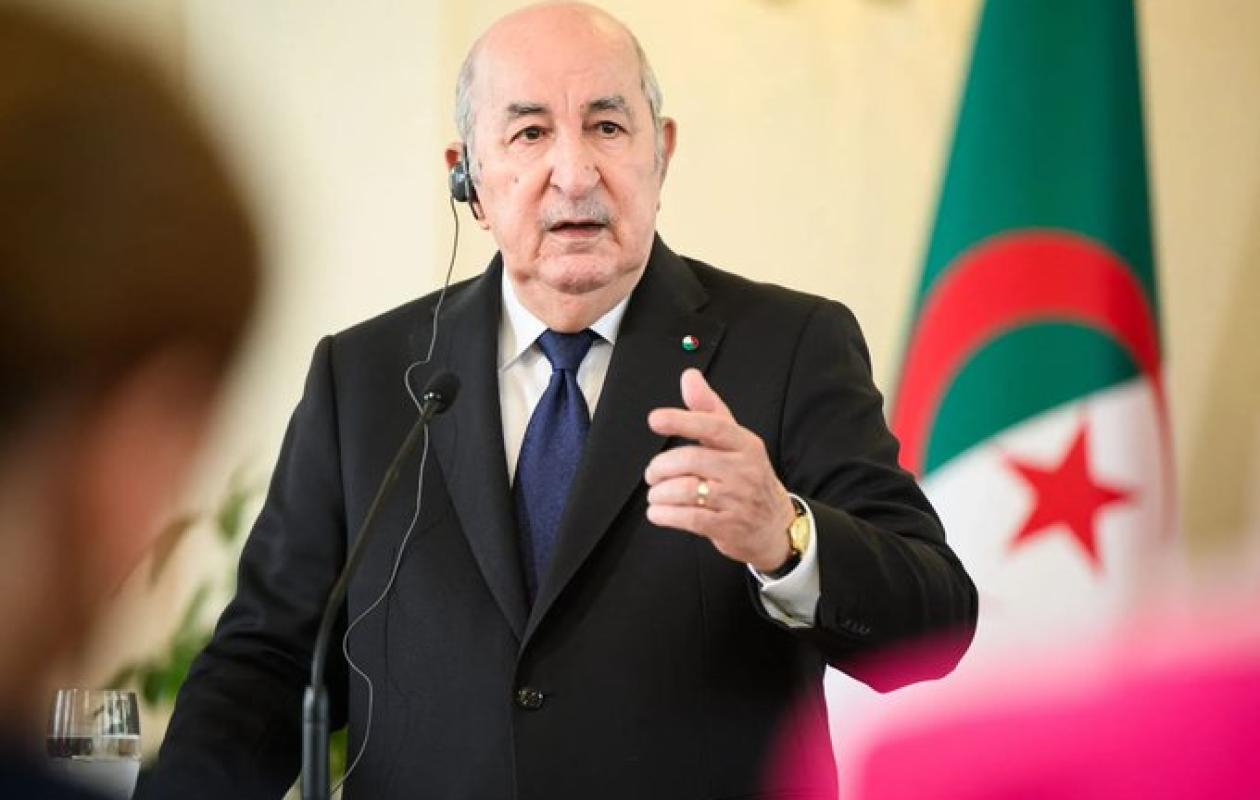
Algérie: la chambre haute approuve l'envoi de troupes au Niger
The upper house of the Algerian Parliament approved on Sunday a proposal authorizing the sending of troops to Niger to protect energy installations, a senator told AFP.
If the National People's Assembly (APN), the lower house, in turn validates the proposal during its session on Sunday, it would be the first official deployment of Algerian troops outside the national territory since the 1973 Arab-Israeli war.
One hundred and forty-eight members (out of 174) of the Council of the Nation (Senate) voted, behind closed doors, in favour of the text, this parliamentarian specified, under cover of anonymity.
This initiative marks a notable evolution in Algerian military doctrine, in a context of accelerated rapprochement with Niger.
The two countries, which share nearly 1,000 kilometers of border, have recently strengthened their security cooperation and signed a defense protocol, the details of which have not been made public.
They intend to intensify their fight against jihadist groups, cross-border crime and trafficking.
According to several media outlets, Algerian units could be tasked with securing oil installations and investments of the Algerian national hydrocarbon company Sonatrach in northern Niger.
For several months, Algiers has increased its gestures of support for Niamey, notably by providing four military helicopters and deploying fighter jets after an attempted military mutiny in August.
The two countries are also developing their cooperation in energy, hydrocarbons and mining, while pursuing the trans-Saharan gas pipeline project intended to link Nigeria to Europe via Niger and Algeria.
In early October, President Abdelmadjid Tebboune stated that his country would defend Niger against threats to its stability, emphasizing the importance of Algerian economic interests in that country.
"We will protect Niger no matter what," he declared during a meeting with national media broadcast on state television. "There are countries—which I will not name—that have conspired against (Niger). We stand by its side," he added.
"We have concluded agreements (with Niger) in oil, mining and other sectors, and some are seeking to destroy all of this overnight," he stressed.
The vote comes a few days after Niger's Defense Minister, Salifou Modi, visited Algiers, where he met with President Tebboune and the Chief of Staff of the People's National Army, General Saïd Chengriha. A military cooperation protocol was signed on this occasion, but its contents have not been made public.
"This decision marks a major evolution in Algerian defense doctrine, historically based on the principle of non-intervention in the military outside national borders," said Abdellah Akir, a researcher in political science and international relations.
- "Strong signal" -
"It is motivated by the need to protect Algeria's strategic depth and to secure the future trans-Saharan gas pipeline," he told AFP.
According to him, this measure aims to "send a strong signal to competing players including Morocco and the United Arab Emirates," with whom Algiers no longer has diplomatic ties.
According to Geoff Porter, an analyst specializing in security and political risks in North Africa, "the deployment illustrates a change in Algerian policy".
Algeria "had tried to preserve its national interests and to exert its regional influence through its usual means: dialogue, international law, multilateral forums," he told AFP.
"But in a multipolar and purely transactional world, this no longer works. Instead, Algeria has turned to more tangible means, a concrete physical presence," he believes.
The sending of Algerian troops abroad has been authorized since the constitutional revision of 2020, subject to the approval of two-thirds of the members of each of the two chambers of Parliament.
Relations between Algiers and Niamey deteriorated last year after Algeria shot down a drone launched from Mali, an incident that triggered a regional diplomatic crisis. Since then, the two capitals have embarked on a process of normalization and strengthened their political, economic, and security cooperation.



















Commentaires (24)
De grâce, plus de professionnalise !!!
C’est pas Sissi.
Le vrai calcul : contrer les Émirats arabes unis, qui avaient failli obtenir en 2019 une base militaire au nord du Niger. L'Algérie s'installe aujourd'hui exactement là. Elle veut aussi freiner la percée marocaine, qui a rallié le Mali, le Niger et le Burkina à un partenariat commun. Les Émirats, eux, réagissent déjà par la voie diplomatique.
Mais c'est un pari risqué : forte de son expérience antiterroriste intérieure et de ses moyens financiers, l'Algérie n'a aucune expérience d'opérations militaires extérieures ni de maintien de la paix. Elle se tromperait en croyant débarquer au Sahel la fleur au fusil.
Le pompier pyromane 🔥
Me maroc lui l'a compris depuis tres longtemps c'est pourquoi il a une longueur d'avance sur l'algerie au plan commerce et invesstissement en afrique noir ,longue vie et bonne santé a sa majeste le rois mouhamed six lui qui n'a jamais soutenu de terroristes dans la sous region
L'Algérie n'envoie pas de troupes à l'extérieur selon leur constitution. Donc comment va se dérouler cette protection. Vont il simplement rester le long de la frontière ? Vrai changement de paradigme à ne pas sous estimer en tout cas.
Y a eu une révision constitutionnelle en 2026 (Mars) avec des changements techniques dont l'interventionnisme extérieur qui n'a plus eu court depuis la guerre israélo arabe.
Participer à la Discussion
Règles de la communauté
💡 Astuce : Utilisez des emojis depuis votre téléphone ou le module emoji ci-dessous. Cliquez sur GIF pour ajouter un GIF animé. Collez un lien X/Twitter, TikTok ou Instagram pour l'afficher automatiquement.
Se connecter
Commentez avec votre profil, votre photo, et soyez averti des réponses.