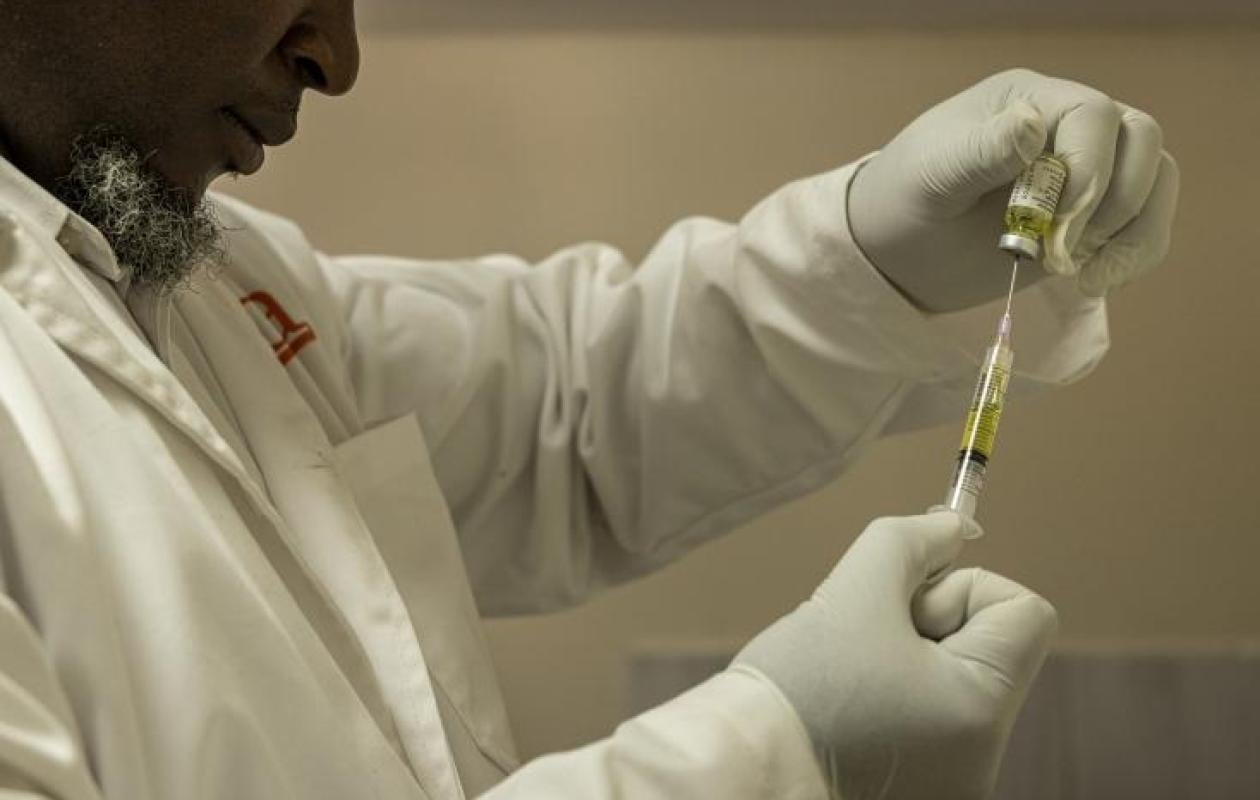
Au Kenya, la politique sida de l'administration Trump tue déjà
Beneath an unfinished concrete slab in a Nairobi cemetery lies Judy, a 36-year-old HIV-positive Kenyan prostitute. Ill after being deprived of her antiretroviral medication by drastic cuts in US aid, she died on August 7, a few hours before a scheduled interview with AFP.
AFP was able to confirm with sex worker organizations the deaths in Kenya of at least 24 of them, who, like Judy, were HIV-positive but in good health at the beginning of 2025, when the administration of Donald Trump announced the freezing of American humanitarian aid.
These cuts led to the closure of numerous clinics dedicated to sex workers, where they received condoms, pre-exposure prophylaxis (PrEP), or antiretroviral drugs. These treatments prevented them from becoming infected or reduced the viral load of HIV-positive women to the point of making them non-infectious.
The United States, historically the main bilateral donor to the Kenyan health system, did sign a five-year health agreement with Kenya in December, worth $2.5 billion, of which $1.6 billion was financed by Washington and the rest by Nairobi.
But in keeping with the moral line of the Trump administration, which this year adopted rules prohibiting NGOs it supports from promoting social issues it opposes, the US-Kenyan "cooperation framework" has brought no major progress for prostitutes, whose clinics have not reopened.
A global trend: in July 2026, a report by the Foundation for AIDS Research (amfAR) revealed that 73% of US-funded organizations had permanently ended services for "key populations" — sex workers, LGBT communities and drug users — even though they are most at risk of infection.
Several experts interviewed by AFP fear a future "catastrophe" in Kenya: an explosion of HIV infections, already observed among the country's many sex workers.
Kenyan authorities estimate their number at 285,000, of which 27.5% are HIV positive.
Stopping treatment for prostitutes can only have disastrous consequences for the general population, according to experts and a dozen prostitutes interviewed by AFP. Many clients refuse—or cannot afford—condoms and then have unprotected sex with other partners.
- "Risk" -
In an interview with AFP, UNAIDS Executive Director Winnie Byanyima expressed her regret over the closure in Kenya of numerous facilities serving at-risk populations. These are peer-run centers that focus on prevention, where these communities can go without fear of judgment.
These care centers and clinics represent a "huge part of the HIV response," she notes, warning that cuts by the United States, followed by other major donors, are "jeopardizing" decades of the fight against AIDS.
As the phenomenon is recent, Kenyan statistics do not currently reflect an increase in infections in the population.
Douglas Bosire, chairman of the NSDCC, a government agency overseeing, among other things, the strategy towards HIV/AIDS, points instead to the "great progress" recently made in Kenya.
In 2025, some 14,000 new infections were recorded there, compared to approximately 20,000 in 2024, representing a 27% drop, he noted with satisfaction. Deaths from AIDS-related illnesses decreased by 8%, from 21,000 to approximately 19,500 deaths over the year, he pointed out to AFP.
But he acknowledges "a risk that these gains could be reversed" if the most at-risk populations are not better targeted in Kenya, where nearly 1.5 million people, or 3.2% of the population, are living with HIV.
Judy was diagnosed HIV-positive in 2017, according to her friend Diana, who was also a prostitute.
A status she had learned to fight thanks to the Bar Hostess Empowerment and Support Program (BHESP), an NGO that delivered medicine, condoms and sometimes a little food to her in the Mathare slum, where she lived.
Judy's situation, like that of many Kenyan prostitutes, was extremely precarious. Sometimes selling herself for 50 or 100 Kenyan shillings (30 or 60 euro cents), sometimes for food for her four children, she could not afford transport to a BHESP clinic.
But when the NGO lost funding from the US federal aid agency USAID, which was virtually dismantled under Donald Trump, BHESP's field teams were laid off. And Judy found herself without vital support.
Because although antiretrovirals are available in Kenyan public hospitals and the authorities want them to be treated there, the sex workers interviewed by AFP refuse to set foot in them because they feel stigmatized, even more so if they are HIV positive - another factor of discrimination in Kenya.
They also fear running into a neighbor or acquaintance who would learn of their viral status and reveal it, making their children outcasts in turn, they confide.
- Advanced stage -
To avoid this, Judy stopped taking her medication, despite the danger, Diana recalls. Her immune system malfunctioned. Judy lost a considerable amount of weight and became very weak.
"She had sores on her body. Her skin was rough," says Diana, very moved, whom AFP met on the day of her friend's death, who, she says, was taken by tuberculosis, a disease associated with AIDS.
Judy is one of three HIV-positive prostitutes in Mathare who have died in recent months because they stopped taking their medication, according to initial reports from BHESP. Several others are believed to have died for the same reason in nearby slums, particularly in Korogocho, says Diana.
"The order to suspend missions, issued by the American administration, is for us an order to kill" the prostitutes, denounces Daisy Kwala, program director for BHESP. This NGO had to close one of its two USAID-funded centers in September 2025.
The second, in an anonymous building in Roysambu, a suburb of Nairobi, is still operating minimally, but will cease all activity, due to lack of money, at the end of September.
Of the 14,500 prostitutes treated at these two clinics, some 12,000 have disappeared from BHESP's radar, including 2,300 who were HIV-positive. Impoverished and unable—like Judy—to seek treatment on their own, the NGO does not know how many have died, become seriously ill, or been infected.
New infections have exploded where American aid has disappeared.
In the second quarter of 2024, when Joe Biden was still in the White House, nine infections were detected among 6,685 prostitutes tested at the BHESP center in Roysambu, which, over the same period this year, recorded 45 among 2,439 women tested.
This represents a 14-fold increase in the number of infections, with a constant population.
Conversely, no new infections have been recorded in the last two years in the two other BHESP facilities supported by the Global Fund to Fight AIDS, Tuberculosis and Malaria, according to the NGO.
Another problem is that, whereas previously prostitutes, who were regularly monitored thanks to American aid, discovered their HIV-positive status at an early stage, they are now more advanced in the disease when they come to the Roysambu center, observes Sharon Lagat, a nurse at this facility.
"They have oral thrush, skin rashes, symptoms of sexually transmitted infections," she lists, all diseases favored by the immunodeficiency caused by HIV.
- "Out of control" -
"Because they come late, they have transmitted more HIV to their clients," the nurse laments. And "these clients are our husbands, our friends. In the end, the virus will inevitably reach our homes."
The Sex Workers Awareness Program (SWOP), an NGO monitoring 45,000 sex workers in Nairobi, half of whose clinics closed with the cessation of US funding, also observed a 48% rise in new infections in the first half of 2026, compared to the first six months of 2024.
Its clinical and research director, Dr. Joshua Kimani, says he fears "a return to the situation of the 1990s," when infections were "out of control."
A veteran of the fight against the virus, which he began in 1992, this renowned epidemiologist remembers 1998 as his "worst year." "I had become the Dead Doctor," he recounts, "because I was telling people to go home to die. I don't want to relive that."
And Dr. Kimani observed: when, after the dark years of AIDS in Kenya, "we began to see a decline in viral load and deaths among sex workers, the same thing followed in the rest of the population. So, if you start to see deaths among prostitutes, it will happen throughout the community."
In this context, all the sex workers interviewed by AFP lamented the lack of free condoms. Many of them are too poor to buy a box of three, which costs 100 shillings, sometimes more than the price of a sexual encounter.
But today, HIV-positive prostitutes "who no longer receive their antiretrovirals, who cannot afford condoms, continue to work," notes Daisy Kwala. "They continue to sell their bodies, six to ten times a day."
Until they get too sick.
On the Kenyan coast, 14 prostitutes have already died after stopping their treatment, according to the Coast Sex Workers Alliance.
At least five others have died in western Kenya, where the HIV/AIDS prevalence rate, among the highest in the country, already exceeded 10% of the population, notes the Kisumu Sex Workers Alliance.
None of the 25 clinics dedicated to prostitutes existing in four counties in this region, all funded by USAID, have survived, laments its president Dorothy Agalla.
Less than a thousand of the approximately 20,000 practicing there are now being treated in public facilities, she observes.
- "Worst times" -
"We are living through the worst period" regarding the fight against HIV/AIDS, laments Ms. Agalla, "we are going backwards, but we don't know where we are going," whereas at the beginning of the epidemic "we were starting (the fight) but we had a goal."
Caroline Kemunto, president of Survivors of Busia, an NGO of sex workers in this other region of the west, bordering Uganda, reports two deaths among her members, who were HIV positive and had stopped receiving treatment.
In Mathare, near Nairobi, Cecilia Joseph mourns her friend Beatrice. A prostitute like herself, 43-year-old Beatrice stopped taking her antiretrovirals when visits from BHESP members ceased, refusing to go and collect them from the nearby dispensary, to avoid her and her two children being stigmatized, Cecilia Joseph recounts.
"When her condition started to deteriorate (...), a large rash appeared around her stomach, resembling a burn," her friend recalled. "Then the headaches started. And poof. She was gone."
Beatrice "died in her bed" on August 24, 2025, from a kidney infection, according to Cecilia Joseph. Beatrice's sister, Rosemary, died a year later. Aged 29, according to Ms. Joseph, she was also a sex worker, HIV-positive, and had also stopped taking her medication due to the US budget cuts.
Cecilia Joseph implores President Trump to "rectify" the measures taken by his administration, before placing her trust "in God" to "bring us back what we had before." "We would be so happy," she sighs.
When questioned by AFP about these deaths, the Trump administration's assistant secretary for Africa, Frank Garcia, preferred to get annoyed on September 9 during a visit to Nairobi, notably to promote the US/Kenya health agreement.
"I totally reject," he declared, "the narrative that the slightest change coming from the most generous country in the world in terms of AIDS research, funding for the fight against AIDS and the dissemination of life-saving treatment methods could in any way be responsible for this."



















Commentaires (4)
Participer à la Discussion
Règles de la communauté
💡 Astuce : Utilisez des emojis depuis votre téléphone ou le module emoji ci-dessous. Cliquez sur GIF pour ajouter un GIF animé. Collez un lien X/Twitter, TikTok ou Instagram pour l'afficher automatiquement.
Se connecter
Commentez avec votre profil, votre photo, et soyez averti des réponses.