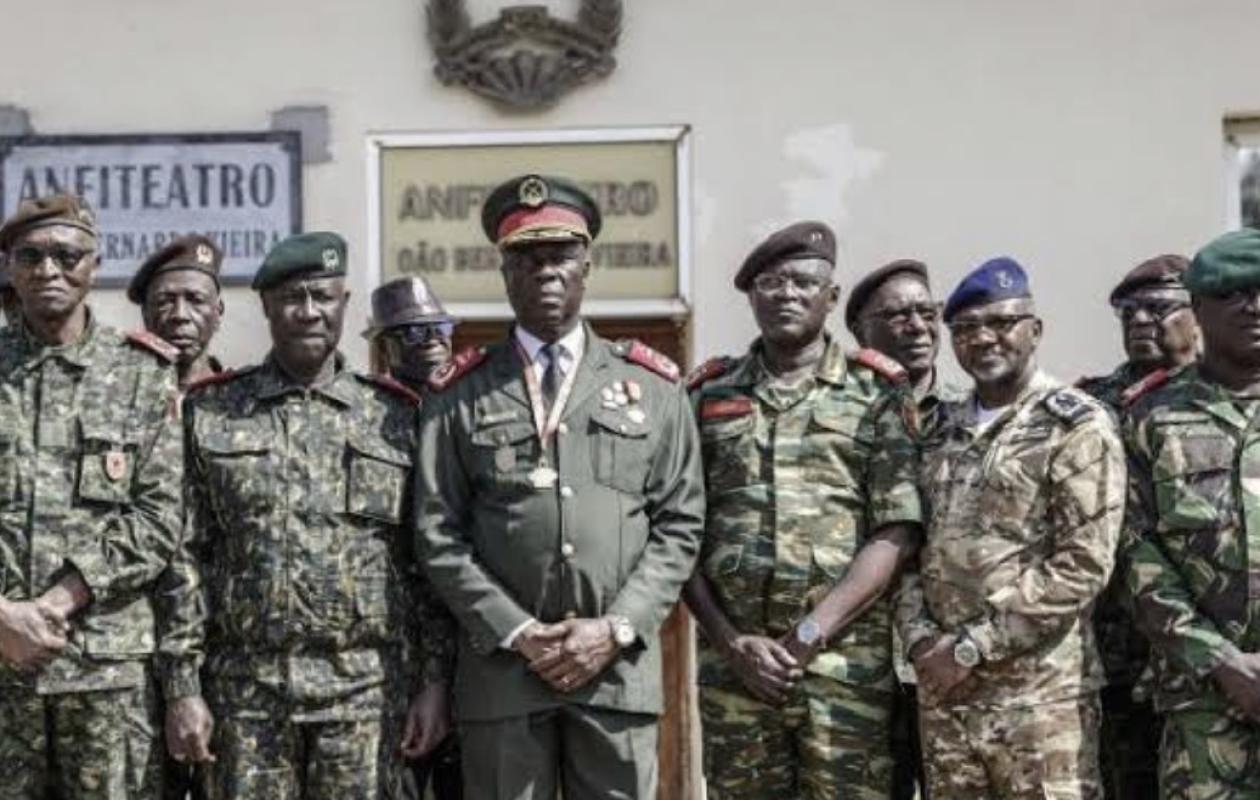
Guinée-Bissau : un référendum sous la botte des militaires pour verrouiller le pouvoir avant même les urnes
The vote this Sunday, August 30, is not a simple technical constitutional exercise, but the culmination of a process initiated by a coup d'état, the outcome of which will weigh heavily on the democratic future of the country.
A political context born from a coup with murky outlines
It all began with the general elections of November 23, 2025, which took place peacefully with a 65% voter turnout. Three days later, while the final results had still not been announced and both independent candidate Fernando Dias and incumbent President Umaro Sissoco Embaló were claiming victory, the army seized power. Umaro Sissoco Embaló and veteran opposition leader Domingos Simões Pereira were then arrested. According to Pereira, soldiers even attempted to storm the electoral commission headquarters to force the proclamation of the incumbent president's victory over Fernando Dias, who was believed to have won the election.
One detail fuels suspicions of a staged coup: the head of the junta, General Horta N'Tam, was then the army chief of staff and a close associate of President Embaló. This close relationship has led some observers to suggest a "sham" coup, primarily intended to disrupt an electoral process that was going badly for the outgoing government.
The major revisions of the new Constitution
The text, adopted by the National Transitional Council in January 2026, represents a major institutional shift. The president simultaneously becomes head of state and head of government, presides over the Council of Ministers, and directs government action. He also gains the power to appoint and dismiss the prime minister independently of the parliamentary majority resulting from the legislative elections, thus rendering the very principle of competitive legislative elections meaningless.
Furthermore, the Prime Minister becomes explicitly subordinate to presidential directives, while the National Assembly can no longer ratify appointments or dismissals decided by the executive branch. The President could also dissolve Parliament under certain conditions, including once per term without requiring the approval of the Council of State. Finally, a 4% electoral threshold is introduced, which could lead to the dissolution of smaller parties and further reduce the scope for political pluralism. In other words, the text enshrines the outright disappearance of the parliamentary system in favor of full presidentialism, precisely what the opposition denounces.
An opposition silenced even before the vote
This is where the picture becomes truly alarming, causing the official narrative of a "peaceful transition" to collapse. Domingos Simões Pereira, leader of the PAIGC (the historic independence party), was placed in pretrial detention in July 2026 by a military court, accused of financing alleged coup attempts in 2023 and October 2025. He is currently under house arrest, a measure that an official from the Guinean League for Human Rights openly describes as illegal under Guinea-Bissau law and a means of exerting pressure on the country's most popular politician.
The PAIGC called for a boycott, describing the referendum as a "staged event designed to give the appearance of legitimacy" to the new Constitution, while asserting that the institutions established by the coup are "devoid of any democratic legitimacy." The party also denounced the authorities' efforts to prevent the "no" camp from campaigning, amidst "severe restrictions on civil liberties." Pereira himself went even further, calling the vote an "absolute farce" and stating that what will happen on August 30 is a continuation of the coup d'état perpetrated on November 26.
On the ground, the repression takes other forms: the military authorities now require political parties to obtain authorization from the Supreme Court to campaign, as well as a signed list specifying the associations authorized to do so in each region, thus establishing administrative control that stifles open debate. Several civil society organizations have also published an open letter condemning the drafting of a new Constitution under the tutelage of the military junta.
ECOWAS 's credibility has been tarnished
The regional organization, meant to arbitrate the crisis, has itself found itself accused of complicity. The announcement of a future referendum by the ECOWAS mediation mission reignited tensions, with the opposition accusing it of overstepping its role as mediator and legitimizing the transitional government. The spokesperson for Fernando Dias's team denounced ECOWAS for "only making the problem worse," arguing that no one in Guinea-Bissau believes in its impartiality anymore, given its failure to consult the opposition. ECOWAS defended itself by stating that it had "not validated any constitutional process in the name of the people of Guinea-Bissau," a nuance that convinced no one on the ground.
This fragility is also explained by the regional context: ECOWAS, already weakened by the withdrawals of Mali, Burkina Faso and Niger, can hardly afford a new zone of turbulence on its Atlantic coast, which fuels the suspicion of realpolitik taking precedence over the defense of democratic principles.
The real issues at stake in the August 30th election
The official calendar then calls for presidential and legislative elections on December 6, 2026, intended to pave the way for a return to civilian rule. But this referendum is the deciding factor that will determine the institutional framework for these elections. If the "yes" vote prevails, General Horta N'Tam will have a legal basis to extend his influence, and even run in a future presidential election under a regime where the legislative branch no longer has any real power over the executive.
For West Africa, this election is yet another test in a region where referendum legitimization of powers resulting from coups d'état has become a recurring modus operandi, raising each time the same fundamental question: can we speak of a free popular choice when the opposition is in prison, under house arrest or prevented from campaigning?




















Commentaires (3)
Participer à la Discussion
Règles de la communauté
💡 Astuce : Utilisez des emojis depuis votre téléphone ou le module emoji ci-dessous. Cliquez sur GIF pour ajouter un GIF animé. Collez un lien X/Twitter, TikTok ou Instagram pour l'afficher automatiquement.
Se connecter
Commentez avec votre profil, votre photo, et soyez averti des réponses.