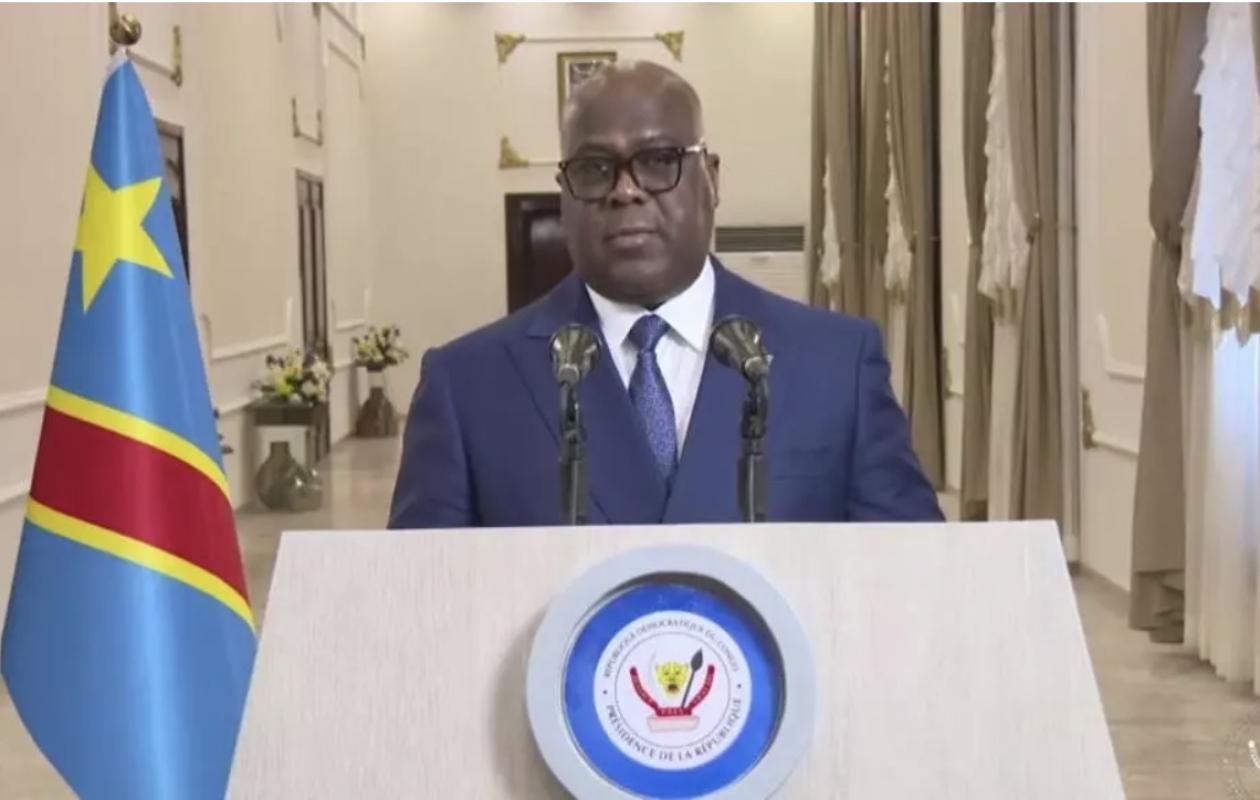
RDC: Félix Tshisekedi fixe le cadre d'un dialogue national de trois mois
The Congolese president officially launched a "National Dialogue for Peace, Cohesion, and the Refounding of the State" on Thursday, August 27, 2026. The process will begin in the 26 provinces before a national conference in Kinshasa and is not expected to exceed three months. The majority, the opposition, civil society, religious groups, and numerous segments of the population are to be involved. Those who continue to fight by force of arms will be excluded.
Félix Tshisekedi clarified on Thursday, August 27, the format of the national dialogue he had been promising for several weeks. In an address to the nation, the President of the DRC officially launched a process he intends to be different from previous political consultations organized in the country: discussions will not begin in Kinshasa among national leaders, but in the 26 provinces, before culminating in a summit in the capital.
A "broad political and technical consultation" must first be organised in each province. Preliminary forums will bring together, in the provincial capitals, the populations and local authorities, the national deputies and senators elected from the province, the representatives of the territorial entities, the political parties and groups of the majority and the opposition, civil society, customary authorities, religious denominations as well as the professional, economic, academic and scientific communities.
National public institutions and services, public enterprises and establishments, women's, youth and workers' organizations, representatives of people living with disabilities and other vulnerable people must also be consulted. The president further mentions entrepreneurs, farmers, teachers, researchers, artists, healthcare professionals, informal economy workers, and the Congolese diaspora.
Each province will have to conduct its own assessment of several issues: insecurity, land and customary disputes, community tensions, administrative shortcomings, inequalities, obstacles to development, and reforms deemed necessary. The proposals gathered will then be compiled into a national synthesis that will serve as the basis for the Kinshasa conference.
“The Kinshasa conference will not be the starting point of the dialogue, but the culmination of input gathered from across the country,” declared Félix Tshisekedi. According to him, the delegates to the national conference must reflect the political, institutional, social, territorial, and cultural diversity of the country.
Three months maximum
The head of state also set a time limit: the entire process must not exceed three months. However, no specific date for the start of the provincial consultations or the national conference was given in his address.
The implementation itself will take place in several stages. Félix Tshisekedi announced that, "in the very near future," an order establishing an organizing committee responsible for the administrative, material, and logistical preparation of the dialogue. This committee will have to submit a preliminary report to the president.
Based on this, a second decree will formally convene the dialogue and specify its guiding principles, main stages, methods of representation, and monitoring mechanisms. It will also establish a Preparatory Commission tasked with developing the roadmap and conducting political and technical consultations. Religious denominations will be represented on this commission. A bureau and a plenary assembly will subsequently be formed.
The presidential plan thus resolves several issues debated since the announcement, on July 17, of the principle of a national dialogue. In an interview with RFI on August 21, opposition leader Martin Fayulu argued for a shorter format, not exceeding three weeks or a month, with religious leaders acting as mediators. He also contested Félix Tshisekedi's right to unilaterally determine the framework and the topics to be addressed.
The Save the DRC movement, close to former president Joseph Kabila, had called for "neutral, independent, and impartial" mediation, with the support of the African Union and the United Nations, as well as for the dialogue to be held in a third country. Félix Tshisekedi has opted for a different approach: the process will take place in the DRC, under the responsibility of the Congolese people.
Religious denominations will have a role in the process, but the president did not assign them, in his address, the leadership or mediation of the dialogue. They will be represented on the Preparatory Commission and, according to him, will have to contribute to building trust and fostering consensus.
The limits of inclusivity
The presidential speech mainly clarifies what the inclusive nature of the dialogue will entail, one of the main points of controversy in recent weeks.
Félix Tshisekedi affirms that no one will be excluded because of their opinions, criticisms, political affiliation, provincial origin, language, ethnicity, or religion. But he sets a limit: "No one can claim to sit at the table of the Nation while taking up arms against it."
Therefore, those who, at the start of the process, are fighting the constitutional order with weapons, occupying part of the territory by force, illegally administering entities of the Republic or acting, according to the president, in the service of a foreign power, "in this case Rwanda", will not be able to participate "as political components".
These criteria, under current conditions, exclude the AFC/M23 from the political components admitted to the national dialogue. Félix Tshisekedi maintains the Doha process as the framework for discussions with the movement on issues related to the conflict, including the cessation of hostilities, disengagement, cantonment, and disarmament.
This separation was already defended by the government. At the end of July, its spokesperson, Patrick Muyaya, explained that the discussions with the AFC/M23 were a matter for Doha, while the national dialogue had to respond to an "internal imperative" and allow the building of an internal front against what Kinshasa calls Rwandan aggression.
This concept of inclusivity is contested by part of the opposition. Martin Fayulu, in particular, had called for the participation of former president Joseph Kabila and Corneille Nangaa, coordinator of the AFC/M23, arguing that those who contributed to the crisis should be able to explain their reasons. Corneille Nangaa, for his part, rejected the dialogue proposed by Kinshasa, without calling into question the discussions already underway in Doha.
An option remains open for individual members of armed groups who sincerely and verifiably renounce weapons and all forms of violence and condemn the aggression denounced by Kinshasa. Their reintegration would then be handled through disarmament, demobilization, and reintegration mechanisms, as well as justice and reconciliation processes.
The president, however, ruled out a general amnesty for war crimes, crimes against humanity, acts of genocide, serious sexual violence and other imprescriptible crimes.
No suspension of institutions
Félix Tshisekedi also ruled out the possibility that the dialogue would lead to the suspension of institutions or call into question "the sovereign choice of the people expressed at the ballot box." He affirmed that the institutions will continue to exercise their prerogatives until the constitutional end of their mandates.
This clarification comes as several opposition groups have placed the constitutional question among their red lines. The C64 coalition refuses to allow dialogue to serve as a pathway to constitutional change. Meanwhile, the "Save the DRC" movement has demanded the prior abandonment of any referendum project intended to amend or replace the fundamental law.
In his address, Félix Tshisekedi did not present constitutional reform as an objective of the dialogue. Instead, he stated his intention to learn from previous national consultations. According to him, the DRC has "too often responded to crises by sharing power rather than by consolidating the state." He also criticized processes that remained concentrated among political leaders and agreements whose implementation and monitoring mechanisms proved inadequate.
De-escalation measures before dialogue
The head of state also announced "confidence-building and political détente measures." He is expected to ask the government to prepare them with the relevant institutions and "in strict compliance with the separation of powers." Their content has not been specified.
Félix Tshisekedi also promised to personally ensure that the necessary security and trust conditions are in place "for the return and participation" of Congolese who, for various reasons, are currently marginalized from national unity. No names were mentioned.
Political détente was among the main demands made before the address. The "Save the DRC" movement had specifically called for the release of political prisoners and prisoners of conscience, the return of political exiles, the lifting of restrictions targeting opposition leaders, and equitable access to public media. The president did not indicate whether these specific demands would be met.
At the end of the three-month period, the conference is expected to produce a "National Pact for Peace, Cohesion, and the Refounding of the State." A public document will specify, for each commitment, the responsible institution, the implementation schedule, and the expected results. A national monitoring mechanism and periodic reports are also planned.
The dialogue must finally remain separate from the diplomatic processes already underway around the conflict in the East: Washington for the interstate dimension between the DRC and Rwanda, and Doha for the discussions between Kinshasa and the AFC/M23.
After several weeks of discussions on its format and degree of inclusivity, the address of August 27th thus establishes the framework desired by the presidency. Several elements, however, remain to be clarified: the launch date of the consultations, the composition of the Organizing Committee and the Preparatory Commission, the exact procedures for appointing delegates to the Kinshasa conference, and the content of the announced confidence-building measures.















Commentaires (0)
Participer à la Discussion
Règles de la communauté
💡 Astuce : Utilisez des emojis depuis votre téléphone ou le module emoji ci-dessous. Cliquez sur GIF pour ajouter un GIF animé. Collez un lien X/Twitter, TikTok ou Instagram pour l'afficher automatiquement.
Se connecter
Commentez avec votre profil, votre photo, et soyez averti des réponses.