Financer, accompagner et accélérer la transformation agro-industrielle du Sénégal : La BNDE s’engage avec le PNDAS
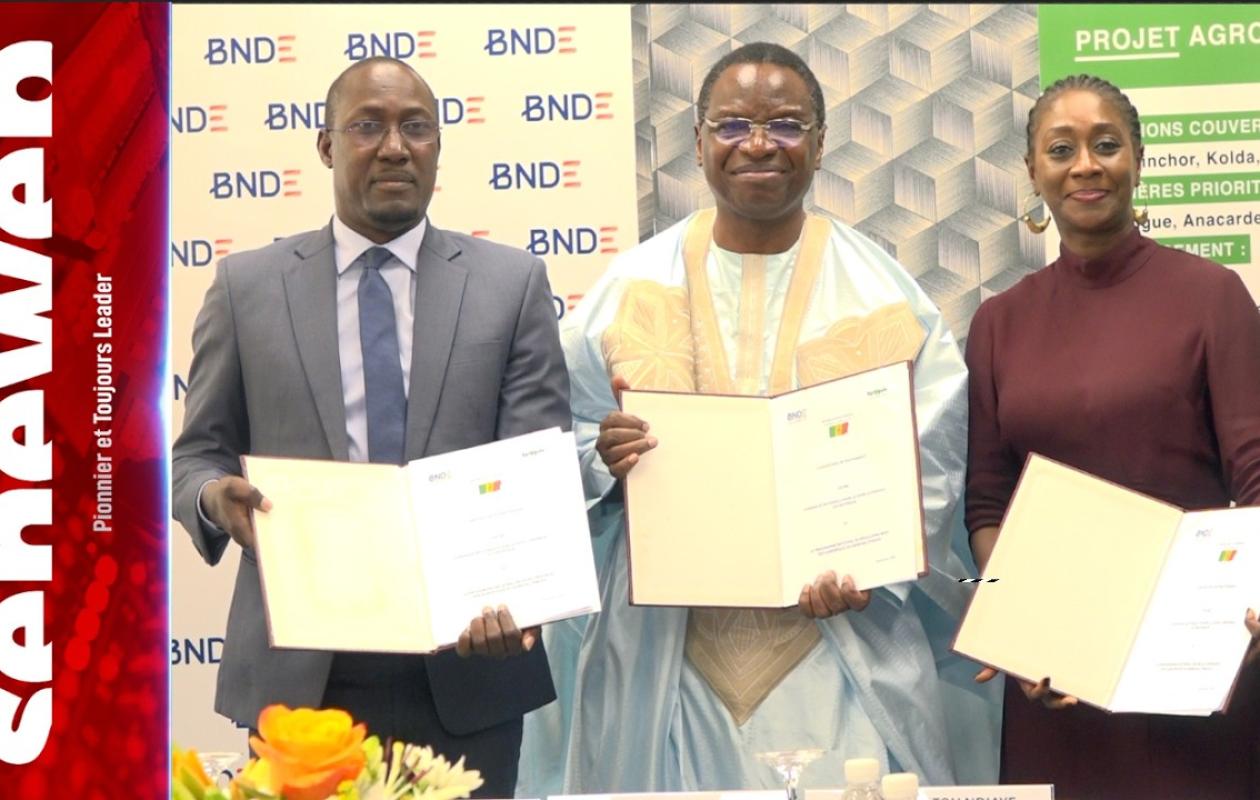
The National Bank for Economic Development (BNDE) and the National Program for the Development of Agropoles in Senegal (PNDAS) have decided to align their efforts to support agropoles. On Tuesday, September 29, 2026, they signed a partnership agreement for the industrial transformation of Senegal and the development of competitive national value chains. This agreement, which aims to finance, support, and accelerate the agro-industrial transformation of Senegal, embodies the commitment of these two public institutions to making agropoles centers of production, processing, and prosperity. It was initialed by Mr. Mamadou Faye, Director General of the BNDE, and Ms. Aïssatou Ndiaye, Coordinator of the PNDAS, under the chairmanship of the Minister of Industry and Trade, Dr. Serigne Guèye Diop.
"To make agropoles true engines of territorial development"
The National Bank for Economic Development (BNDE) was created to support the economic development of Senegal. As such, through this agreement, the BNDE commits to mobilizing appropriate financial instruments for the benefit of businesses, small and medium-sized enterprises (SMEs), cooperatives, producer organizations, and project promoters operating in the value chains targeted by the agropoles.
In addition to these financial resources, the bank is committed to providing the planned technical assistance which will make it possible to identify projects with high potential, contribute to their maturation and provide promoters with answers adapted to each stage of their development.
BNDE's ambition is to make agropoles "true engines of territorial development and promote the emergence of Senegalese companies capable of meeting the needs of the national market as well as conquering regional and international markets."
A partnership centered around three key issues
According to the Director General of BNDE, this signing goes beyond a simple agreement between his bank and PNDAS. "Today, we are not just signing an agreement; we are providing an operational framework for a shared ambition: to better finance, better support, and better leverage the potential of our agriculture and industry," emphasized Mamadou Faye.
For him, this signing represents less of an end point than a starting point: the beginning of concerted action, geared towards concrete results to serve the economic transformation of our country. The primary challenge is to transform more in order to create more value. Producing more is necessary, but our ambition must go further: to process locally, to market more effectively, and to conquer new markets. Wealth lies in our ability to convert our resources into jobs, income, and competitiveness.
This is precisely the purpose of agropoles: to bring together production, processing, investment, innovation and financing within high-performing territorial economic hubs.
The second challenge, meanwhile, is to mobilize a solid, expert, and committed development bank. Here, the BNDE's ambition is to be a bank that goes beyond simply providing financing, but also helps to bring projects to fruition, structure them, and ensure their long-term sustainability.
The third and final challenge is to transform this commitment into measurable results. Here, the bank's commitment, according to its CEO, must be measured by concrete achievements: companies financed, processing units developed, investments made, jobs created, and more competitive value chains.
For the Director General of BNDE, the success of this ambition will depend on their ability to coordinate their efforts, to make swift decisions and to plan their actions for the long term.
In this regard, Mamadou Faye reassured that his bank will "play its full part, putting its expertise, resources and capacity to intervene at the service of Senegal's economic priorities".
"This partnership will be a game-changer for agropoles."
The coordinator of the PNDAS, for her part, maintained that this partnership, which they have been developing for several months, will be a game-changer for agropoles. According to her, it aligns with their desire to establish a genuine financing ecosystem around agropoles, particularly through the future fund for the development of agro-industrial value chains.
"This partnership is expected to facilitate access to financing for companies established or wishing to establish themselves in our agro-industrial parks, through adapted credit lines and truly accessible conditions, particularly in terms of interest rates and deferred repayment," said Ms. Aïssatou Ndiaye.
She adds that her program also relies on the BNDE to support the mobilization of resources from other financial institutions for its projects, and to participate in the training and financial education of actors in their value chains.
The National Agropole Development Programme of Senegal, for its part, is committed to playing "fully" its role in the success of the partnership.
Three major recommendations formulated for the implementation of the convention
Regarding the recommendations for the implementation of this partnership agreement, Ms. Ndiaye insists on the need to quickly operationalize the steering committee provided for in the agreement, with an alternating chairmanship of their two institutions, and to ensure that it meets regularly.
The PNDAS coordinator also recommends establishing a clear mechanism for identifying and referring project promoters to the BNDE, involving the ministry's support structures, such as the Upgrading Office. It is also essential to ensure that the commitments made by both parties translate into long-term monitoring indicators. She believes that the quarterly reporting stipulated in the agreement must be a genuine management tool.
"A natural partnership"
For the Minister of Industry and Trade, the agro-industrial parks and the BNDE (National Bank for Economic Development) represent a natural partnership. Dr. Serigne Guèye Diop hopes this agreement will serve as a catalyst for the country's industrialization, bringing in significant funding which, he believes, will create value and generate millions of jobs in the long term.
“Our industrial revolution must be supported by the BNDE. It is an agro-industrial revolution, but also an industrial revolution in general. This is where we want the BNDE to be able to support our companies,” stressed Dr. Serigne Guèye Diop, adding that the future of the country rests on industry.





















Commentaires (1)
Participer à la Discussion
Règles de la communauté
💡 Astuce : Utilisez des emojis depuis votre téléphone ou le module emoji ci-dessous. Cliquez sur GIF pour ajouter un GIF animé. Collez un lien X/Twitter, TikTok ou Instagram pour l'afficher automatiquement.
Se connecter
Commentez avec votre profil, votre photo, et soyez averti des réponses.