Forages ruraux : Une étude de l’ANER en cours de validation pour produire de l’eau à bas prix
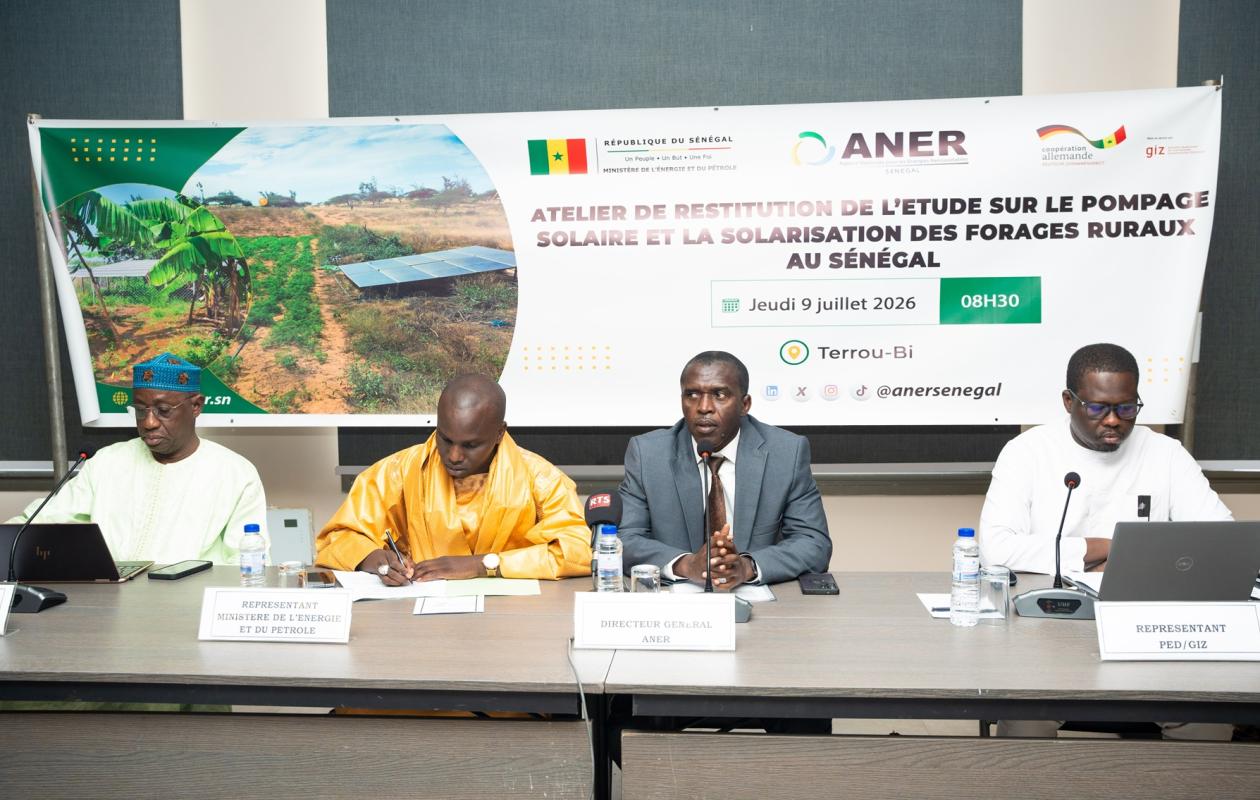
"With so much solar energy potential in Senegal, it is incomprehensible that we have energy problems producing low-cost water." This is what Professor Diouma Kobor, Director General of the National Agency for Renewable Energies (ANER), lamented.
He was speaking on the sidelines of the workshop to present the study relating to the technical standards and economic models of community solar pumping systems and the solarization of rural boreholes which ANER organized this Thursday in Dakar, as part of the implementation of its missions to promote renewable energies, with the financial support of the Sustainable Energy Program (PED/GIZ).
During this meeting, which constitutes an important step in the process of validating the recommendations from this study, the Director General of ANER revealed that in addition to this difficulty, his agency also noticed that, in agricultural irrigation, there is a major problem related to the cost of energy.
To change the situation, Diouma Kobor reports that since his arrival, ANER has taken initiatives. "That's why, when we came in 2024, we put in place a first project called 'Hybridization of the 2,000 rural boreholes of Senegal' because the Rural Borehole Office (OFOR) had informed us that there were approximately more than 2,000 boreholes in Senegal," he indicated.
For him, this study relating to the technical standards and economic models of community solar pumping systems and the solarization of rural boreholes has shown that today it is possible to reduce the energy bill by 60 to 70% through solar pumping, regardless of the type used.
Even better, she showed that even with the farmers managing these boreholes, the cost per cubic meter of water could be reduced to 20 CFA francs, whereas it is currently produced at 80 CFA francs, with a selling price of around 250 CFA francs. This means that with the use of solar energy, this cost can be drastically reduced.
According to the Director General of ANER, "this study has two aspects and several impacts. It not only allows farmers to be competitive, but also to reduce the environmental impact of generators."
On an institutional level, Professor Kobor argues that this technical framework provides a reference on which the State, regardless of the actor who wants to install their equipment, could base itself on the references of the sector concerned in order to comply with the norms and standards that ANER wants to apply today.
The meeting provided an opportunity to share key findings, gather feedback from stakeholders, and promote the adoption of the proposed technical frameworks and economic models for large-scale deployment. It brought together public administrators, technical and financial partners, funding institutions, professional organizations, local authorities, the private sector, universities, and producer organizations, among others.





















Commentaires (0)
Participer à la Discussion
Règles de la communauté
💡 Astuce : Utilisez des emojis depuis votre téléphone ou le module emoji ci-dessous. Cliquez sur GIF pour ajouter un GIF animé. Collez un lien X/Twitter, TikTok ou Instagram pour l'afficher automatiquement.
Se connecter
Commentez avec votre profil, votre photo, et soyez averti des réponses.