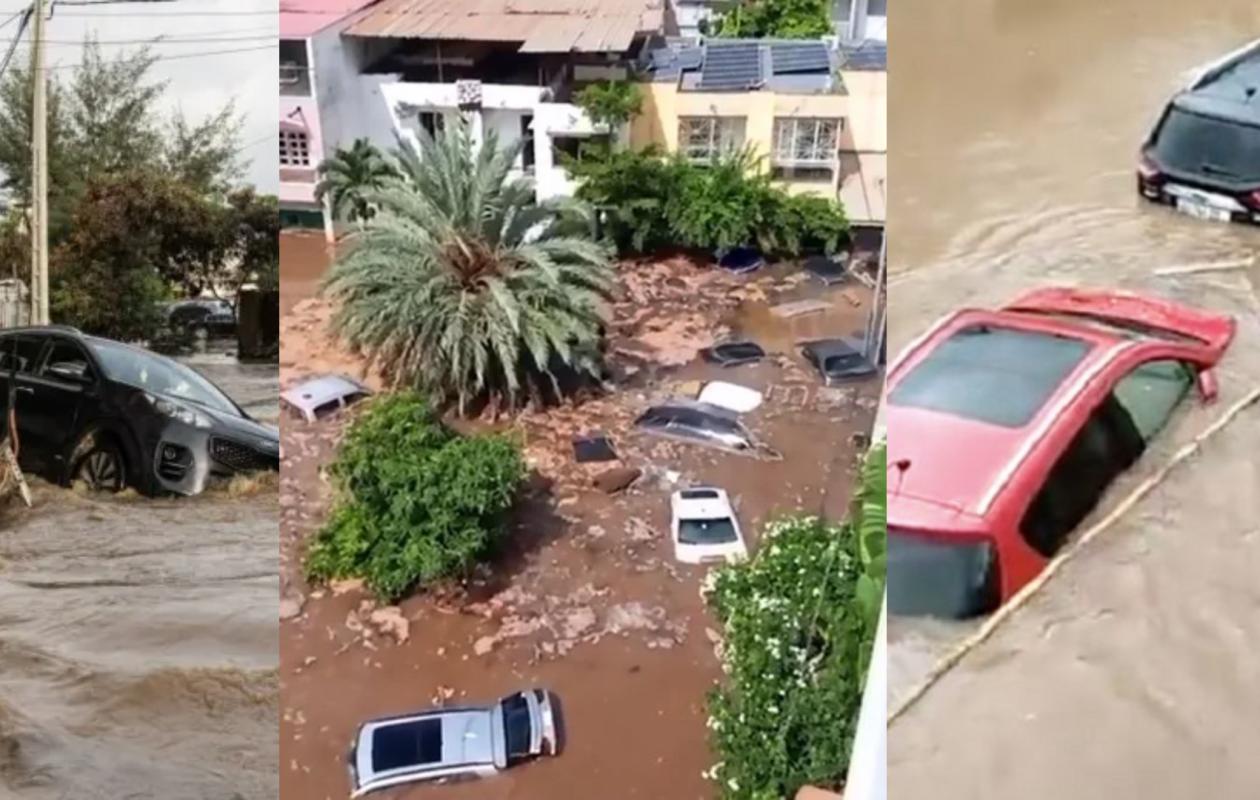
Après la pluie, la tempête financière : L’indemnisation, le second calvaire des automobilistes sinistrés
After the waters receded, the headache of compensation began. In Dakar, hundreds of motorists whose vehicles were submerged by the recent floods are discovering that their third-party insurance covers nothing.
"After the rain comes the sunshine," as the old French saying goes. In Dakar and its suburbs, when the rain stops, the nightmare is often just beginning. Neighborhoods are completely cut off from the rest of the world (Keur Massar, Cité Belle Vue, among others), vehicles are completely submerged by the floodwaters… Once the waters begin to recede, a bitter reality takes over from the material disaster: that of victims facing a legal and financial nightmare to obtain compensation for their losses. The material damage is estimated at hundreds of thousands, even millions of CFA francs. And among these victims, it is the motorists who bear the brunt of the bill.
Faced with the scene of devastation left behind by the storms, a nagging question arises: who pays the price? The water recedes, but the battle over paperwork begins. Between contracts that cover virtually no damage of this nature and the daunting procedures of insurance companies, the quest for fair compensation feels like a second ordeal that many affected motorists are unwilling to endure. Many prefer to shoulder the burden of repairing their flood-damaged vehicles themselves.
This is the case of Adji, a former insurance agent who invested her savings in a ride-hailing service. Last Sunday, October 4th, during a few hours of torrential rain, her taxi found itself in the wrong place at the wrong time. To avoid the floodwaters near the Patte d'Oie roundabout while transporting a passenger, her driver took refuge in a roadside gas station, waiting for the rain to stop. A miscalculation that the driver and his employer still regret. The vehicle was completely submerged, causing significant damage that the owner is trying to assess with her mechanic in order to repair at her own expense. When asked why she hasn't yet reported the incident to her insurer, Adji offers the most common refrain among Senegalese drivers: "It's a waste of time!"
The precariousness of insurance contracts in Senegal
Indeed, behind the distress of this ride-hailing driver lies a contractual trap into which the majority of motorists in Senegal fall. Having subscribed—either for budgetary reasons or due to an insufficient perception of the risk—to a mandatory third-party liability insurance policy that only covers damages caused to others, many don't even dare to initiate a compensation claim. It's a battle lost from the start, one that even someone familiar with the system like Adji (a former insurance broker) doesn't venture into.
She has already spent nearly 100,000 CFA francs repairing her vehicle, crossing her fingers and praying that the bill won't increase with the possible discovery of new problems. "Water got into the tank and mixed with the diesel. I changed the cartridge, the filter, and did some repairs on the electrical system. So far, I've spent 95,000 CFA francs. We're going to test it to see if the engine has been damaged. If it has, which we hope isn't the case, we'll have to buy a new engine," she explains.
“I didn’t report the incident to my insurer because my contract doesn’t cover this risk. The insurance policy I took out is a ‘recourse advance’ type policy with glass breakage coverage. I figured it would be a waste of time and money to start a compensation claim because my ride-hailing vehicle might be out of commission while the process runs,” explains Adji, who expresses her desire to take out comprehensive insurance in the future, but the only problem is that to qualify, you need a new vehicle or a used one that is no more than three years old.
Adji's story is not an isolated case. It merely confirms an open secret: the great illusion of car insurance coverage in the face of increasingly severe weather in Senegal and Dakar, which are clearly very vulnerable to exceptional rainfall. Other motorists, like Raphael Waly Senghor, have learned the hard way how inadequate their insurance policies are against the risk of flooding.
Mr. Senghor, Seneweb's technical director at the time, had parked his vehicle (a Chevrolet Equinox SUV) in the underground parking garage of the Atryum Center building on the Ouakam road, where the offices of West Africa's leading news website are located. After just over an hour (2:30 p.m. to 4:00 p.m.) of torrential and devastating rain, the water caused a section of the perimeter wall of the Lycée Français Jean Mermoz to collapse and flooded the building's parking lot with tremendous force. The damage was extensive. Several vehicles were damaged, including Raphaël's, which was left with a completely unusable engine.
“Since I started driving, I’ve never benefited from insurance. The only use for my insurance policy is to ensure I comply with traffic regulations. That’s it! That’s why, when my car flooded on August 5, 2022, I didn’t even bother contacting my insurer. I paid for the repairs myself, which cost over 300,000 CFA francs. A very professional mechanic managed to save the engine after it was flooded. Seneweb’s management decided to reimburse me since the incident occurred on our premises,” explains Raphaël, thus expressing the negative perception that the vast majority of Senegalese drivers have of insurance companies.
Misconceptions vs. reality: the true role of insurers
Faced with deep-rooted mistrust, the companies grouped around the Senegalese Federation of Insurance Companies acknowledge a critical lack of education. "Many people simply remember that they are 'insured,' without necessarily knowing precisely the extent of their policy's coverage. We, therefore, collectively—insurers and intermediaries—have a duty to educate and explain much more clearly what is covered, what is not, and what additional coverage options are available," the Federation told Seneweb.
This educational challenge that the Federation must address should allow policyholders to make an informed choice because, as Pape Ousmane Diop emphasizes on behalf of the Federation, "Third-party liability insurance and insurance covering damage to the vehicle do not meet the same protection needs." Referring to the recent claims caused by last week's heavy rains, Mr. Diop clarifies that the Federation does not yet have figures on the number of claims filed. These are currently being collected and processed by the various insurance companies.
But he is already making a distinction between the claims received, the number of claims actually covered, and those that will result in compensation. "These are three different concepts," he points out, effectively dashing some people's hopes. "For a vehicle damaged by flooding to be compensated, the contract must include coverage for this type of damage, according to the terms and conditions of the policy," he explains. Unlike the French system, where a ministerial decree declaring a "natural disaster" triggers compensation for victims, the CIMA Code (Inter-African Conference of Insurance Markets, which came into force in 1995), applicable in Senegal and 13 other African countries in the Franc Zone, only recognizes the coverage actually included in the contract and its associated terms and conditions.
Thus, many motorists, sometimes with luxury cars costing a fortune, risk having to bear the cost of repairing their flooded vehicles. "Market statistics clearly show the very significant weight of third-party liability in car insurance in Senegal. And it is indeed a matter of asset protection. When someone owns a vehicle worth 15 or 20 million CFA francs but only insures their liability towards third parties, they risk bearing the loss of their own vehicle themselves," emphasizes Papa Ousmane Diop, who is also the director of the corporate market and reinsurance at AXA Senegal.
The procedure to follow in Senegal
According to Mr. Diop, the first thing to do is: "absolutely do not attempt to restart a vehicle that has been submerged. This can worsen the mechanical and electrical damage. Next, secure the vehicle, take photos or videos to document the damage, and quickly report the incident to your insurer or intermediary."
For its part, the insurer will first: “verify the contract and the coverages purchased, then analyze the circumstances of the claim. When necessary, an expert is appointed to assess the damage and evaluate the cost of repairs. The expert will determine, in particular, whether the vehicle is repairable and, when the damage is very extensive, whether the vehicle should be considered a total loss or a financial loss, according to the applicable rules and the terms of the contract. The insurer then proceeds with compensation in accordance with the coverage, the insured value, any applicable limits and deductibles, as well as other contractual provisions.”
Faced with the evolving climate risk in Senegal, with its unprecedented storms, he acknowledges that insurance products must naturally evolve accordingly. "When a risk becomes more frequent, more predictable, and more costly, we must necessarily ask ourselves if traditional coverage mechanisms are still sufficient. We need to build economically sustainable mechanisms that make this protection accessible to the greatest number of people," he explains, attempting to restore trust between insurers and policyholders.








Commentaires (26)
l'assurance au Sénégal mérite un audit .
elle ne couvre rien en réalité Apart les contrôles routiers
Donc finalement, à quoi bon les assurances, juste un petit et de l'argent jetés en l'air quoi malgré notre volonté.
tés ...y a aucun frais a payer ou que ce soit pour changer son pare brise ne cas de garantie Bris de glace...et le client ignore le coût du remplacement à....400 000 fcfa...mmmddrrr
Cest a nettre dans le calcul de ton business VTC.
Encore une fois le senegalais est négligeant
Bon courage à tous les sinistrés.
Cette info devait clairement être relayée.
Maintenant du fait de l ampleur et de la récurrence des inondations les contrats auto doivent pouvoir évoluer
Cette info devait clairement être relayée.
Maintenant du fait de l ampleur et de la récurrence des inondations les contrats auto doivent pouvoir évoluer
Participer à la Discussion
Règles de la communauté
💡 Astuce : Utilisez des emojis depuis votre téléphone ou le module emoji ci-dessous. Cliquez sur GIF pour ajouter un GIF animé. Collez un lien X/Twitter, TikTok ou Instagram pour l'afficher automatiquement.
Se connecter
Commentez avec votre profil, votre photo, et soyez averti des réponses.