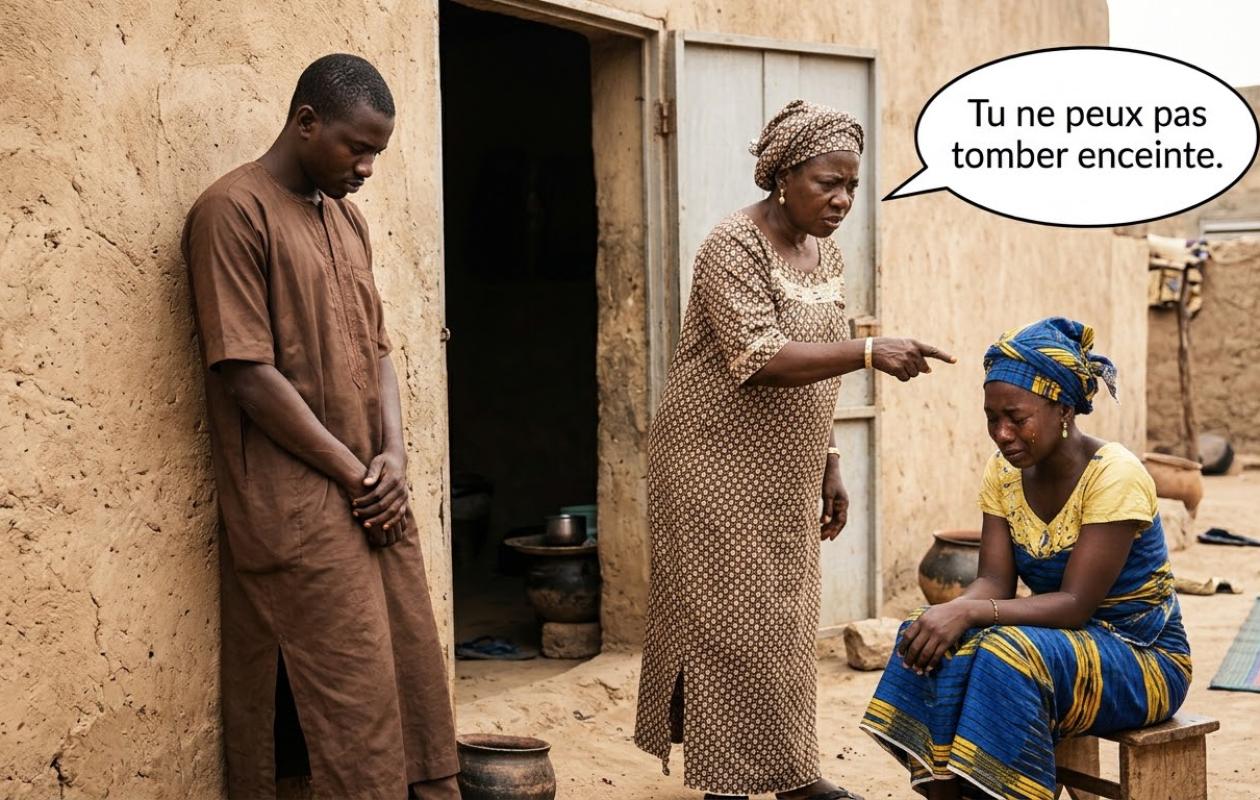
« Il savait qu'il était infertile, mais il laissait sa mère me traiter de... » : Chronique d'un tabou social (1/2)
The heavy taboo surrounding male infertility in Senegal shatters lives and unjustly condemns women to the stigma of family shame. Behind the systematic attribution of infertility to the wives' wombs, hidden tragedies are brought to light, revealing the medical reality of a shared affliction. Poignant investigations and testimonies, illuminated by the scientific perspective of an andrologist, address the wall of denial, the exorbitant cost of treatments, and the urgent need for a shift in attitudes.
In Senegal, infertility remains a taboo subject where women alone bear the burden of judgment and exclusion. Yet, the desire for a child concerns the couple, and infertility is not a woman's responsibility but a shared reality.
Behind closed doors, the inability to conceive destroys lives and shatters destinies. For many, fertility remains, wrongly, the sole measure of womanhood.
Ndèye Ndiaye is 42 years old and works in a grocery store. This brave woman still bears an indelible scar from her first four years of marriage.
“We got married full of hope, we were already choosing the names of our future children. Then the years went by without any positive tests. After four years, the hurtful words and insults from my in-laws started,” she confides.
Read also : "Control of flows or identity withdrawal: Is Senegal losing its Teranga?"
She ran from hospital to hospital and from marabouts, but the doctors were adamant: everything was fine with the lady.
“When they suggested I come with my husband, his behavior changed completely. He became aggressive, saying there was no doubt about his masculinity.”
Driven to the brink by repeated insults from her spouse and in-laws, Ndèye finally filed for divorce.
“I left and rebuilt my life. Three years later, I saw my very first positive pregnancy test… Today, I am the happy mother of three children. For his part, my ex-husband remarried two other women, and none of them were able to get pregnant after years of marriage,” reveals the woman in her forties who understood that it was her ex-husband who had fertility problems.
For Aïssata Diallo, a shopkeeper married at 19 to her cousin, denial was tinged with cruelty.
“Every two weeks, when my husband returned from his trip, I suffered from serious infections. The doctor put us on treatment, but he refused to take it. My mother-in-law, who was my own father’s sister, insulted me and called me a ‘stone belly,’ going so far as to force her son to marry a second wife,” she recounts painfully.
Three years later, the second wife still had no children. One evening, she overheard a conversation that would change everything.
“My husband confessed to his mother that traditional remedies had no effect on him. That’s when I realized they knew from the beginning that the problem stemmed from him, but they were leaving me to bear the shame alone.”
The courage to take responsibility
Faced with these injustices, some men are now choosing to break with the dictates of tradition to protect their homes. Mamadou Djigo embodies this growing awareness.
“During the first three years of our marriage, my wife was under constant pressure from my family. Seeing her suffering, I took the initiative to seek medical help on my own, without telling my family. The diagnosis came back: the problem was with me. I had a treatable condition. I was very ashamed at first, but I followed my treatment for a year and took responsibility in front of my family. Today, we are the parents of a little girl. Infertility is not something to be ashamed of and does not call into question our worth as men or our virility,” he reassures.
Read also: "'They like it…': When influencers sell their privacy to gain attention"
Insights from the expert
Faced with these social tragedies, medicine provides indisputable scientific facts to dismantle preconceived notions. Dr. Hassan Hakim, a urologist-andrologist specializing in male infertility and onco-urology, points out that it is now estimated that the man alone is responsible in 20% of infertility cases, and a female factor is involved in 40 to 50% of couples facing this difficulty.
“The medical causes of this male infertility are numerous. They range from varicocele, a dilation of the veins in the testicle that impairs sperm production, to poorly treated genital infections and STIs, as well as hormonal disorders, blockages of the sperm ducts, or a history of cryptorchidism and trauma. Added to these factors are elements related to lifestyle and the environment, such as smoking, excessive alcohol consumption, obesity, chronic stress, or occupational exposure to pesticides, solvents, and high temperatures,” explains the doctor.
The specialist emphasizes a fundamental nuance that is too often ignored.
“It is essential to distinguish between sexuality and fertility. A man can have a perfectly normal sexuality and still be infertile. Male infertility does not mean sexual impotence or loss of virility,” explains Dr. Hassan Hakim.
The trap of delayed diagnosis
Beyond the social taboo, self-medication and prolonged recourse to traditional care constitute a major obstacle to healing.
“Some patients use traditional preparations for months, even years, without ever having a spermogram or hormonal assessment,” the doctor laments.
He warns of the dangers of these practices.
“The main risk lies in delayed diagnosis, because during this time, the partner ages and the condition can worsen. Furthermore, the uncontrolled use of certain so-called stimulant products or exogenous testosterone can block the natural production of sperm and cause azoospermia.”
For couples facing this ordeal, accessing healthcare is often a real struggle. The lack of specialized facilities in the region forces many patients to travel hundreds of kilometers to Dakar for a simple blood test or to consult a specialist.
In addition to geographical distance, there is the financial barrier. While the initial diagnosis remains financially accessible, the cost of specialized treatments and Assisted Reproductive Technology (ART) techniques, such as in vitro fertilization or ICSI, can reach up to 3 million CFA francs per attempt, a price beyond the reach of the majority of Senegalese households.
To break this social and health deadlock, Dr. Hassan Hakim advocates a comprehensive reorganization of public health policies: increased national awareness to deconstruct the prejudice of female guilt, the decentralization of first-line examinations such as spermograms to regional hospitals, and better financial access to care.
Dr. Hassan Hakim's message to Senegalese men:
“Seeking help for difficulty conceiving is not a sign of weakness. On the contrary, it is a responsible step that helps preserve one's health, spares unnecessary suffering to one's partner, and significantly increases the couple's chances of realizing their parental dream.”





















Commentaires (3)
Participer à la Discussion
Règles de la communauté
💡 Astuce : Utilisez des emojis depuis votre téléphone ou le module emoji ci-dessous. Cliquez sur GIF pour ajouter un GIF animé. Collez un lien X/Twitter, TikTok ou Instagram pour l'afficher automatiquement.
Se connecter
Commentez avec votre profil, votre photo, et soyez averti des réponses.