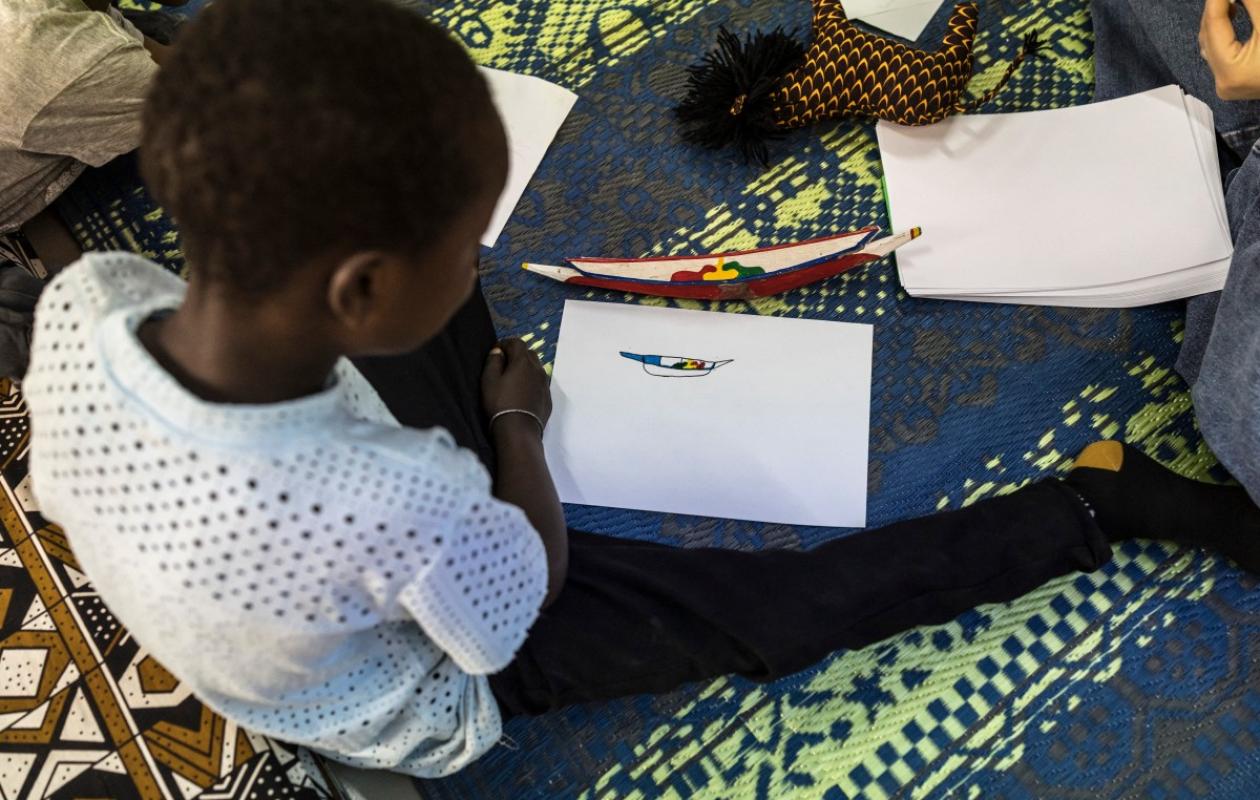
[ENQUÊTE (1/3)] "Nés, mais invisibles" : Ces enfants fantômes que l'État ne connaît pas
They breathe, grow, play, and dream. Yet, for the administration, they don't exist. In Senegal, thousands of children still live without birth certificates, deprived of this legal identity that is essential for accessing many rights. Behind this administrative invisibility lie multiple realities: poverty, remoteness from public services, lack of awareness of procedures, family conflicts, and even denial of paternity. For several weeks, Seneweb investigated in Dakar and Saint-Louis, meeting these "born but invisible" children, their families, and the organizations that support them in their quest for identity. This is an immersion into the heart of a phenomenon where each case tells a story far more than a simple formality: the story of a childhood waiting to be recognized.
This report is the first part of a three-part series of investigations devoted to the issue of civil registration in Senegal.
Her voice wavers as she speaks these words. In her arms, her nine-month-old baby stirs peacefully. He smiles, reaches out to his mother, and discovers the world like any other child his age.
Yet, in the eyes of the Senegalese administration, he still does not exist. No birth certificate. No legal identity. No administrative existence.
This young mother, who agreed to speak on condition of anonymity, struggled to hold back her tears. Religiously married to a Senegalese man living abroad, she separated from him before their union could be formalized with a civil ceremony. A few months later, she gave birth to a baby boy. Since their separation, the father has cut off all contact.
When she goes to the town hall to register her child, she discovers a reality she was unaware of: without a civil marriage and in the absence of the father, the process turns into a real obstacle course.
Today, her son is nine months old. At this age, he should already be able to enroll in daycare, benefit from his mother's health insurance, and receive care without each appointment becoming a source of financial anxiety. But none of this is possible. Administratively, this child doesn't exist.
“My son is nine months old today. He still doesn’t have a birth certificate. I can’t register him for daycare. He can’t benefit from my health insurance. When he’s sick, I pay for everything myself even though he should be entitled to this coverage,” she testifies.
Each medical appointment cruelly reminds her of the consequences of this lack of administrative recognition. Her gaze lowered, she continues: "My son exists for me, but not for the State. Today, he has practically no rights because he is not officially recognized."
More than just a lack of documentation, this administrative invisibility deprives children of access to healthcare, health insurance, basic public services, school exams and, later, formal employment or the right to vote.
“If I had known that civil marriage was essential to facilitate the registration of my child, I would have done it despite all the difficulties. Today, I ask the authorities to better inform families and to review this legislation. A mother should not be prevented from registering her own child when the father is absent,” she believes.
Her story is not an isolated case. While this infant has been deprived of official recognition for nine months, other children bear this burden for several years. In Saint-Louis, Coumba Diallo's journey illustrates how far the denial of paternity can delay a child's most fundamental right: the right to possess an identity.
Outside the Saint-Louis High Court, families arrive with the same cardboard folders, the same crumpled photocopies, and the same official documents. For many, this mobile court hearing represents the last hope of ending a long wait.
Among them, Coumba clutches a file she protects like a treasure. For seven years, she has fought to obtain a birth certificate for her son. Throughout all these years, the child has grown up without a legal identity, and each new school year reminded her of this damaging absence.
When her name is called, she stands up with a mixture of hope and exhaustion: "Today, I came to finally give my son an identity. He is seven years old and, until now, he cannot go to school because he did not have a birth certificate. His father always refused to acknowledge him and disappeared from our lives. I found myself alone facing all the procedures. Every time I wanted to register my child, I was asked for the father. Since he refused to take responsibility, all the doors closed in front of us," she confides.
Over the years, the applications and rejections piled up. Discouraged, she eventually gave up before resuming her fight as the start of the school year approached.
"I had no other choice. My son has to go to school like all the other children. So I came to register him in the name of my brother, in the name of my family, so that he can finally have an identity and start a normal life," she explains.
Her testimony highlights the distress of many mothers confronted with the denial of paternity. The absence of the father is not only an emotional or financial ordeal: it directly deprives the child of an administrative identity.
"I am asking the Ministry of Family Affairs, the Ministry of Women and the State to review this law. Some men are taking advantage of these provisions to abandon their responsibilities, while women and children pay the price. No child should be deprived of identity because his father simply refuses to acknowledge him. Laws must first and foremost protect the best interests of the child," she says.
In Senegal, Article 52 of the Family Code stipulates that the name of the father of a child born out of wedlock can only be entered on the birth certificate if he himself acknowledges paternity. Furthermore, Article 196 does not, in principle, allow for legal action to establish paternity when such acknowledgment is refused. In practice, these provisions place many mothers in an administrative deadlock and deprive their children of a legally established paternal lineage.
When the hearing ended, Coumba left relieved: "Today, I leave relieved. After seven years of anguish, my son will finally have papers. He will be able to go to school, exist in the eyes of the State and build his future. It's an immense weight off my shoulders."
Just a few meters from the courtroom, a little girl clutches a simple sheet of paper. For many, it's just a photocopy. For 12-year-old Ngoné Diop, this document could decide her entire life.
The young girl has just reached a significant milestone in her schooling: she obtained her Elementary School Leaving Certificate (CFEE). A source of pride for her and her family, although another challenge awaits her: finally obtaining a birth certificate. Without this crucial document, her admission to sixth grade is jeopardized.
In front of the Saint-Louis court, Ngoné displays a shy smile, unable to hide his anxiety:
"I obtained my CFEE, but I don't have a birth certificate. To register at school, they ask for this document. That's why I came with my parents to file a court order in order to finally obtain a birth certificate and be able to exist legally like my classmates."
At twelve years old, she doesn't talk about holidays or the start of the school year. She talks about an administrative document on which her entire future depends.
Ngoné's story is far from isolated. In Saint-Louis, Mr. Thiam, a school principal, sees this scenario repeated every year: bright and diligent students who find themselves held back by the absence of a birth certificate.
"We usually discover the problem at the time of registration. They take the CFEE, but once they have obtained the exam, the difficulties begin. Without a birth certificate, many struggle to register at college."
The teaching staff then direct families to mobile court hearings or the court. But for this teacher, the observation remains bitter:
"As a director, my heart breaks when I see a child penalized in their schooling simply because they were never registered at birth."
According to him, a local administration, particularly in rural areas, would prevent so many children from being left behind:
"Village chiefs or neighborhood delegates could play a more important role so that no child is left behind."
A few meters away, Mary Ka, a resident of Ndiawsir—a village a few kilometers from Saint-Louis—is also waiting her turn. Illiterate, she holds her ten-year-old son's hand tightly. The child watches the comings and goings in front of the courtroom, not understanding why he has to appear before a judge before even setting foot in a classroom.
Her mother, however, fully grasps the weight of those lost years:
"I came to make a judgment so that I could enroll my son in school next year. I don't know the administrative procedures. I've never been to school. It was a neighbor who explained the procedures to me and helped me prepare the file," she says.
Then she sums up her tragedy in a few words: "I have four children. None of them have a birth certificate. None of them have been able to go to school. Their father always says he doesn't have time to take the necessary steps."
Behind this testimony lie the consequences of a lack of understanding of procedures, precariousness, and resignation. For this mother, the absence of civil registration not only deprived one child of their right to education, but also relegated an entire family to the margins of the school system.
She continues, between bitterness and hope: "When I wanted to regularize their situation, they asked me for money. I didn't have the means."
Today, she refuses to let her youngest son suffer the same fate as his older brothers.
Through the stories of Ngoné and Mary Ka, and the observations made by Mr. Thiam, one reality becomes clear: for many Senegalese children, the first obstacle on the path to school is neither distance, nor the cost of supplies, nor the lack of teachers. It is the absence of a document that should have been issued to them in the first days of their lives.
In the waiting room of the Saint-Louis courthouse, children make up the majority. Accompanied by their parents, they hope to obtain the document they have lacked since birth.
Yet, among them is Aguibou Sow. At 23, his struggle is no longer about school registration. He has come to obtain the document that will finally allow him to apply for a national identity card. Without a birth certificate, this process remains impossible, and without an identity card, the doors to working life remain firmly closed to him.
For several years, professional opportunities have slipped through his fingers for the same reason. Sitting in the waiting room, he calmly recounts the repercussions of this administrative invisibility that has haunted him since birth:
"I missed out on several job opportunities because I didn't have my papers. I want to join the army, but I can't realize my dream because I have neither a birth certificate nor a national identity card. Without these papers, you don't exist. Today, I'm here to file a court order to finally obtain my birth certificate, be able to work, exercise my right to vote, and realize my dream of becoming a soldier."
At 23, Aguibou is not asking for financial assistance or privileges. He is simply asking for a legal identity: the right to work, to vote, and to build his future.
Her story serves as a reminder that failure to register a birth does not only penalize early childhood. It can haunt an individual for decades, hindering access to education, employment, public services, and the exercise of civic rights.
From the child deprived of care to the young adult prevented from working, all the trajectories encountered during this investigation illustrate the same reality: an entire life suspended on an administrative act that should have been issued in the first days of existence.
These trajectories are far from exceptional. They reflect a large-scale phenomenon, supported by official data.






















Commentaires (19)
Les mêmes personnes, si la femme tarde à tomber enceinte après le mariage, ils vont remuer terre et ciel et peuvent payer des millions pour enfanter. Une fois le baptême celebré, l’enfant est jeté comme un mouchoir usagé, plus personne ne s’en occupe. Je ne parviens toujours pas à comprendre ce paradoxe chez les sénégalais. Si on veut un enfant au moins d’être pressé que sa femme tombe enceinte, on devrait prendre grandement soins de cet enfant comme du diamant mais c’est tout à fait le contraire, on a l’impression que ce sont des enfants indésirables dès qu’ils finissent le baptême.
A quoi sert le certificat de naissance délivré par la structure sanitaire ou hospitalière
Si l'un des conjoints refuse le lien de parenté avec le bébé, celui-ci ou celle-ci doit être traduit devant la justice et soumis à un test d'ADN;
au courant de cette naissance d'un individu.
Participer à la Discussion
Règles de la communauté
💡 Astuce : Utilisez des emojis depuis votre téléphone ou le module emoji ci-dessous. Cliquez sur GIF pour ajouter un GIF animé. Collez un lien X/Twitter, TikTok ou Instagram pour l'afficher automatiquement.
Se connecter
Commentez avec votre profil, votre photo, et soyez averti des réponses.