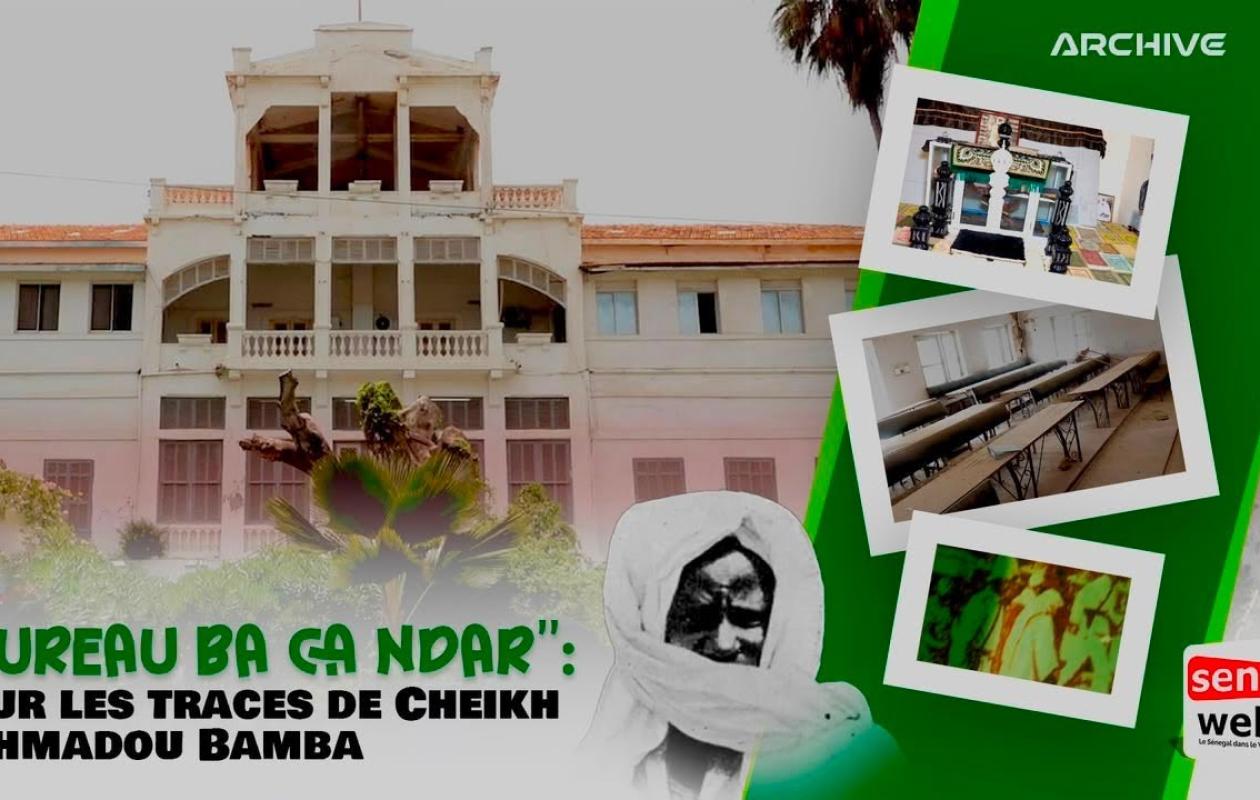
[Magal] "Bureau Ba ca Ndar" : Sur les traces de Cheikh Ahmadou Bamba
The exile of Sheikh Ahmadou Bamba Mbacké to Gabon, between September 1895 and November 1902, constitutes a foundational chapter of Mouridism and the Magal of Touba. A flagship event for the community, inscribed on Senegal's national intangible cultural heritage list since July 2025, the Magal commemorates the Sheikh's deportation, which took place on September 5, 1895, in Saint-Louis. Decided by the Privy Council of the colonial administration following a hasty audience at the Saint-Louis Governorate to extinguish Serigne Touba's moral influence, this seven-year, seven-month deportation, intended to isolate him, ultimately had the opposite effect, triggering his national and international renown. Through this exclusive immersion in the famous "Bureau ba ca Ndar," Seneweb takes you back to the atmosphere of that fateful day, September 5, 1895.
No sooner had we crossed (Tuesday, July 14, 2026) the legendary Faidherbe Bridge—a majestic metal structure completely renovated in 2011—than an old, imposing white building greeted us. This is the Governor's House of Saint-Louis. Once the nerve center of colonial administration in French West Africa (AOF), this architectural colossus alone tells the story of more than three centuries of French power and domination.
An old fort built in 1659, its advanced position on the island and its old cannons, still pointed towards the Senegal River as if to ward off a possible attack, recall the defensive structure and the vanguard role it once played.
Today, the reality is more fragile. Its thick, fortified walls, now faded and crumbling under the weight of age, barely resist the ravages of time and the onslaught of humidity. Its weary front balcony is now supported by only a simple wooden plank. Yet, it is within this now vulnerable palace that one of the most decisive chapters in the history of Senegal in general, and of Mouridism in particular, was written.
As part of the production of a series of reports in the lead-up to the 2026 Magal of Touba, Seneweb had the honor of visiting - for the first time for a media outlet - the famous "Bureau ba ca ndar", the courtroom where the colonial power thought it had sealed the fate of the guide of Mouridism, Cheikh Ahmadou Bamba.
As guardian of the site's memory, Mr. Mohamed Lamine Kane, head of the Saint-Louis regional archives, received us at the governor's residence with the permission of the Governor of the three-hundred-year-old city, for a unique exploration of the history of Serigne Touba, whose meteoric rise and fall are inextricably linked to this building. His deportation to the forests of Gabon—which will be commemorated for the 132nd time on Sunday—was decided here on the morning of September 5, 1895.
From slanderous accusations to arrest in Djéwol
According to Mr. Kane, who recounts the history, the animosity between Sheikh Ahmadou Bamba and the colonial administration stemmed from a negative prejudice fueled by numerous slanderous accusations. This occurred during a period when France had decided to no longer tolerate the slightest disobedience.
“By a decree of June 16, 1895 (less than two months before the arrest of Sheikh Ahmadou Bamba), France created French West Africa, which initially comprised four territories: Senegal, which had been French since 1816, Ivory Coast, French Guinea (Conakry), and Sudan (Mali). Later, four more territories were added: Togo, Dahomey (Benin), Upper Volta (Burkina Faso), and Mauritania. France, which had previously clashed with Sheikh Umar Tall, decided to no longer tolerate resistance. Many kingdoms had already fallen under its rule, the last being Cayor with the death of Lat Dior at Dékhelé in 1886. But one name kept coming up: that of Sheikh Ahmadou Bamba,” explains the archivist.
As Sheikh Ahmadou Bamba extended his spiritual influence throughout Cayor, Baol, and Walo, a disinformation campaign was waged against him. Worried about losing their prestige and authority, some collaborators with the French and local canton chiefs spread false rumors about his intentions. They accused the son of Qadi Mor Anta Saly Mbacké of wanting to wage a holy war, thus rekindling the colonial administration's deepest fears.
At that time, the Sheikh was staying in Guéwoul. The isolation of the place and the lack of direct information encouraged the spread of rumors, giving rise to a series of alarming reports.
“Sheikh Ahmadou Bamba was in Guéwoul at that time, and the lack of information fueled rumors. That's how the first reports surfaced. The intelligence services informed the colonial administration that Serigne Touba was preparing to do worse than Sheikh Oumar Futiyou Tall. Another report surfaced the day after Lat Dior's death, on October 27, 1886, stating that the most ardent lieutenants of the deceased Damel had just sworn allegiance to Ahmadou Bamba and that a confrontation was imminent,” Mr. Kane points out, adding that France did not give much credence to this information.
But the third report hit the mark. “It was written by the canton chiefs, Senegalese like us, who told the Governor, ‘If you want to consolidate your authority, you must deal with the Ahmadou Bamba case,’” recounts Mr. Kane. The colonial administration then took the threat seriously and dispatched the Commandant of the Saint-Louis district, LeClerc, and heavily armed troops to arrest Sheikh Ahmadou Bamba in Djewol. The Sheikh then decided to follow Leclerc without resistance on August 10, 1895, to avoid bloodshed. He was thus escorted to Louga, where he took the train on August 12, 1895, to Saint-Louis. There, he was held for about twenty days in the grim and tiny cell number 4 (see the video tour), which has since become a place of pilgrimage.
According to some popular accounts not verified by the archives, Serigne Touba endured several ordeals during his days of detention in Saint-Louis before his summary trial. It is said that at the Sor Botanical Garden (a 25-hectare site developed by the colonizers in 1865, where they cultivated vegetables, ornamental plants, and fruit trees), the holy man miraculously tamed a starving lion. "The colonial administration guards locked him up here in the botanical garden with a ferocious lion. As the Sheikh approached, the animal became as gentle as a lamb," recounts Mbacké Fall of the 2 Rakkas Committee in Saint-Louis, curator of the Mouride pilgrimage sites in the former capital.
"Bureau ba ca Ndar" (September 5, 1895): A trial based on intent
After these trials came the fateful day of September 5, 1895. The atmosphere under the vaulted ceilings of the old fort was electric that late summer morning (9 a.m.) in Saint-Louis. Inside the building, beneath the high ceilings of the first floor, the Privy Council of the colonial administration met in full force: Acting Governor Mouttet (chairman), Kersaint-Gilly (colonial commissioner), Boyer (senior commander of troops), Jurquet (director of the interior), Cnapelynck (attorney general), among others. For the French high-ranking officials, the man they had summoned represented a disturbing enigma.
Although no act of violence or armed rebellion could be attributed to him, the authorities sought by all means a legal pretext for this trial based on intent. The minutes of the Privy Council hearing explicitly acknowledge the weakness of the procedure: "While no clear act of preaching holy war could be found against Ahmadou Bamba, his attitude, his actions, especially those of his principal students, are suspicious in every respect."
In plain terms, Sheikh Ahmadou Bamba Mbacké did not take up arms or preach bloody revolt, but his rapidly spreading moral authority terrified the colonial power. His followers already numbered in the thousands. For the administration, it was time to strike a decisive blow and extinguish Serigne Touba's influence before it spiraled out of control.
In this office—in a state of advanced disrepair—which collective memory has decided to call "Bureau ba ca Ndar" (the Ndar office), he is accused, in veiled terms, of disturbing public order and harming French interests. Faced with the accusations echoing in the room, the Founder of Mouridism remains absolutely serene. "Within the Privy Council, there were two camps: one for severe punishment and the other for deportation. Ultimately, it was the latter sentence that was adopted by the Council," confides the Head of Archives of Saint-Louis.
The sentence was handed down: Sheikh Ahmadou Bamba would be taken to Dakar, where he left the port on September 21, 1895, aboard the steamship Ville-de-Pernambouco, bound for Gabon. The administration thought it had finally rid itself of a high-ranking religious authority who had become too much of a liability. For Sheikh Ahmadou Bamba, it was the beginning of a divine mission that would be crowned with resounding success.
Today, while the walls of governance crumble under the weight of centuries, the political and spiritual legacy born in the "Bureau ba ca Ndar" remains intact. Inscribed on Senegal's national intangible cultural heritage list since July 2025, the Grand Magal of Touba gathers millions of pilgrims from around the world each year.






















Commentaires (17)
Pourtant, il était entièrement nourris-logé durant sa détention en exil.
Les militaires ont aussi construit la mosquée de Touba de 1932 à 1963.
Ils lui interdisaient simplement les gros rassemblements pouvant mettre en péril le pouvoir colonial.
Tout le reste appartient aux contes et légendes.
Les militaires français ? Sénégalais?
J'ai des parents qui ont participé à la construction. C'est pas si lointain que ça.
Cesses de mentir et vas soigner ton cœur noir 🖤
Les militaires colons Français ont validé, organisé et conduit sa réalisation.
Pour le faire, les colons ont rallongé la ligne Dioubel-Touba (1930 à 1932) afin d'acheminer le matériel (ferraille, ciment, ...).
Les paysans mourides ont payé et ont servi de manœuvres sur le chantier.
Baayee niou ak souniou histoire farfelue.
Un lion affamé et laissé en divagation dans ce milieu clos c'est quand même assez improbable.
Si l'année de référence est 1895, 2026 ne peut pas correspondre au 132eme magal. La magal est célébré suivant l'année lunaire musulmane (18 Safar) qui fait environ 12 jours de moins que l'année solaire.
Si quelqu'un peut apporter des éclaircissements sans polémique il est le bienvenu.
?
Participer à la Discussion
Règles de la communauté
💡 Astuce : Utilisez des emojis depuis votre téléphone ou le module emoji ci-dessous. Cliquez sur GIF pour ajouter un GIF animé. Collez un lien X/Twitter, TikTok ou Instagram pour l'afficher automatiquement.
Se connecter
Commentez avec votre profil, votre photo, et soyez averti des réponses.