"Mon mari venait d'être enterré qu'on me demandait déjà..." : Course à l'héritage, quand la cupidité prend le dessus sur le deuil
In Senegal, the death of a family head often transforms mourning into a perpetual tug-of-war. Everyone tries to seize the deceased's property. Under pressure from tradition, the lack of official documents, or simply greed, widows and minor children are generally the biggest losers in this pitched battle.
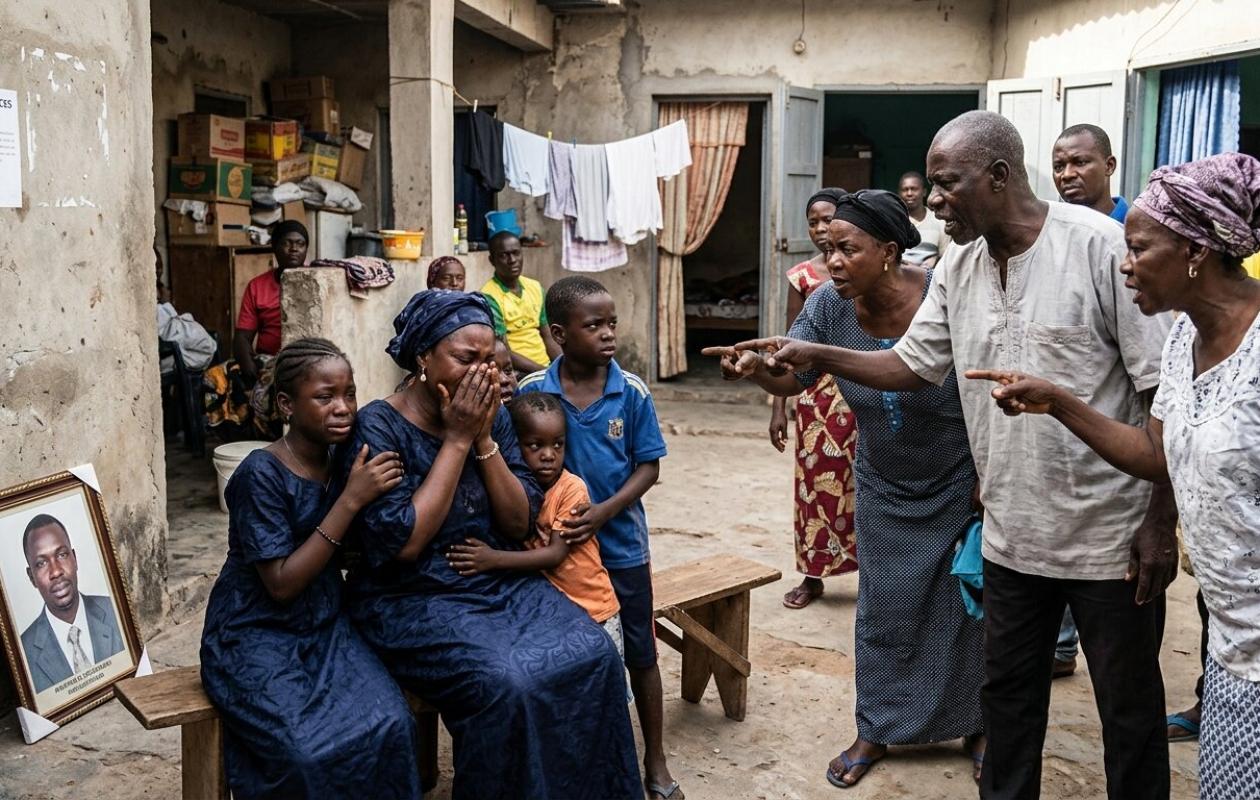
No sooner is the deceased's body buried than voices begin to rise. The mourning ceremonies are barely over, and already, in the living room, the unsettling questions are surfacing: Where are the house keys? Who took the savings accounts? Who gets the land? Who will keep the car? Within days, sadness gives way to greed and the division of the deceased's possessions. Brothers and sisters who grew up together become enemies. In-laws clash openly. And in these stories, widows and children are the victims of these fratricidal conflicts.
Astou Cissé, 42, tells her story. Just nine days after her husband's death, while she was observing her iddah (the four-month, ten-day waiting period required by Islam), her brothers-in-law came to ask her for the keys to the house. "My husband had barely been buried when his older brother was already asking me to count his money and leave the room," she says, tears welling in her eyes. "They told me that the house belonged to the blood relatives and that my two daughters and I were nothing but strangers."
To force her to leave, her in-laws cut off the water and changed the locks. Faced with the pressure, she preferred to give up everything to protect her children. "I was already in too much pain with my husband's death. I no longer had the strength to fight. I preferred to leave," Astou sighed.
While Astou threw in the towel early on in this battle imposed on her by her in-laws, Mariama Sow refused to give up. Aged 39, she was left with young children by her husband.
He died of a heart attack. He owned a beautiful house in Keur Massar and two small businesses. Very quickly, his brothers-in-law wanted to get their hands on the property titles in order to sell everything. "They came to my house one Sunday morning. They claimed that my husband owed them money and that the house had to be sold to pay off the family debts," recounts this shopkeeper.
Mariama quickly suspected manipulation. While he was alive, her husband had told her everything and had taken care to leave her the official documents. Despite the threats and insults from her in-laws, who called her a cursed and greedy woman, the widow did not give in. She refused to leave. "I double-locked the door and went to see a lawyer. They told me I would bring misfortune upon my children, but the real misfortune would have been leaving them homeless," she explains.
After more than two years of court proceedings, the judge ruled in her favor: the house was awarded to her children, and she retained control of it. Today, Mariama lives in the house with her family, even though her in-laws no longer speak to her. She's happy about this: "It's the best possible outcome. I prefer my children to grow up away from them," she says.
While widows suffer psychologically, minor children often face serious financial injustices. The risk of receiving nothing affects many families, both in cities and in the countryside. The excuse is always the same: a daughter will get married and "give the family property to a stranger," or a child who is too young "doesn't need property." To circumvent the law, some men in the family use every trick in the book: selling assets quickly before the division of the estate, concealing the children's existence on inheritance documents, or using the concept of " soutoura" (discretion) to make those claiming their share feel guilty.
Khadija Diop is a lawyer and international expert in strategic litigation. She explains that these cases are a daily occurrence in the courts. And it's always the same pattern: "These situations are very common. When a man dies, he leaves behind a wife and children, often young. The deceased's family often wants to take everything and forget about the children themselves."
She points out that Senegalese law recognizes two ways of dividing an inheritance. "There is classical law and Islamic law. In all cases, you must go to the courts, a judge or a notary, to make the division legally," the lawyer advises.
But there is a major problem with marriages contracted only at the mosque or according to custom, without a civil registration. "If the marriage has not been registered at the town hall, the widow has great difficulty defending herself in court. Yet, the law protects the married woman: if she has children, she is entitled to a share equal to that of a child. If there are no children but parents or brothers, she is entitled to half. If there is no one else, she takes everything," she explains.
In response to these abuses, Oustaz Omar Ba, a religious leader, reiterates what religion teaches. "The widow has a clear and unambiguous right to her husband's inheritance. No one can take it away from her," he repeats.
Mr. Ba strongly condemns the practice of expelling women from their homes, explaining that it is a grave sin and a bad custom. "A woman must spend her iddah (waiting period) in her husband's house, in peace and quiet. No one should make her leave before this time," he warns, recalling that it is those who are distant from the Muslim faith who commit such acts.
And as for orphans, that's a line that must not be crossed. "Whoever touches the property of orphans commits a grave sin before God. Even if he prays and fulfills the five pillars, his good deeds will be taken away from him on the Day of Judgment to pay for the harm he has done to defenseless people," he warns.
A Muslim does not have the right to make a will
Oustaz Ba warns against the practice of writing a will before death. He reminds us that, according to Islamic teachings, this practice is forbidden by the religion.
Between customs, greed, and the lack of official documents, widows and minor children remain the primary victims of inheritance disputes. While the legal system can offer refuge to these individuals, religion condemns their mistreatment and marginalization by their in-laws.






















Commentaires (34)
Bayil lénn yakar ni sen mak yi yenn lagnuy ligueyal! Tegouwoul fenn.
Respectez les règles de l'héritage sinon tribunal rek.
Vaut mieux aller en justice que de laisser ses enfants dépouiller par des opportunistes
Sinon, le testament est permis en Islam, mais bien encadré.
Félicitations pour l'article !
Des textes , oui c'est des textes, donc c'est humain, rien qu'humain ( tiens "homme", comme par hasard), conçus depuis des siècles dans un autre contexte social et culturel, qui s'entendent régler des problèmes et conflits d'aujourd'hui, c'est normal que ça coince...
Islam interdit le testament?
Cette religión est injuste et machista
Femmes et enfanrs sont moins considérés qu'une merde
Mon pays et sa religión me répugnent
4 femmes pour un homme?
Égalité ....4 hommes pour une femme
Heureusement qu'elles ont des amants et la plupart des maría son cocus
Chaque jours des choses qui te fend le cœur.
Merci de nous avoir proposé ce thème.
Très beau travail de journaliste.
Merci encore
Naniou delossi khel yi parce que adouna yagoul et tout un chacun rendra compte au seigneur de l’univers
Continuez de nous parler de notre société.
NB c'est le temps qu'on laisse a la veuve de vérifier si elle est enceinte de son mari ou pas , et l'intervalle a respecté avant d'avoir un autre mari sans conflit de paternité !!!
Ce que cette mère, je le confirme et dans cette histoire on oublie les personnes demeurant dans la diaspora sous prétexte qu’ils ne sont pas au pays. Cela amène des tiraillements parce qu’on donne le soin à d’autres de décider sans vraie discussion. La personne va préférer rester à l’extérieur et prier pour ses proches. Elle ne mettra plus les pays et ne pourra pas se recueillir sur sa tombe. Il y a un risque de tension quand elle mettra les pays. Le deuil se vit loin et seul Dieu est témoin. Les imams , nos guides religieux et même l’Etat doivent se pencher sur cette situation qui divise des familles
Il appartient dès lors à tout un chacun, peu importe son âge de rédiger son testament et de régulièrement le mettre à jour.
Un testament bien rédigé et transparent est la clé de la paix ; surtout que dans bien des cas, les biens ne sont qu'un prétexte avancé par les héritiers pour régler des comptes personnels qu'ils n'osaient pas régler du vivant du défunt.
Il faut mettre de l'ordre dans sa maison de son vivant pour éviter que le sommeil éternel ne soit perturbé par des disputes incessantes.
On a expulsé ses enfants mineurs sur recommandation de ces deux autres épouses.
je voudrai faire mon testament vu que j ai des biens
cependant je voudrai savoir s il y a des frais de succession à payer pour les héritiers comme en France
Participer à la Discussion
Règles de la communauté
💡 Astuce : Utilisez des emojis depuis votre téléphone ou le module emoji ci-dessous. Cliquez sur GIF pour ajouter un GIF animé. Collez un lien X/Twitter, TikTok ou Instagram pour l'afficher automatiquement.
Se connecter
Commentez avec votre profil, votre photo, et soyez averti des réponses.