Primes des Lions, étude économique [2/3] : une occasion en or loupée avec les hommes de Pape Thiaw
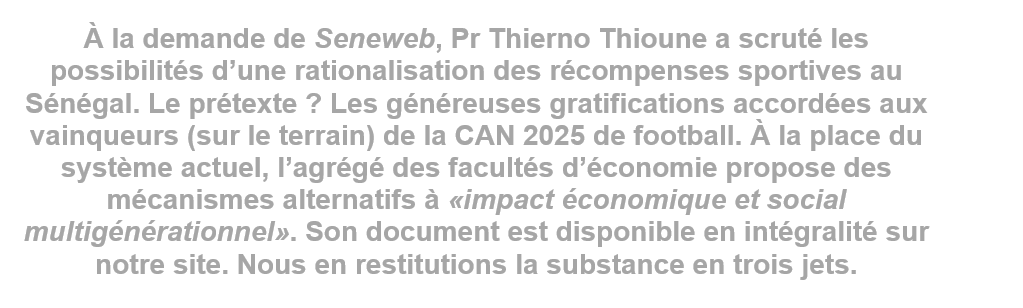
Pape Thiaw's men are shareholders in strategic public companies such as Petrosen, Sonatel or AIBD SA: in the second draft of the study he devoted to the bonuses of the Lions champions of Africa 2025, Professor Thierno Thioune sets out "the economic model which could underpin such an approach in the Senegalese context of sovereignty" .
“Shareholder-Ambassadors”
“Substantively, granting shares in strategic public companies to African champions would, in my view, be an extremely relevant innovation that deserves thorough and rigorous economic analysis. The theoretical advantages of this model are both numerous and diverse. First, it would create a genuine class of shareholder-ambassadors of a new kind. The champions would become effective co-owners of the national economy, thus creating a natural alignment of interests between the sporting success they embody and the economic performance of the country they represent. This transformation of intangible capital, constituted by sporting glory and international renown, into productive and sustainable financial capital represents a major innovation in the way we conceive of sporting rewards in the 21st century.”
“The valuation model I propose is based on proven economic mechanisms adapted to current realities. Take, for example, PETROSEN, Orange Senegal, or AIBD SA, strategic public companies in the Senegalese state portfolio whose financial performance in 2024-2025 was particularly robust. Allocating 0.1% of the capital of different strategic companies to each player would represent an initial valuation of 120 million CFA francs, an amount comparable to double the current premium. But the fundamental difference lies in the temporal and productive dimension of this reward. With an estimated annual return of 12% in dividends based on the 2022-2025 performance of these companies, each champion would receive approximately 10 million CFA francs per year, year after year.” Over a 30-year period, roughly corresponding to the post-career life expectancy of a high-level athlete retiring in 2026, the cumulative income would reach nearly 300 million CFA francs in nominal value, or four times the current one-time bonus of 75 million. Even when discounting these future cash flows at the average Senegalese inflation rate of 2022-2025, which is approximately 4% annually, the net present value remains substantially higher than the one-time bonus.
"THE COMPANY OF CHAMPIONS"
“The multiple positive externalities of this system extend far beyond simply rewarding champions. From a corporate governance perspective, the presence of public figures with recognized integrity and international renown as shareholders would send a strong signal to markets and potential investors in the context of Senegal’s economic recovery and revitalization in 2026. In terms of institutional marketing, the concept of a ‘champions’ company would become a powerful marketing tool, both domestically and in the conquest of regional ECOWAS markets. The company could legitimately claim to be supported by national heroes, thus creating an emotional connection with consumers that transcends a simple commercial relationship. Finally, this approach would send an extremely strong signal of capital democratization and the sharing of national wealth in a context where inequalities have increased between 2020 and 2025, demonstrating that excellence, in whatever form it takes, opens the doors to economic ownership.”
“The creation of a dedicated sovereign wealth fund for sports, which could be called the ‘Senegal Champions Fund’, would be the ideal vehicle for managing this collective heritage. This fund would be endowed with 5 to 10% of the capital of five carefully selected strategic public companies chosen from among those that have demonstrated solid performance.”
THREE INSTITUTIONAL PILLARS
“The institutional architecture I recommend to operationalize this vision rests on three complementary pillars adapted to the Senegalese legal and institutional framework. First, the creation of a dedicated sovereign sports fund, which could be called the 'Senegal Champions Fund', This would constitute the ideal vehicle for managing this collective wealth. The fund would hold 5 to 10% of the capital of five carefully selected strategic public companies with a proven track record of solid performance. The winning companies would then receive units in this fund rather than direct shares in the companies, thus avoiding the fragmentation of ownership and the risks associated with potentially erratic individual management. Technical management would be handled by the Caisse des Dépôts et Consignations (CDC), an institution that will strengthen its expertise and credibility to guarantee prudent and effective management in compliance with WAEMU standards. Secondly, robust protection mechanisms must be integrated from the outset to ensure the long-term viability of the scheme. The shares would be subject to a 10-year lock-up period, guaranteeing the territorial and asset-based stability of the winning companies while protecting them against the temptation of hasty liquidation that could result from poor advice or various forms of pressure in the years following their victory. Dividends would be paid annually, ensuring a regular and predictable income stream. Finally, the possibility of hereditary transfer would be explicitly provided for in the fund's statutes, allowing champions to bequeath this legacy to their descendants and thus creating a multigenerational impact that would span decades. Third, clearly defined behavioral conditions would govern the allocation and maintenance of these benefits over time. Maintaining sporting and moral integrity would be a prerequisite , with revocation mechanisms in case of serious misconduct, particularly relevant in the context of the fight against doping and sports corruption. A minimum involvement in grassroots football development programs would be required, amounting to at least 20 hours per year, thus ensuring that champions remain connected to the realities of national sport and actively contribute to the emergence of new generations for future Africa Cup of Nations tournaments. Finally, a role as international economic ambassadors would be formalized, leveraging the champions' renown to promote Senegal's economy.
NEW ZEALAND, NORWAY, SINGAPORE…
“There is no shortage of inspiring international examples that demonstrate the viability of such approaches in the current context. In New Zealand, the famous All Blacks, the national rugby team, have held shares in certain provincial franchises since the 2000s, generating a sustainable economic model that has proven successful over more than two decades. Norway, in the field of winter sports, created an Olympic fund with shares in the oil company Equinor, the proceeds of which are redistributed to medalists, thus ensuring their long-term financial security. In 2018, Singapore developed a program called the ‘Champions Fund’ that awards government bonds indexed to national economic growth to elite athletes, thereby creating an explicit link between athletic performance and national economic performance. The financial impact estimate I propose is based on conservative and verifiable assumptions grounded in actual economic performance.” On an initial portfolio of 100 million CFA francs invested in shares of high-performing public companies, with a 10-year horizon extending to 2036 and assuming average annual growth of 8% in line with current trends, the potential valuation would reach 200 million CFA francs. Over a 30-year horizon extending to 2056, more relevant for assessing the impact on the entire post-career life of an athlete retiring in 2026, the valuation could reach 800 million CFA francs, including the capitalization of reinvested dividends. When this result is compared with a single premium of 75 million CFA francs discounted over 30 years, at an average inflation rate of 4%, the societal return on shareholder investment is 50 times greater. This quantitative demonstration scientifically illustrates the economic superiority of an approach based on the creation of productive wealth compared to a single cash distribution. (To be continued)
PR THIERNO THIOUNE
A graduate of the French university system, he was a tenured lecturer with CAMES ( African and Malagasy Council for Higher Education ) and earned a doctorate in Economics. The Council for the Development of Social Science Research in Africa (CODESRIA) also awarded his doctoral research as part of its doctoral grant program. Professor Thioune recently completed a postdoctoral research fellowship at Sciences Po Paris. He served as Director of the Center for Applied Economic Research (CREA) from 2022 to 2024, after having been Director of Studies at the Center for Research and Training for Economic and Social Development (CREFDES) from 2017 to 2021. He teaches at several public and private higher education institutions, including the Institute for Public Procurement Regulation (IRCOP) , the National School of Statistics and Economic Analysis (ENSAE), and the School of Law at BEM School of Management. His research areas encompass the economics of public policy, network economics, industrial economics, energy economics, natural resource economics, and institutional economics.
READ OR RE-READ Lions bonuses, economic study (1/3): what the rewards paid by Diomaye Faye reveal
Find the full study by Professor Thierno Thioune on models for valuing sports awards.