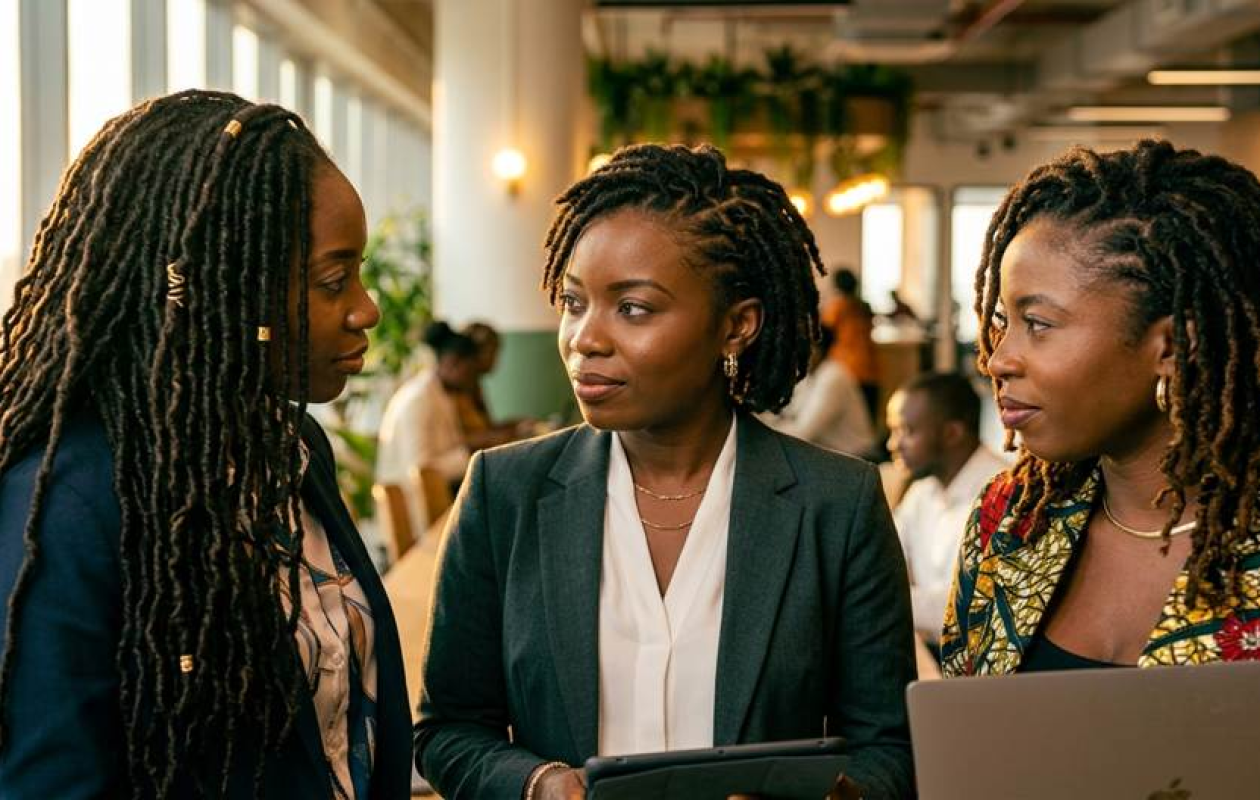
SPLENDEUR, PRÉJUGÉS, ASSUMATION DE SON IDENTITE : COMMENT LES LOCKS ONT CONQUIS L’ELITE FEMININE AU SENEGAL
In Senegal, wearing dreadlocks has long been a source of discord and harsh judgment. For years, society associated this hairstyle with delinquency, promiscuity, or drug use. Today, these prejudices are crumbling. From the highest levels of government to the business world, and including the media and the arts, Senegalese women have transformed this ancestral hairstyle into a symbol of beauty, freedom, and professional success.
The shift in perception accelerated when influential figures began proudly displaying their dreadlocks in the upper echelons of society. Former First Lady Marième Faye Sall recently made headlines by sporting her dreadlocks during her last visit to Senegal.
In the same vein, Fatou Kiné Diakhaté, now Deputy Chief of Staff to President Bassirou Diomaye Faye, embodies this new image. Alongside her, female directors, business leaders, journalists, doctors, and others demonstrate daily that one can wear dreadlocks and hold very high-level positions. Hairstyle is no longer a barrier; it has become a mark of elegance, seriousness, and confidence.
Behind every head of dreadlocks, there is a personal story made up of strong choices, financial compromises, and a quest for freedom.
For Aïcha Ndour, 33, a musician, her love of dreadlocks dates back to her childhood. At 21, her intense spiritual life prevented her from dedicating time to braiding them. "I would cut my hair so I wouldn't have to braid it. Besides, every encounter with someone with dreadlocks awakened a deep emotion in me," she says with a smile.
In 2022, she decided to take the plunge. Faced with the high prices of salons, she chose to be independent. "I didn't have 50,000 CFA francs to get dreadlocks, so I watched YouTube tutorials. Later, I decided to try it on my own hair and it worked, to my great surprise," she rejoiced.
Since then, her hairstyle has evolved in rhythm with her emotions. "Sometimes I like to put my dreadlocks up and tie them back to experience my innocence and gentleness. But other times I let them flow freely, so as not to dilute either my authenticity or my freedom."
For her, dreadlocks are an intimate and spiritual affirmation. "I have a wild beauty that I've always struggled to accept. These dreadlocks are part of my process of self-affirmation." Her friends and family have welcomed her choice, but she insists: no one can dictate her decisions. "Talk to your heart, reconnect with yourself, and be ready to live unfiltered," the artist concludes.
Zeynab Fall had dreamed of having dreadlocks since childhood, but her mother was firmly opposed. When she finally took the plunge, family tensions erupted. Her father had to intervene to calm the situation.
Today, she savors her victory. "I no longer get up in the morning to put on wigs; I save time and money."
Her routine is simple. "I do treatments every two weeks, without any constraints. With my locks, I feel beautiful and natural," she said with a smile.
After a while, she even received compliments from her mother, who thought her hairstyle was beautiful. For this journalist, no woman should leave her happiness in someone else's hands. "Go for it! Don't let anyone decide for you."
This transformation also relies on passionate professionals. Fatou Mbow founded Falewa Locks in 2022. She is a legal consultant specializing in intellectual property, a podcaster (LockStories by Falewa), and a personal development coach for her clients. Today, Fatou embodies this new generation that has embraced dreadlocks.
Fatou Mbow
His career has been built at the crossroads of law, humanity and culture, with a common thread: to contribute to strengthening self-confidence, the affirmation of identity and the ability of each person to fully take their place.
Based in Bordeaux but deeply attached to her Senegalese roots, she is committed to promoting African talent and cultural expression. "The question of hair identity holds a special place in my approach. I see hair as an element of self-reappropriation, acceptance, and cultural pride," explains Fatou. Her story with dreadlocks goes back to her childhood. "As a child, under the village meeting tree in Keur Madiabel, I spent a lot of time observing and wanting to learn." Later, in France, she styled her friends' hair in her university room. But it was in the United States that she perfected her technique in her cousin's salon. "It was there that I began to consider dreadlocks as a full-fledged profession. The training I received from a Kenyan friend was decisive. This knowledge transfer was a real turning point."
“Falewa Locks is the culmination of a passion that has been with me since childhood and that I have chosen, over time, to turn into a profession,” she confides.
Regarding techniques, she elaborates: “There are several ways to create dreadlocks: twists, crochet, braids, coils, microlocks… Each method has its own specific characteristics. For my part, I've developed my own approach: the Falewa method.” She emphasizes the importance of the initial consultation: “I first try to understand the client's request, her hair history, the nature and condition of her hair, her maintenance habits, but also what she envisions as the result,” she explains.
Demand, according to Fatou, has exploded. “Today, the landscape has completely changed. I notice many more people wearing dreadlocks. Demand is coming to me more often, and sometimes supply is still lower than demand.” Social media has played a role, but she sees it primarily as “a shift in perspective on beauty. Women are looking for more authenticity, freedom, and consistency with who they are.” Her clientele is diverse. It consists mostly of students, executives, lawyers, doctors, businesswomen, and so on. “Dreadlocks are not incompatible with professional excellence, leadership, or responsibilities.” Hence her nickname, “the dreadlock expert for leaders.”
Fatou deconstructs the myths. "Sometimes we imagine that a person who wears dreadlocks necessarily belongs to a certain milieu or that they are neglected. However, dreadlocks require care, maintenance and real attention," she says.
Regarding maintenance, she emphasizes: "The key is consistency: keep the scalp clean, moisturize, protect your locks while sleeping, and avoid overly oily products."
Her biggest challenge remains the clients' patience. "At the beginning, the dreadlocks are still developing and don't always look like what you imagined. Dreadlocks are like a plant; you can't pull on them to make them grow faster." Finally, she sees the future of the profession in professionalization: "Installing dreadlocks isn't simply about creating a hairstyle. You have to understand hair, master different techniques, and know how to advise and guide clients. I would like this profession to be more widely recognized as a true expert profession," the professional concludes.
Moussa Dreadlocks: Ego boosted at the celebrity salon
Moussa Dreadlocks
Based in Guédiawaye, more precisely at the Bou Bess market, Moussa Dreadlocks embodies this new generation of passionate hairdressers who are shaking things up in the Dakar suburbs. Today, Moussa is sought after by numerous celebrities and social media personalities. The young man started his career in 2019 as a purely personal challenge.
From childhood, inspired by his uncles with dreadlocks whom he accompanied to the barber, he nurtured a great passion for this art. But the turning point came from a twist of fate: in his neighborhood, only one barber mastered the technique. “I had to chase him for ages to get him to do my little brother’s dreadlocks, and he always made us wait. Finally, I asked him to show me the method. He told me I couldn’t do it. He hurt my ego. I did my own research, tried it on my little brother, and it worked! Then his friend asked me the same thing, and the requests multiplied until I made it my profession.”
Today, Moussa is campaigning to introduce Senegalese people to the full diversity of dreadlocks: “In Senegal, many people only know about sister locks or microlocks, which take 6 to 8 hours to do. However, there are many other styles: classic dreadlocks, freeform, regular, flat wicks, freeform wicks, bongo wicks, semi-freeform, or one dread. I advise each client according to their hair type.”
In his salon in Guédiawaye, Moussa is a direct witness to this growing female enthusiasm: "In recent years, there has been a considerable increase in the number of women opting for dreadlocks. They are increasingly abandoning wigs. Women are embracing their African identity, and that makes me very proud."
To maintain perfectly healthy hair, Moussa reminds us of a few golden rules accessible to everyone:
Tightening every 2 months.
Shampoo every 15 days.
The use of suitable oils to provide strong hydration.
Wearing a satin bonnet when going to bed to protect the hair and avoid dust.
While dreadlocks were once worn by only a small number of Senegalese, today they've become a trend. Celebrities, prominent figures, and even ordinary Senegalese are adopting them. This suggests that dreadlocks have a bright future.


















Commentaires (32)
et pourquoi le voile?
le voile islamique... lol
Comment peut-on parler de locks sans faire référence à Bob Marley qui contribuera grandement à sa vulgarisation à travers le monde.
Rendons à César ce qui appartient à César.
SAWS lui même n'avait-il pas de dreadlocks?
L'envahisseur poir faire distinguer ses esclaves des gens lobres leur faise tondre les cheveux en plus du marquage ai fer....
Participer à la Discussion
Règles de la communauté
💡 Astuce : Utilisez des emojis depuis votre téléphone ou le module emoji ci-dessous. Cliquez sur GIF pour ajouter un GIF animé. Collez un lien X/Twitter, TikTok ou Instagram pour l'afficher automatiquement.
Se connecter
Commentez avec votre profil, votre photo, et soyez averti des réponses.