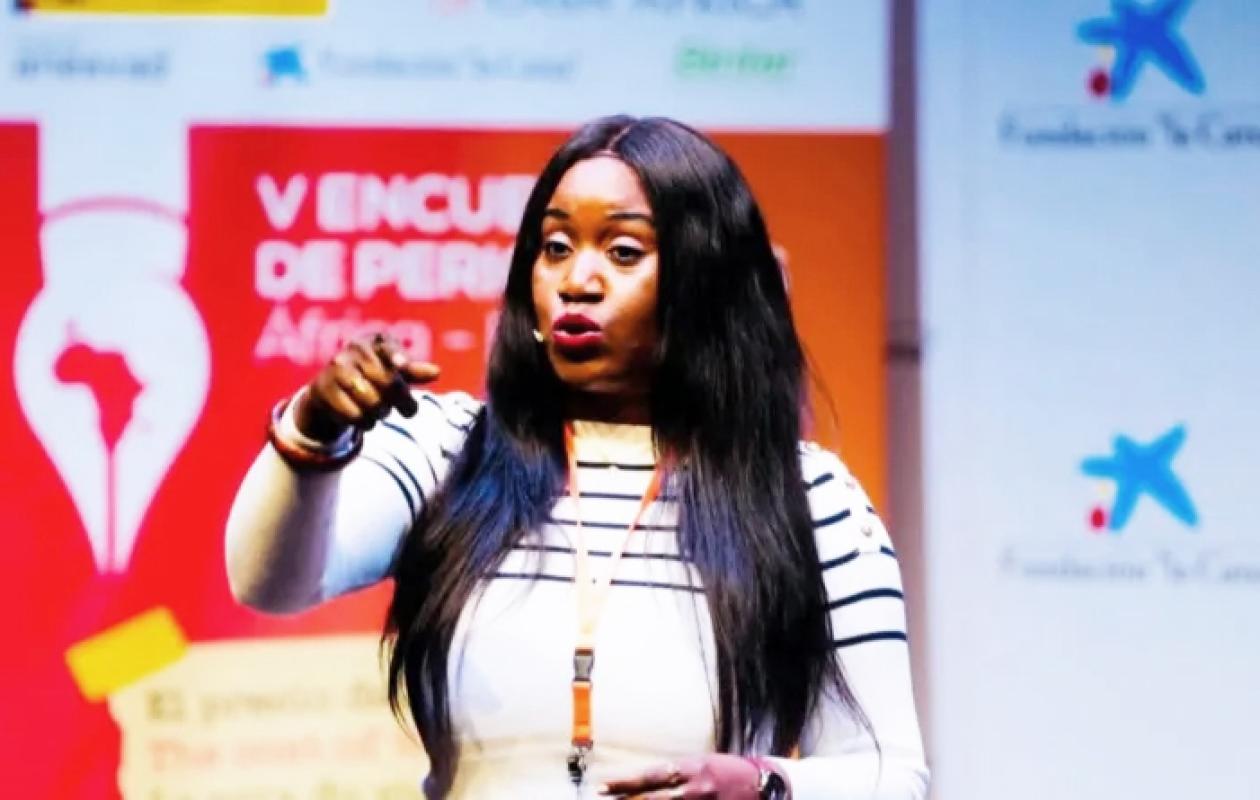
Marie Louise N’Diaye, Journaliste sénégalaise, spécialiste des questions judiciaires et migratoires : « La migration irrégulière n’est que douleur »
After thirteen years spent at the heart of Senegalese newsrooms, between courts, major legal cases, and television studios, Marie Louise N'Diaye made a radical change. In 2023, she left a well-established career at the Futurs Médias Group to closely follow the routes of irregular migration between Africa and Europe. From the Senegalese coast to the Canary Islands, from squats in France to the testimonies of families without news of their loved ones, she documents a reality often reduced to statistics.
Through her project "On the Trail of the Migrant," her international investigations, and her public statements, she is committed to putting the human element back at the heart of the migration narrative and raising awareness of the silent tragedies that afflict African youth. Interview!
Can you introduce yourself and tell us briefly about your background in journalism?
I am Marie Louise N'Diaye, a Senegalese journalist specializing in legal and migration issues.
Having worked here for sixteen years, I completed my first internship at the daily newspaper L'Observateur, part of the Futurs Médias Group, during my second year of studies. After this three-month internship in 2010, I joined the online news site Netali with Mamadou Wane, the current head of the newspaper Enquête, where I spent six months before resigning to join the fledgling team of journalist and writer Ibou Fall's satirical newspaper. After three months with them, I returned to the Futurs Médias Group (GFM), owned by singer Youssou Ndour, where I spent thirteen years.
Passionate about fieldwork and in-depth reporting, I was seconded to the Society Desk as a court reporter. I couldn't bear to be confined to the courtrooms. From Monday to Friday, I covered hearings in the lower courts and assize courts, where criminals and murderers paraded before the judge, and on weekends, I covered celebrity nights out for the Monday edition. I did this for years, while also conducting major investigations. Being in the field is what I love most, and I always found ways to cover topics beyond simple court reports. I combined court appearances, investigations and reports both within the country and abroad, as well as in-depth interviews.
During this time at the court, I covered the biggest trials of the time: that of Karim Meissa Wade, son of the former president of Senegal; of Khalifa Ababacar Sall, former mayor of Dakar; of Hissène Habré, former president of Chad; as well as the case of Imam Ndao and associates, accused of terrorism.
In addition to the daily newspaper L'Obs, I co-hosted the Xalass news program on RFM for three years with my colleague Mamadou Mohamed N'Diaye, then for eight years programs on TFM, Dclique, Quartier Général, Libidor.
I left this media group, which taught me almost everything, in October 2023 to embark on a journey to follow the migrant trail. The first part of the project was the documentary film "On the Trail of the Migrant," the first draft of which was produced in collaboration with the Seneweb group in May 2024. A year later, the "On the Trail of the Migrant" platforms followed, as well as a collaboration with the Investigation Desk of the German newspaper Die Welt for investigations conducted in Senegal, Mauritania, Spain, and France.
For the past two and a half years, I have been following in the footsteps of migrants to raise awareness and show the true face of emigration to young Africans tempted to take the pirogue, and to bring the African narrative to Spain through conferences at Casa África, at the Agüimes and Periplo festivals in Tenerife, at the University of Ceuta, at the annual meeting of journalists dealing with the migration issue in Mérida, and at the biennial meeting of Africa-Spain journalists.
Was there a decisive moment or event that shaped your involvement in this field?
Migration was not unfamiliar territory for me. In 2014, I conducted investigations and reports in the camps in Rome where migrants live, as well as on the island of Lampedusa, the gateway to the central Mediterranean route. So, if I embarked on this project ten years later, it was with a certain amount of experience. But a series of events motivated my decision.
At one point in my career, I felt like I was stuck in a rut. I felt like I'd exhausted my field, and everything I produced was repetitive. Worse, I was no longer going out into the field. I found myself mostly confined to the office, editing articles.
“A close friend, a prominent lawyer, was involved in almost all the important cases, so I could no longer handle major cases. I was reduced to proofreading other people’s work. I was unlearning everything. One day, my editor-in-chief, Saliou Gackou, who knew how much I valued fieldwork, asked me to cover the International Day of Missing Migrants. There, I met wives who hadn’t heard from their husbands in sixteen years, mothers who had lost all trace of their children eight or ten years ago, and brothers and sisters who didn’t know if their loved ones were dead or alive.”
These stories deeply moved me, and they moved the readers too.
Later, I wanted to delve deeper into the subject with a psychologist. Serigne Mor Mbaye put me in touch with his nephew, Mame Cheikh Mbaye, then president of the African Federation of the Canary Islands, who explained the migration situation in the archipelago: the lives of young people, the influx of Senegalese, the deaths and disappearances, and the frequency of boats arriving from Senegal. This was during the period when the current Prime Minister of Senegal was arrested in connection with his confrontation with President Macky Sall. Many young people were dying on the migration routes or disappearing amid general indifference in Senegal.
Around the same time, my best friend's brother wanted to take the pirogue. She called me in tears: "If you don't stop him, he'll die." I threatened to report their pirogue and their point of departure. In the end, the young man didn't leave. All of this triggered something in me: the realization that young Senegalese people were dying at sea, taking such risks, and no one was talking about it.
I initially submitted a request for a two-year leave of absence, but my group refused. I then resigned the same day without thinking.
Suitcases in hand, I arrived in Las Palmas. From the airport, I went straight to the Casa África conference room for a series of events dedicated to migrant children. What I heard there—the suffering of these minors who, after their crossing, are afflicted with various illnesses and pathologies—reinforced my decision. I had absolutely no regrets. It was essential to raise awareness about the dangers of this route and, through my work and my network, to influence the decisions of the authorities. My goal was for migration to be discussed not only in the context of tragedies, but to be placed at the heart of discussions among leaders.
What is the migration situation in Senegal?
Currently, many pirogues are finding it difficult to leave the Senegalese coast. Since signing agreements with the European Union, Senegal and Mauritania have managed to further secure their borders, and it is rare to see pirogues set sail without being intercepted. But as I said in an interview with the Spanish newspaper La Provincia: securing borders is pointless if those of Gambia or Guinea are not also secured. The traffickers are simply shifting their departure points.
As a result, the routes are longer and the risk of loss of life is higher. Yes, in Senegal, the pirogues no longer leave as often, but that doesn't mean that the pirogues departing from Gambia don't carry Senegalese people on board.
What is the percentage of migrant women leaving Senegal?
In recent years, we have seen an increasing number of the most vulnerable groups, women and children, using these dangerous routes, and this is also true for Senegal. I cannot give an exact departure rate, as the number of people taking to the sea cannot be precisely determined. This is why figures are always problematic in Africa, and even on the Spanish side, the data provided is aggregated and does not include those who die or disappear en route.
Women arrive from Senegal alone, with their children, or with their husbands, reaching the islands by dugout canoe. They are the most vulnerable: victims of rape, assault, harassment, and blackmail. In an investigation conducted for the German newspaper, entitled "Horror on the High Seas," we gathered testimonies from women who reported being raped right on board the canoes.
How would you describe the reality of irregular migration based on your field experiences?
Painful! Irregular migration is nothing but pain, from the preparation for the journey to the arrival. All those people who take the pirogues, if they had had a choice, the majority would never have left their country. I visited the homes of migrants who died in shipwrecks in Mbour: they lived in such misery that, without condoning their choice, one understands it.
The hardship of life back home drives migrants to work like crazy to pay for their passage. Then comes the pain of braving the sea, risking their lives, witnessing people die at sea, and arriving traumatized only to realize that reality is different from what they imagined. This is where another struggle begins: life in the camps, the process of obtaining legal status, and the uncertainty of ever being granted it. Without papers, there is no stable work, no housing, no dignified life. In France, I saw people living for years without papers in squats resembling garbage dumps. The pain of leaving behind a family that depends on them, while struggling to reap the rewards of the sacrifice of the journey. Ultimately, migrants carry a lifelong trauma, and this trauma is passed on to us, those of us in direct contact with them.
You made the choice to sacrifice part of your career for this cause. What does this choice represent for you today?
When I look at what I've accomplished in just two years, I'm proud. I'll never regret this choice. Yes, I sacrificed a career, a life, a family, a country, loved ones, to come to a new place and start all over again elsewhere, but this choice gives me more strength to move forward. Even though it's hard, and it's really hard, I'm holding on. When I talk to these parents of migrants who sometimes speak to me in tears, who pray for me when I help them find their child, I tell myself that it's the best choice I've ever made.
The other day, a parent of a victim told me, "You've wiped away the tears of so many parents." It brought a tear to my eye, because what I do, I do out of a sense of duty, to the point of sacrificing so much. I work incredibly hard. When you're carrying out a project alone, without funding, it's incredibly difficult. But what I receive is more valuable than money: managing to comfort a parent, giving them information about their son or daughter, helping them find their child, helping them keep hope even when, deep down, they know the child is dead. I take their pain upon myself, like therapy for them. And I confess that it sometimes exhausts me to the point of burnout, these stories are so heavy and painful.
In your opinion, what are the most frequent errors or shortcomings in media coverage of migration?
I will focus primarily on the African perspective. Our approach to this issue must differ from that of our European counterparts, who are otherwise doing excellent work. We need to tell more about the lives of these migrants, to share the stories that drive young people to take to the sea, rather than simply copying and pasting information and focusing on statistics, agreements, and conventions. We must humanize the way we present information.
For the European media, migration is a crisis to be solved, a technical problem. But we're talking about human beings. We should be talking about human movements rather than crises. For them, it's a crisis; for us, it's young people dying at sea. Let's humanize the way we cover it. And let's not only talk about migration when a tragedy occurs.
Can you share an encounter or story that particularly impacted you in your work?
I can't give you just one name, one face, because this profession has given me dozens, and each one has left a different mark.
There's the fisherman from Bargny who told me he watched a little girl die in a shipwreck off the coast of Gambia. He couldn't save her. He lives with that.
There's this young Senegalese man who saw, with his own eyes, three pirogues plunge behind his. Three pirogues. Dozens of people. Gone in minutes. He survived, and he still doesn't know why him and not them.
There's Nakata, a young Guinean man, who spent seven years waiting in a squat in Toulouse. Seven years living between two worlds, neither deported nor granted legal status. A life on hold.
There is Mama Amy N'Diaye, still waiting for her son's return. He arrived in El Hierro in a heartbreaking state. And since then, nothing. No voice. No trace. A mother waiting in the cruellest silence imaginable.
There's Khalil, now legally residing in France, but scarred for life. Captured by Tuareg rebels who sold him. Crossing the Algerian desert amidst corpses. A woman dead on the road, her baby alive in the arms of a stranger. And the Moroccan forests with all that women endured there, things I can't even describe without my voice failing me.
Every story has its own unique characteristics. Every face bears its own pain. And I would be lying if I said I treated all of this with professional detachment.
Sometimes I cry while writing, not out of weakness, but because if these stories no longer move us, it means we've lost something essential in this profession. What transformed me wasn't a single story. It was their accumulation. It's the weight of all these lives I've carried in my notebook and continue to carry.
What difficulties have you encountered as a journalist committed to these sensitive issues?
The main difficulty for me was transitioning from being a salaried journalist to a freelance one (laughs). No longer relying on a fixed salary at the end of the month, earning only through collaborations, sometimes makes the future uncertain. If I haven't yet filmed the second part of my documentary, it's precisely because I'm limited by the budget. Everything I earn, I reinvest in the project.
For the rest, it's fieldwork, what I've been doing for sixteen years, perhaps with even more risks. Fieldwork isn't glamorous. It means sleepless nights listening to heartbreaking stories, all while having to hold on, because if you break down, you can no longer be of any use. It means walking on departure beaches in Senegal knowing that some of those you meet won't return. It means arriving in the Canary Islands and seeing in the eyes of the survivors a strange light, a mixture of relief and grief. Grief for those they lost along the way, grief for the lives they left behind.
It also means dealing with migrants who are defensive, sometimes violent. One day, while reporting in a squat in France, we had to climb through a window to get in. The young people there were smoking drugs. When one of them saw my colleague Antonio, he tried to force him to leave. I had to stand in front of him to calm him down, talk to him, and explain Antonio's qualities—he's one of the most compassionate people I know who is truly dedicated to the plight of migrants. I was facing someone in a state of distress, in a squat where a knife fight had taken place a week earlier. Sometimes, too, officials refuse to speak, and this stalls the work for months.
Have you observed any positive changes as a result of your work or the work of others in this field?
Yes, very much so. Before, we hardly ever talked about migration. Now, I bombard people with these topics, to the point that I'm presented as a leading authority on migration issues. In two years, the number of arrivals has also decreased: by 62% in 2025 compared to 2024, and by 82% in 2026 compared to the previous year. Agreements have certainly been reached, but I believe our work also has an impact. Talking about migration, doing analyses on radio and television, bearing witness to real events—all of this helps to keep the alarm raised.
Whether this is taken into account or not, I will continue. We may not witness the end of this phenomenon, but if we can influence its evolution so that future generations understand that they do not need to migrate to succeed, that they do not have to take such risks, then it is up to Africans to move Africa forward by staying in their own countries.
Has this commitment had an impact on your personal or family life? If so, how have you managed to reconcile your mission with your work-life balance?
Yes, a lot. I rarely see my family. I adapt and try to balance both as best I can. If I had a child, it would be more complicated, or they would be my life partner. Without children, I manage more easily.
How did your family and friends, and more broadly, Senegalese society, perceive your choice to fully engage in migration issues?
They respected my choice. I'm the kind of person who makes decisions, and I have a phrase I often repeat: I take risks. I might succeed, or I might fail, but if I fail, I get back up and move on. When I left, some people cried, felt sorry for me, knowing it wouldn't be easy. I, on the other hand, always had a smile on my face. Many still ask me, "When are you coming back?" I tell them, "I don't know."
Society sends me encouragement and congratulations for my commitment. Some call me courageous, tenacious. Personally, I see nothing extraordinary in what I do; it's journalism, nothing more. But some resent me, because I supposedly sacrificed a promising career in Senegal, working in print and television, to only talk about sad things, about death, as my friend Moussa Sarr often accuses me of doing. I laugh about it. But that's the reality of life, and we shouldn't turn a blind eye. I show things bluntly, the corpses, even reduced to skeletons, as they are, so that everyone can pass the message on to their own community.
What message would you like to send to young journalists and young people tempted by irregular migration?
To young journalists, I simply say: be human in your storytelling. Be the conduit for these stories so they reach the ears of decision-makers. Even if it's uncomfortable, let's talk about it. Let's show the images, the videos. Let's inform while raising awareness. We are key players in the fight against this phenomenon. And the best way to contribute is to continue telling people's stories. Let's break down stereotypes with our writing, our voices, our faces.
Interview by Kada Tandina
Mali24.info













Commentaires (8)
Participer à la Discussion
Règles de la communauté
💡 Astuce : Utilisez des emojis depuis votre téléphone ou le module emoji ci-dessous. Cliquez sur GIF pour ajouter un GIF animé. Collez un lien X/Twitter, TikTok ou Instagram pour l'afficher automatiquement.
Se connecter
Commentez avec votre profil, votre photo, et soyez averti des réponses.