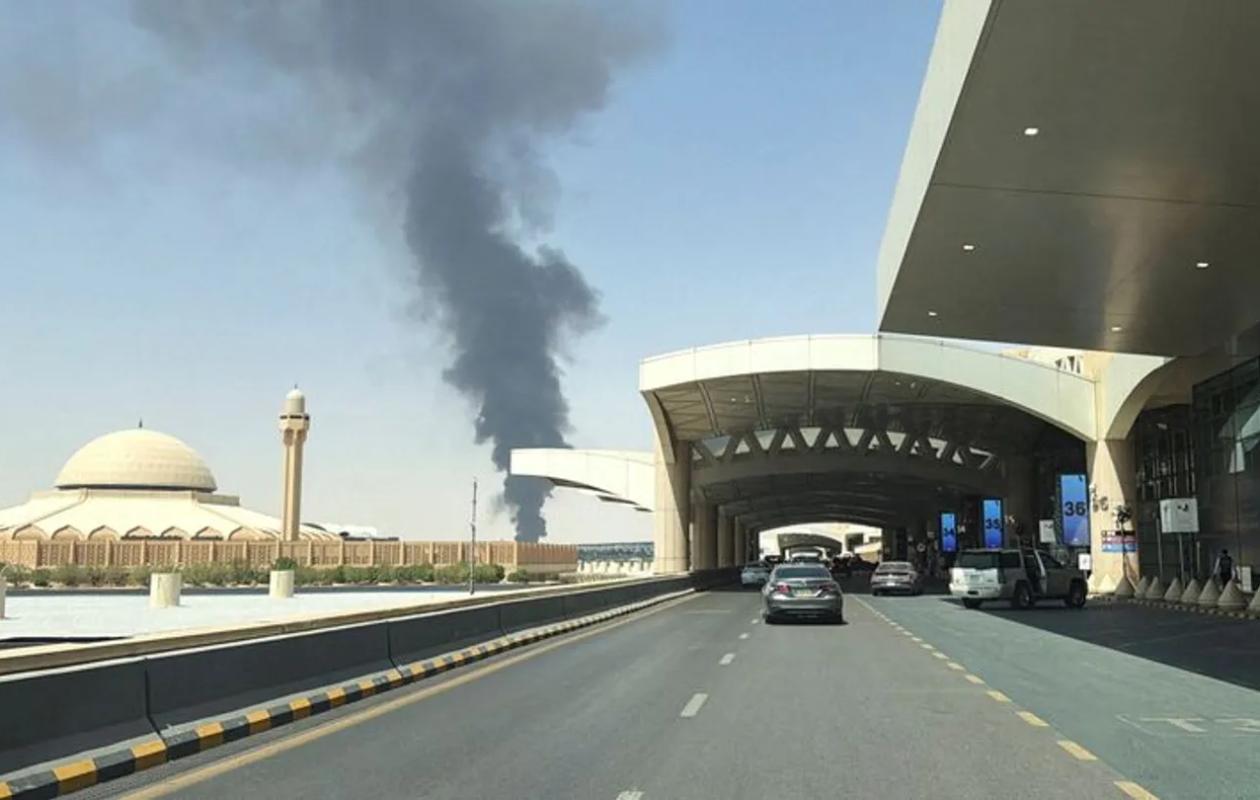
Douze morts dans une attaque imputée aux Houthis contre l'aéroport de Ryad
At least 12 people were killed and 309 wounded in an attack on Riyadh airport on Saturday, the deadliest in the kingdom in more than ten years, Saudi authorities announced, accusing the Houthis of Yemen.
Four Saudis and eight foreigners, including an American, were among the dead, the civil aviation authority said in a statement.
"What happened in Saudi Arabia is not acceptable," reacted US President Donald Trump on Saturday evening, indicating that he would speak with Crown Prince Mohammed bin Salman, the de facto ruler of the kingdom.
This is the deadliest attack in the kingdom since August 2015 when a suicide bombing by the jihadist group Islamic State (IS) killed 15 people in a mosque at the headquarters of the special forces in Abha, in the south of the kingdom.
"The attack that targeted King Khalid International Airport in Riyadh on Saturday (...) left 12 dead, including four Saudi nationals, two Bangladeshis, an American, an Egyptian, an Argentinian, a Syrian, a Palestinian and a Sudanese," the authority on X said on Sunday.
"The attack also left 309 people injured," some of them seriously, she added.
"I saw injured people. Everyone was running," a passenger, who was waiting for a flight near the terminal hit by the missile, told AFP.
The Saudi-led military coalition in support of Yemen's internationally recognized government has accused pro-Iranian Houthi fighters, denouncing "a war crime" to which it will respond "firmly".
Operations have been suspended at the airport and the Ministry of Education has ordered schools in Riyadh to teach remotely for a week.
- "Serious escalation" -
The coalition also announced in the evening that a projectile had landed near Dammam airport in the east of the kingdom. This airport, along with Jeddah airport (in the west), serves as an alternative to Riyadh airport, which has been closed since Saturday. Another projectile was intercepted southeast of Riyadh.
In the capital, doctors were urgently called to hospitals to treat the injured. Several embassies advised their staff to avoid the airport for a week, according to a Western diplomat.
The attack "constitutes a serious escalation," said UN envoy to Yemen Hans Grundberg on Saturday, accusing the Houthis.
Pakistani Prime Minister Shebaz Sharif also strongly condemned the attack, which he called "targeting civilians and critical infrastructure" and a "threat to peace." His country is a signatory to the Mecca Defense Pact with Turkey and Saudi Arabia.
Pro-Iranian fighters in Yemen had already claimed responsibility for attacks on the airport on Wednesday and Thursday. Three Saudis, including a pilot, were killed in those attacks on Thursday. On Wednesday, an Egyptian, an Algerian, and a Sudanese national were killed.
The scale and frequency of attacks targeting Riyadh in recent days are unprecedented since 2014 and the start of the war in Yemen between the Houthis and Yemeni government forces, who received military support from a Saudi-led coalition from 2015.
These strikes also come shortly before the kingdom hosts its major annual investment conference in October, which attracts foreign leaders and leading figures from the business world.
Saudi Arabia, the world's largest crude oil exporter, relatively rarely acknowledges that strikes have hit civilian targets.
- Are US strikes "possible"?
According to US media, the kingdom has repeatedly asked the United States recently for help in countering the Houthis, who launched a lightning offensive in September in Yemen, where they seized the Red Sea coastline and strengthened their hold on the strategic Bab el-Mandeb Strait, triggering a counter-offensive by Yemeni forces.
When asked earlier Saturday by reporters at the White House whether Washington would participate in strikes against pro-Iranian fighters, the US president replied: "It's possible. We're going to look into it. We just learned of this recent attack (in Riyadh), so we'll make a decision. We're acting very quickly."
Military sources from the government camp in Yemen told AFP on Saturday that Yemeni forces had made progress against the Houthis in the Bab el-Mandeb Strait area, but failed to secure this maritime route which has gained importance after Tehran imposed restrictions on navigation in the Strait of Hormuz on the other side of the Arabian Peninsula.
According to these sources and a Houthi official, anti-government fighters still hold Mayyoun Island, at the heart of the sea passage.
"Our forces maintain control of Bab el-Mandeb, Mayyoun Island and other areas" on the country's western coast, Hizam al-Asad, a member of the Houthi political bureau, told AFP.
Claims from the warring parties are impossible to independently verify, as the situation is evolving rapidly and access for journalists is difficult.






















Commentaires (1)
Participer à la Discussion
Règles de la communauté
💡 Astuce : Utilisez des emojis depuis votre téléphone ou le module emoji ci-dessous. Cliquez sur GIF pour ajouter un GIF animé. Collez un lien X/Twitter, TikTok ou Instagram pour l'afficher automatiquement.
Se connecter
Commentez avec votre profil, votre photo, et soyez averti des réponses.