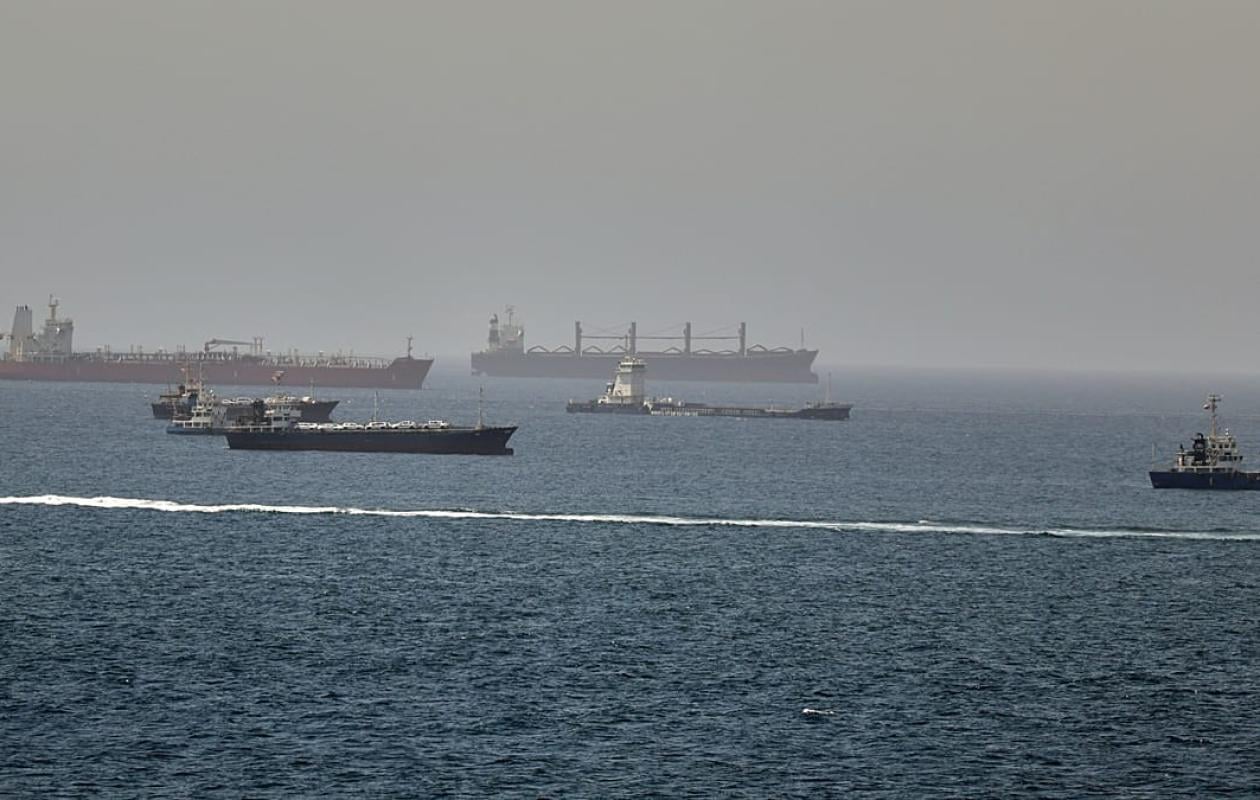
Les Etats-Unis lancent des frappes contre l'Iran et rétablissent leurs sanctions après des tirs contre des navires
Three ships were hit in 24 hours in the Strait of Hormuz, reported the British maritime security agency UKMTO, with Qatar and Saudi Arabia blaming two of these attacks on Iran, despite the ceasefire between Tehran and Washington.
Iran and the United States signed a memorandum of understanding on June 17 to end the war that began on February 28 with the US-Israeli offensive against Tehran.
This text notably provides for the reopening of the Strait of Hormuz - through which normally 20% of the world's crude oil and LNG pass and whose closure by Tehran had shaken the world economy and caused prices to soar - as well as the lifting of American sanctions on Iranian oil.
The US military command for the Middle East (Centcom) announced the launch of a "series of powerful strikes" in retaliation for "Iranian attacks," which it described as a "blatant violation of the ceasefire."
Iranian media reported explosions on Tuesday at sites near the Strait of Hormuz.
"Iran's actions in the strait are totally unacceptable to the United States and will not go unpunished," a U.S. government official said on condition of anonymity, after the Treasury Department published a document banning "new transactions" of Iranian hydrocarbons starting Tuesday.
Navigation had resumed in the Strait of Hormuz following the signing of the memorandum of understanding, despite some incidents.
In late June, accusing Iran of targeting two ships, the United States bombed the country, which retaliated by targeting Gulf neighbors Kuwait and Bahrain.
Washington and Tehran subsequently agreed to cease these hostilities.
Saudi Arabia condemned "the targeting by the Islamic Republic of Iran of the Saudi oil tanker Wedyan", as well as that of "the Qatari LNG carrier Al-Rakayyat", denouncing "an attack on the security of international navigation and the security of global energy supplies".
Previously, Qatar had announced that it had summoned the Iranian chargé d'affaires to protest the attack on its LNG carrier.
The Qatari Foreign Ministry said it had given the Iranian diplomat a note urging Tehran to "immediately cease any practice that undermines regional security" as well as "the security of international navigation and global energy supply," while demanding "an explanation for this attack."
Iranian Foreign Ministry spokesman Esmail Baghai, for his part, denounced an "unacceptable" accusation by Qatar.
Without attributing them, the UKMTO agency then reported two other incidents on Tuesday: an oil tanker hit by an unidentified projectile, suffering "structural damage", and a tanker struck by a drone of unknown origin.
In all three cases, the agency indicated that there were no injuries or environmental damage.
Iran, despite US opposition, rules out any return to the pre-war situation, when passage through the strait was free, and threatens ships tempted to bypass the only route it has authorized along its coasts.
The American website Axios reported Monday evening that Iran had "fired at least two missiles at commercial vessels," citing two US officials. According to one of these officials, a second ship was hit and sustained significant damage.
AFP has not been able to independently confirm this information.
This rise in tensions comes as Iran has been holding a six-day national funeral since Saturday for its supreme leader, Ali Khamenei, who was killed on the first day of the war by Israeli-American strikes, and whose body has just arrived in Iraq for processions in Najaf and Karbala, two cities housing the most revered shrines of Shiite Muslims.



















Commentaires (0)
Participer à la Discussion
Règles de la communauté
💡 Astuce : Utilisez des emojis depuis votre téléphone ou le module emoji ci-dessous. Cliquez sur GIF pour ajouter un GIF animé. Collez un lien X/Twitter, TikTok ou Instagram pour l'afficher automatiquement.
Se connecter
Commentez avec votre profil, votre photo, et soyez averti des réponses.