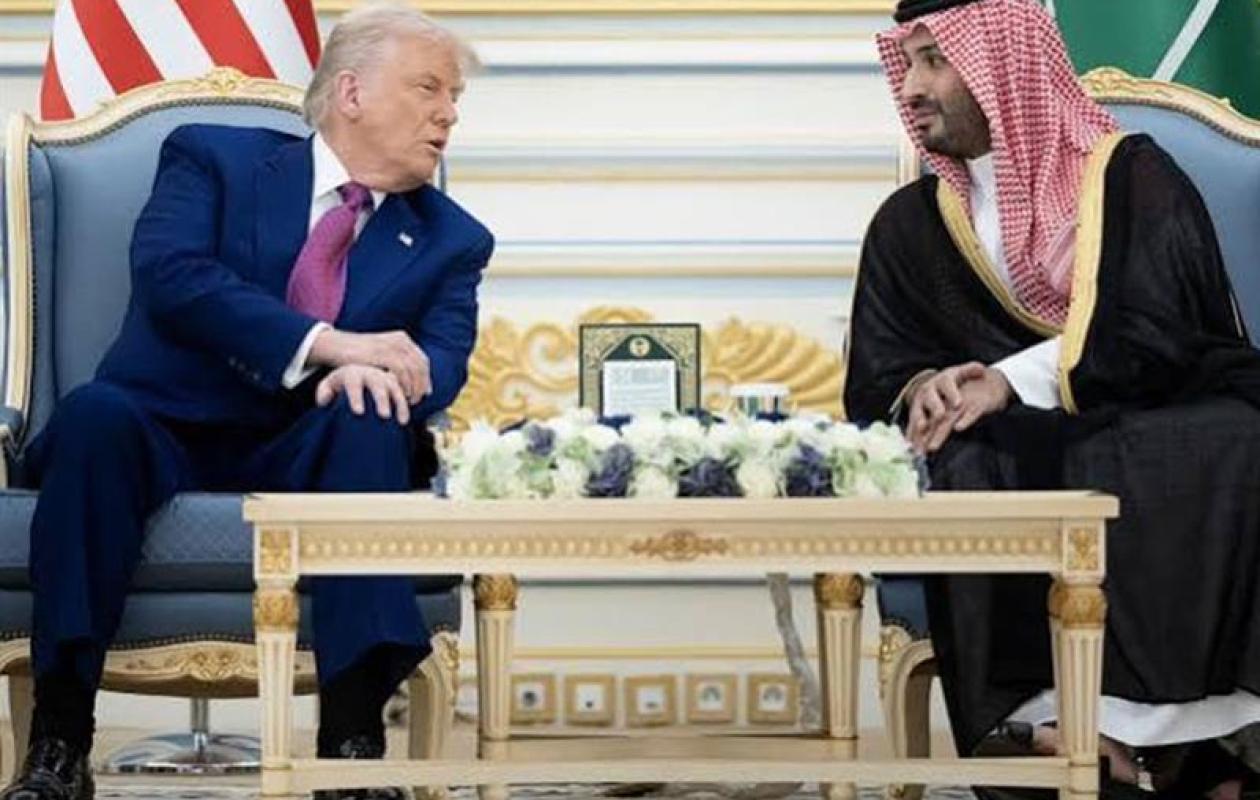
Washington prévoit d'annoncer un accord sur le nucléaire avec Ryad
The United States plans to announce an agreement with Saudi Arabia on Wednesday that would provide the kingdom with a civilian nuclear program, according to US media.
The announcement would come as the United States has resumed its war against Iran, a rival of Riyadh, which was triggered in particular by American fears that the Iranian nuclear program aims to equip the country with the atomic bomb.
The New York Times, citing two unidentified US officials, reported Tuesday that the government intended to officially sign and announce the agreement with Riyadh on Wednesday.
President Donald Trump's administration has stated that this arrangement will allow the American nuclear industry to benefit from an influx of billions of dollars.
Indeed, a clause in the agreement, which would be valid for 30 years, stipulates that American companies will build a uranium enrichment complex in Saudi Arabia, if a joint study establishes that it is justified, the Wall Street Journal reported.
However, Republican and Democratic US lawmakers, as well as Israeli officials, have expressed opposition to any civilian nuclear project in Saudi Arabia, fearing it could ultimately be used to develop nuclear weapons.
Asked about this on Wednesday in Manila, on the sidelines of an ASEAN meeting, US Secretary of State Marco Rubio refused to confirm such an agreement, referring any possible announcement to the White House.
Pressed with questions by journalists and visibly a little embarrassed, he nevertheless assured that the United States "would never enter into an agreement with any country in the world that would lead to a risk of nuclear proliferation."
The agreement is expected to be submitted to the US Congress in the coming days, but its approval is not required for it to be ratified.
Saudi Arabia has long insisted on its right to civilian nuclear power.
In recent years, Washington has sought to integrate any nuclear agreement into a broader strategy, which would include normalizing relations with Israel and signing a defense pact.
Washington signed a nuclear agreement in 2009 with a neighbor of Saudi Arabia, the United Arab Emirates, which, however, does not enrich uranium.
In May, the Emirati nuclear power plant of Barakah, the only facility of its kind in the Arab world, was attacked by a drone which struck a generator, causing a fire.
Abu Dhabi attributed the attack to pro-Iranian Iraqi militias, amid hostilities between Washington and Tehran.
Despite a ceasefire and a memorandum of understanding signed in June, clashes resumed on July 7, raising fears in the region, and particularly in the Gulf, of further destabilization.
Among the most important points of contention between the United States and Iran is the Iranian nuclear program: while Tehran defends its right to civilian nuclear power, the West and Israel suspect it of wanting to acquire the atomic bomb, which it denies.
Political leaders also fear that if Tehran were to produce a nuclear weapon, its Gulf neighbors would follow suit, leading to an arms race.
The region is also shaken by the announcement by Yemeni Houthi rebels of a maritime blockade of Saudi Arabia, which could affect the global oil supply, the kingdom being the world's leading crude oil exporter.
This announcement follows exchanges of fire between the two sides in Yemen last week, jeopardizing the truce negotiated in 2022, which is still active despite its expiry.

















Commentaires (0)
Participer à la Discussion
Règles de la communauté
💡 Astuce : Utilisez des emojis depuis votre téléphone ou le module emoji ci-dessous. Cliquez sur GIF pour ajouter un GIF animé. Collez un lien X/Twitter, TikTok ou Instagram pour l'afficher automatiquement.
Se connecter
Commentez avec votre profil, votre photo, et soyez averti des réponses.