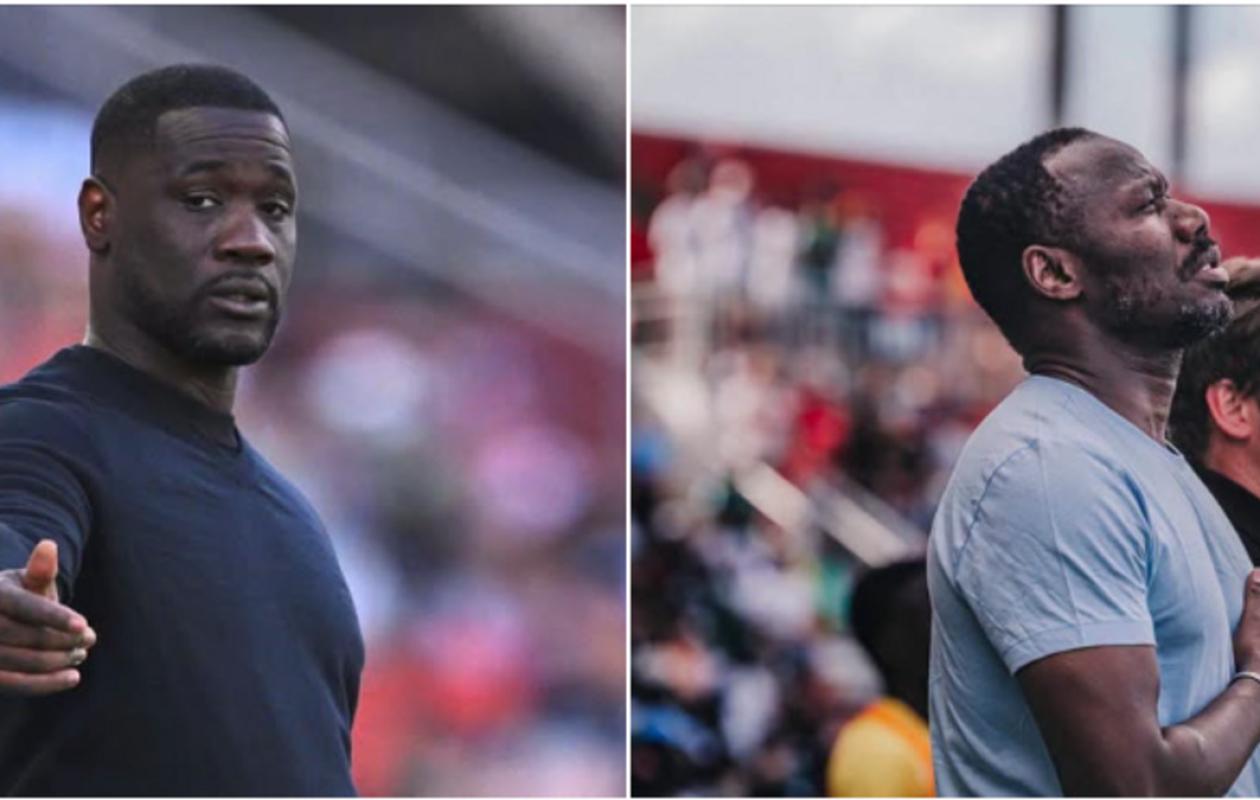
Foot: après la gloire, les techniciens africains en perte de terrain sur le continent
2019, 2022, 2024, 2026... After a successful period in which they won the last four Africa Cup of Nations (CAN), local coaches are being questioned by some federations who prefer to rely again on the old methods of the "white wizards".
Are we witnessing the end of the love affair between African coaches and their national teams? Long undervalued and relegated to a secondary role in the shadow of expatriate coaches, local coaches had managed in recent years to establish themselves at the helm of numerous national teams in Africa, with some resounding successes to boot.
Djamel Belmadi (Algeria, 2019), Aliou Cissé (Senegal, 2022), Emerse Faé (Ivory Coast, 2024) and Walid Regragui crowned with Morocco in 2026 by default or Pape Thiaw, winner with Senegal on the field: the last AFCONs have all been won by local coaches.
Regragui also qualified Morocco for the semi-finals of the World Cup in 2022, a first for an African team.
Another indication of their aura in recent years: in 2019, nearly half of the 24 teams that took part in the AFCON in Egypt were led by African coaches, a record.
Described as a "revolution" by many observers at the time, this takeover was made possible in particular by the emergence of a new generation of young coaches - sometimes trained in Europe - some of whom had made their national teams famous as players.
Added to this was also the loss of influence of their foreign colleagues, nicknamed "white wizards", who, once adored, saw their reputation decline on the continent because they were considered too expensive and ineffective.
But this trend seems to be reversing, as shown for example by the replacement of Emerse Faé by Hervé Renard on the Ivory Coast bench, the return of veteran Claude le Roy to Congo Brazzaville, the dismissal of Pape Thiaw for Patrick Vieira in Senegal or the departure of Kaba Diawara to Guinea replaced by Paulo Duarte.
For Kamou Malo, former coach of Burkina Faso, semi-finalist of the 2019 AFCON, himself replaced by the Frenchman Hubert Velud in 2022, "even with positive results, local coaches will always have difficulty convincing".
The results of Senegal and Ivory Coast, both eliminated in the round of 16 of the 2026 World Cup, were thus deemed disappointing and revealed some tensions between coaches and federations.
"We must recognize that there are objective limits, particularly in the rigor and scientific approach imposed by modern football," analyzes Abdoulaye Dabo, a Senegalese sports journalist.
Local coaches are often criticized for a lack of top-level experience, tactical shortcomings, or a lack of authority in the face of dressing rooms full of stars.
The president of the Ivorian federation did not hesitate to compare the careers of Emerse Faé and Hervé Renard, highlighting the Frenchman's "experience".
"The coach who left won one AFCON, Hervé Renard won two. The coach who left brought Ivory Coast back to the World Cup, Hervé Renard brought several teams back to the World Cup," he said during his presentation.
The difference stems mainly from the fact that federations give more time to expatriates than to locals who "live under constant pressure", says former Ivory Coast international and now coach Basile Aka Kouamé.
Like him, many other observers interviewed by AFP point to federations which, according to them, do not put the premises in the best conditions for performance.
"Even when signing a good contract, local technicians do not have the same guarantees as foreign coaches," Mr. Malo points out, citing the example of Pape Thiaw who went to the World Cup with Senegal without a contract.
However, not all African nations have succumbed to the allure of European coaches: Algeria and South Africa have recently announced the appointment of local coaches to take the reins of their national teams.
Winner of three AFCON tournaments (1980, 1994, 2013), Nigeria has also been led since January 2025 by Malian coach Eric Chelle.


















Commentaires (9)
Ceci pour dire que tout ce monde que l'auteur cherche à opposer dans ce papier sont à 99% des Français de même rang. Ils ne sont aucunement des techniciens africains au sens strict du mot, puisque tout leur savoir technique ayant été acquis en Occident et précisément en France.
Participer à la Discussion
Règles de la communauté
💡 Astuce : Utilisez des emojis depuis votre téléphone ou le module emoji ci-dessous. Cliquez sur GIF pour ajouter un GIF animé. Collez un lien X/Twitter, TikTok ou Instagram pour l'afficher automatiquement.
Se connecter
Commentez avec votre profil, votre photo, et soyez averti des réponses.