JOJ Dakar 2026 : Le dispositif opérationnel de mobilité pour faciliter les déplacements et préserver les activités quotidiennes à Dakar, validé
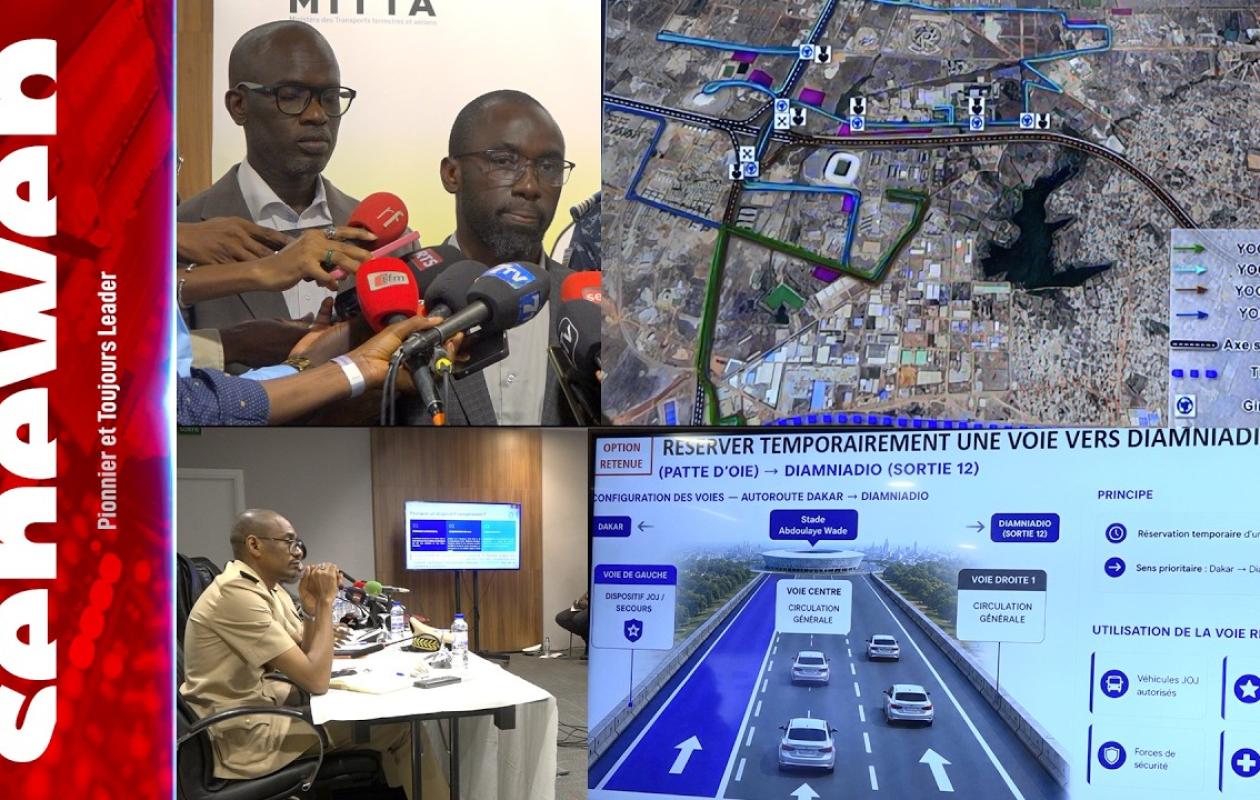
As part of preparations for the Dakar 2026 Youth Olympic Games, the Governor of the Dakar region, Ousmane Kane, presented on Tuesday, October 6, the strategic traffic management plan that will be implemented around the competition venues throughout the Games. This plan, which includes stringent measures and recommendations, has been approved by the relevant stakeholders, namely: the agencies attached to the Ministry of Land and Air Transport, administrative authorities, local governments, the Organizing Committee for the Youth Olympic Games (COJOJ), the Defense and Security Forces, and public transport operators. The meeting aimed to present the plan, inform the public about the expected traffic changes, and allow them to plan their journeys during the Games.
Traffic plans adapted to the different competition venues were developed by the mobility committee.
With the approach of the Dakar 2026 Youth Olympic Games, which will take place from October 31 to November 13, 2026, the Ministry of Land and Air Transport, through the Mobility Committee whose secretariat is provided by the Executive Council for Sustainable Urban Transport (CETUD), has put in place an operational system designed to support the competitions while ensuring the continuity of travel and daily economic, social and cultural activities in the Dakar region.
These are the traffic plans adapted to the different competition venues that the committee has meticulously developed with all stakeholders in the land transport sector.
In total, 166 traffic calming and regulation measures are planned across three hubs: Dakar, Diamniadio, and Saly, and at 14 intersections classified as critical or high-traffic. These measures aim to manage traffic flow, improve safety, and facilitate access to venues during the Games. They are tailored to each venue, with designated routes and solutions for users.
One device, four principles
This operational mobility plan is based on four principles: separating different traffic flows, prioritizing public transport, protecting users, and gradually returning to normal after the Youth Olympic Games. The TER (Regional Express Train), BRT (Bus Rapid Transit), Dakar Dem Dikk (Dakar Dem Dikk), AFTU (Association of Transport Users), GTS (Guadeloupe Transport Company), dedicated shuttle buses, and accredited Youth Olympic Games taxis form the backbone of access to the venues. Specific routes, road improvements, pedestrian zones, and reserved lanes will better organize the movement of participants, spectators, local residents, and regular users.
Dakar hub: measures adapted to each site
In the Medina district, around the Iba Mar Diop complex, Street 11 will be reserved for authorized buses and emergency vehicles, with one-way traffic. The sections of road between Streets 13 and 11 will be closed to traffic, with the exception of Streets 24 and ME 30, which provide access to Boulevard Général de Gaulle. Blaise Diagne Avenue will have two lanes reserved for authorized buses traveling from the Iba Mar Diop Stadium towards the Tilène Market. Users arriving by BRT (Bus Rapid Transit) can disembark at the Grande Mosquée station and reach the site via a marked pedestrian walkway.
At Point E, around the Tour de l'Œuf complex (Olympic Swimming Pool), the Rue du Tour de l'Œuf will be entirely pedestrianized, except for accredited vehicles. Avenue Birago Diop will be converted into a shared roadway, while traffic restrictions will apply to streets including Rue G, Rue A, and Rue 1. Incentive measures are also planned: adjustments to the school calendar, teleworking, carpooling, and time off during the Games.
On the Corniche Ouest, on November 7, 8, and 10, from 6:00 a.m. to 4:00 p.m., the affected sections will be closed to general traffic and reserved for the Youth Olympic Games (JOJ) event. Detour routes will be in place, notably via Avenue Cheikh Anta Diop, Rue Aimé Césaire, and the roads in the Fann Résidence area. At Les Mamelles, general traffic will be diverted via the road passing in front of the Mamelles lighthouse and joining Avenue Cheikh Anta Diop. Checkpoints and traffic controllers will be stationed at the main intersections.
In Diamniadio, general traffic will be prohibited within the security perimeters of the venues. On the road leading to the ministerial complexes, the right lane will be reserved for shuttle buses and accredited vehicles, while access to the A1 motorway slip roads will be controlled based on origin. Users are encouraged to use the regional express train (TER), with shuttle buses running from Diamniadio station to the venues. Parking areas set up away from the venues will offer 2,214 spaces for spectators.
Stay informed, plan ahead, and prioritize public transportation.
According to the governor of Dakar, this mobility system will be accompanied by regular updates for users. Volunteers and the Defense and Security Forces will also be deployed at key traffic points to guide users and assist with their journeys.
Therefore, users are encouraged to plan their journeys in advance, to prioritize the TER (Regional Express Train), BRT (Bus Rapid Transit), Dakar Dem Dikk (Railway Dem Dikk), AFTU (Transports de France Urbain), GTS (Guadeloupe Transport Company), shuttle buses and JOJ taxis, to carpool, to respect parking regulations and to follow temporary signage. Residents living in restricted zones must have their access permit.
Ousmane Kane also reports that residents retain access to their homes, students to their schools and patients to health facilities; dedicated crossing points are provided for this purpose and staffed by guidance agents.
The TROC, mobility management center
Throughout the Youth Olympic Games, the Transport Operations Center (TROC) will be responsible for the real-time management and coordination of the entire mobility system. Hosted by CETUD at the Urban Mobility Management Center (CGMU) in Grand Médine (Dakar), it will monitor traffic and transport conditions, coordinate the various stakeholders, and intervene rapidly in the event of disruptions, in constant contact with the COJOJ Main Operations Center (MOC).
During these Dakar 2026 Youth Olympic Games, everyone is invited to adapt their travel habits, to get informed in advance and to favour public transport solutions in order to contribute to smoother, safer and more accessible mobility for all.
It is worth recalling that Dakar, Diamniadio and Saly are the three host cities for the Dakar 2026 Youth Olympic Games. These Games, which will be held for the first time on African soil, will host 2,700 athletes, 25 competitive sports and 10 engagement sports.


















Commentaires (3)
Participer à la Discussion
Règles de la communauté
💡 Astuce : Utilisez des emojis depuis votre téléphone ou le module emoji ci-dessous. Cliquez sur GIF pour ajouter un GIF animé. Collez un lien X/Twitter, TikTok ou Instagram pour l'afficher automatiquement.
Se connecter
Commentez avec votre profil, votre photo, et soyez averti des réponses.