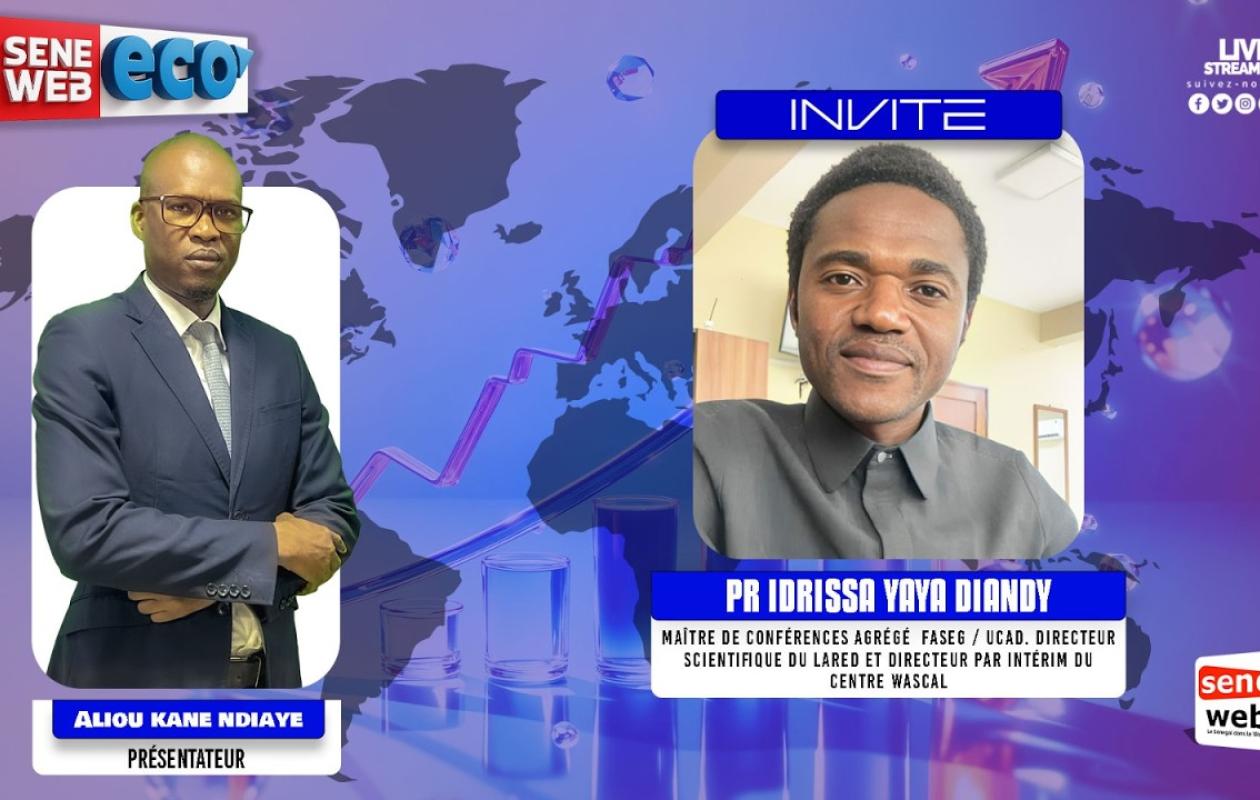
Idrissa Yaya Diandy sur l’éco : « Il ne faut pas s’attendre à plus d’autonomie financière… »
While the Economic Community of West African States (ECOWAS) has announced a phased rollout of its single currency, the Eco, some believe that the debate on monetary sovereignty should not be reduced to a simple opposition between maintaining the current system and adopting a new currency. This is the conviction of a senior lecturer in economics at Cheikh Anta Diop University of Dakar (UCAD).
Idrissa Yaya Diandy believes that true monetary sovereignty rests first and foremost on the strength of the economy and the credibility of the currency.
Asked about the choice between the price stability offered by the current exchange rate regime and greater monetary flexibility to support exports, the guest on "Seneweb Eco" this Sunday, July 26, 2026, emphasizes that "empirical evidence does not show the superiority of either monetary regime."
According to him, each system has advantages and limitations. "The fixed exchange rate regime has its advantages and disadvantages. It's true that we have the advantage of inflation stability. We also have the advantage of exchange rate stability, and therefore investors have more visibility. But, on the other hand, we lose the monetary instrument, in particular the flexibility of the exchange rate to adapt it to our domestic competitiveness," he explains.
Regarding the ECOWAS single currency project, the scientific director of the Laboratory for Analysis, Research and Development Studies (Lared) at Cheikh Anta Diop University (UCAD) expressed his support for its implementation. "I will be in favor of this common currency because, after 60 years of independence, I think we are still capable of managing our own currency," he stated, while also urging people not to have illusions about the immediate effects of such a change.
Indeed, the academic points out that a new currency does not automatically guarantee greater financial autonomy. "We shouldn't expect more financial autonomy when we have our own currency," he warns, believing that states will have to demonstrate their ability to ensure credible monetary governance.
For Idrissa Yaya Diandy, the concept of monetary sovereignty goes far beyond simply issuing a national currency. "For me, monetary sovereignty isn't just about printing money. Monetary sovereignty means having a currency that is stable enough, strong enough, and one that partners trust. A currency that can also support a productive base," he asserts.
The economist also believes that the Central Bank of West African States (BCEAO) should have greater scope for action to support the economies of the union.
Commenting on the recent decision allowing the institution to buy back government bonds, he believes this development is a step in the right direction. "That's the role of a central bank; it's the lender of last resort," he argues.
According to him, "this is a measure that goes towards easing the constraints of the BCEAO's monetary policy, which I find too rigid for a developing country."
While acknowledging the importance of preserving monetary stability, Idrissa Diandy believes this objective should not be pursued at the expense of development imperatives. "It's true, we must defend the exchange rate, but not at any cost. We must sometimes also have economic policy objectives, even if it means allowing the currency to devalue slightly," he says.




















Commentaires (0)
Participer à la Discussion
Règles de la communauté
💡 Astuce : Utilisez des emojis depuis votre téléphone ou le module emoji ci-dessous. Cliquez sur GIF pour ajouter un GIF animé. Collez un lien X/Twitter, TikTok ou Instagram pour l'afficher automatiquement.
Se connecter
Commentez avec votre profil, votre photo, et soyez averti des réponses.