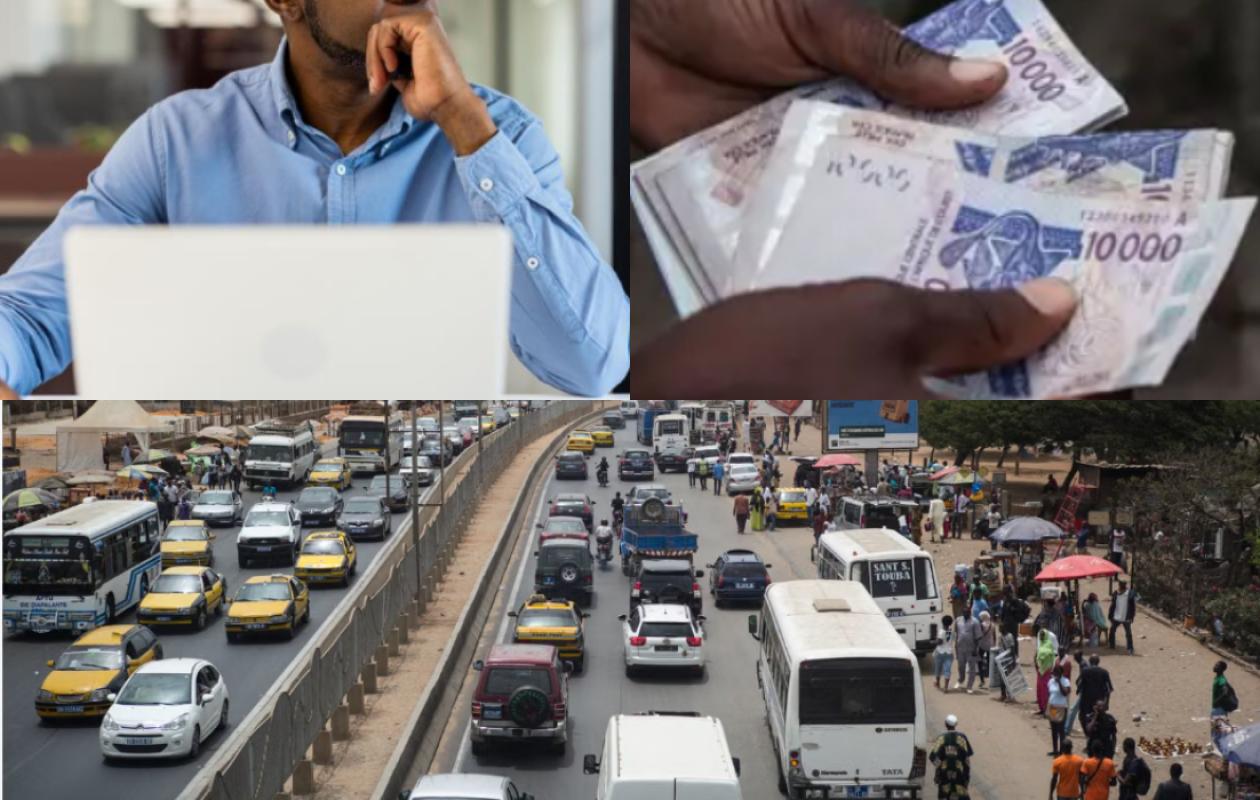
Quand aller travailler coûte une partie du salaire : Le calvaire des longs trajets à Dakar (Dossier 1/3)
Working in Dakar often means a daily struggle. Between early morning wake-ups, endless traffic jams, and exorbitant public transport fares, getting to work has become an ordeal that takes a heavy toll on the health and finances of suburban residents. In this first installment of a three-part series on urban mobility, Seneweb followed these workers, a significant portion of whose wages vanish before they even reach their pockets.
Dakar is still asleep. But for those who live far from their workplace, the day has already begun. In Keur Massar, Pikine, or Rufisque, it's wake-up before dawn, walking, waiting, connections, traffic jams, and a string of fares. 500 francs here, 500 francs there: by the end of the month, transportation can eat up a significant portion of their income.
But the cost isn't measured solely in CFA francs. It's also paid in time, fatigue, and sometimes even lost jobs. In this report, Seneweb followed several people to measure the true price of a workday in Dakar.
The journey begins even before the workday.
In Keur Massar, the day begins well before the offices open. Maguette Diagne (not her real name), a saleswoman for a company in downtown Dakar, closes her front door. It's still early. She doesn't have a car, but she has a duty: to be at the office by 8 a.m. She heads to the unlicensed taxi stands, bound for the city center.
First leg: 200 CFA francs to the "cars rapides" garage. Then 1,300 CFA francs to continue the journey. But before leaving, you have to wait for the vehicle to fill up. Only then, it's off to Dakar.
A few kilometers away, but with the same constraint, Seynabou Faye experiences a similar daily commute. A journalist for a news outlet, she too leaves Keur Massar to reach her workplace in downtown Dakar. To be at the office by 8:00 or even 8:30, she wakes up between 5:00 and 5:30.
Three vehicles for a single trip: “I take three vehicles: a shared taxi to the Total station, then a Ndiaga Ndiaye bus, and finally a fast bus to get to the office,” she explains. And when transportation becomes difficult, she has to improvise. “I often also take shared taxis: a shared taxi to the station, then a regular taxi, and finally another shared taxi to get to the office.”
Between connections and traffic jams, the journey can take 1 hour 45 minutes to 2 hours 30 minutes, or even three hours. In Dakar, the commute thus becomes the first day of work before even arriving at the office. For Maguette, as for Seynabou, this mobility also comes at a cost. Maguette spends approximately 3,000 CFA francs per day. Seynabou, on the other hand, spends between 1,200 and 2,500 CFA francs, depending on the means of transport used.
“With the Ndiaga Ndiaye buses, the trip costs me 1,200 CFA francs. With taxis, it can cost up to 2,500 CFA francs,” explains Seynabou. But in addition to the financial cost, there’s the less visible one of fatigue. “I arrive tired and stressed, especially after spending a lot of time in traffic jams or on crowded public transport. When I get to the office, it takes me 10 to 15 minutes just to recover and be able to really concentrate. It affects my motivation and productivity,” she adds.
Maguette describes the same wear and tear: “I wake up at 5 a.m. to have a chance of arriving on time. Here, missing a single transport can ruin my whole day. It’s become a routine, but an exhausting one. Some days, I’m already tired before I even get to work. And when I can’t find a car, I have to run or spend more to get around. Eventually, it’s discouraging.”
For Seynabou, some days are particularly difficult, especially Mondays and rainy days: “Yes, I sometimes get discouraged. When you calculate the salary, transport, food and other expenses, you can sometimes wonder if the work is still really profitable. It's not easy, but we don't have a choice, we're just following our passion.”
And when the day ends, the same journey begins again in reverse: queues, traffic jams, transfers, and more expenses. Over 26 working days, Maguette spends approximately 78,000 CFA francs on transportation. Seynabou, whose expenses vary depending on the mode of transport used, can spend up to 65,000 CFA francs per month. Tens of thousands of CFA francs are thus lost each month simply to get to and from work.
When transportation costs eat into wages
Behind these figures, another reality emerges: the actual available salary is not what appears on the payslip. For a worker earning less than 300,000 CFA francs, spending more than 60,000 francs on transportation already represents a considerable expense. Maguette is experiencing this firsthand.
“It’s very hard. At some point, you think it doesn’t make sense because I’m working, but part of my salary disappears into transportation. I’m essentially working for the vehicles. My salary is less than 300,000 francs. I spend over 60,000 francs a month on transportation. After rent and other expenses, I have almost nothing left.” She works, but part of her salary is already gone before it can even cover living expenses.
When the commute requires leaving work
There are those who adapt. And those who end up giving up. Mamadou Diémé, an IT specialist and former employee, is one of the latter. Every day, he left Pikine at 6 a.m. to go to Plateau and didn't return until late afternoon. Salary: 150,000 CFA francs. Transportation: nearly 50,000 CFA francs per month.
“I left every day at 6 a.m. I left Pikine for Plateau and returned at 5 p.m. Transportation cost me almost 50,000 CFA francs per month and I was exhausted. With a salary of 150,000 francs, it was financially suffocating. I finally left because I couldn't continue like that.”
So he changed course. Today, he manages a Wave location, does numerous photo shoots and sessions, develops his own business, and continues to look for a better-paying job. "I left to start my own business. Right now, I'm taking a bit of a financial break while I wait to find a better job." His journey shows that a job can exist without being economically sustainable.
Distance , a barrier to employment
In a context where overall unemployment reached 22.9% in the first quarter of 2026, and 28.4% among young people, keeping a job is already a major challenge. But being able to get there at an affordable cost is another matter entirely. Even with the same salary, purchasing power differs significantly between someone who lives ten minutes from their office and someone who commutes daily across the Dakar metropolitan area. Distance is therefore no longer simply a matter of kilometers: it can become a real barrier to employment.
CETUD wants to measure the cost of mobility
Faced with this reality, the Executive Council for Sustainable Urban Transport (CETUD) is seeking to more accurately measure travel practices and costs. In 2026, three surveys were conducted in the Dakar metropolitan area, targeting 4,500 households and 20,000 transport users. Of these, 10,000 participated in the origin-destination and travel behavior survey, and 7,500 in the survey on the Bus Rapid Transit (BRT) system.
Journey times, distances, modes of transport, costs, origins and destinations: CETUD aims to generate the data needed to better plan mobility. Our interviewees, however, didn't wait for statistics to know the cost of travel. They pay it every day.
Moving to avoid paying for distance
For some, the solution is to live closer to their workplace. Transportation costs decrease, but rent increases. The expense simply changes form. This is the choice made by Kalidou Guèye, 29, a cashier on the VDN.
“I was spending almost 75,000 CFA francs a month on transportation. After three or four months, I saw that it wasn’t profitable. Since I couldn’t afford to buy a vehicle, I rented a room next to my work.”
Paying for transportation or paying for proximity: in both cases, distance comes at a price. Others opt for motorcycles, cars, or carpooling. But fuel, maintenance, insurance, and potential monthly payments keep the bill high. Changing modes of transport doesn't eliminate the cost: it simply shifts it.
Working without traveling
What if, sometimes, the solution was to stop using public transport altogether? This is the case for Khadijatou Diallo Sall, who works for an American company from Dakar. Her office fits inside her computer.
“After the birth of my third baby, I asked to return to Senegal. The company allowed me to work remotely. I don’t spend anything on transportation and I get back several hours that I can spend with my family.”
For her, teleworking should be further developed when the job allows it. "Not all jobs can be done remotely. But for certain administrative, digital, or service functions, it is possible. In Dakar, this would reduce fatigue and expenses related to commuting."
Teleworking obviously doesn't apply to all sectors. However, some functions can be performed remotely, at least partially. Draft Law No. 15/2026, the Labor Code, which will be examined in 2026, specifically provides a framework for teleworking. The question is therefore no longer simply how to transport more workers, but also which ones can avoid commuting.
Transportation : a matter of purchasing power
All these stories ultimately tell the same story: the cost of mobility reduces purchasing power. For economist Meïssa Babou, mobility has become a determining economic factor in the daily lives of Senegalese households.
“When a significant portion of income is spent on transportation, the household’s disposable income decreases. Every franc spent on transportation is a franc that can no longer be spent on housing, food, education, or other needs.”
But the cost of transportation varies depending on income, distance, and mode of transport. For managers with a car, expenses can reach 50,000 to 75,000 CFA francs per month, primarily for fuel. For middle managers, who more frequently use taxis, the cost is around 30,000 to 50,000 francs. For lower-income households, the expense may be lower in absolute terms, but it represents a larger portion of their budget. Those who favor public transportation such as minibuses and shared taxis ("Ndiaga Ndiaye") spend between 500 and 1,000 francs per day, or approximately 15,000 to 30,000 francs per month.
“Depending on the options, costs vary according to the areas, distances, but also the type of transport chosen by the person,” Meïssa Babou points out.
Behind these discrepancies lies a reality: 30,000 francs in transportation costs do not have the same impact on a salary of 150,000 francs as on a higher income. The lower the income, the more transportation costs reduce purchasing power.
The price of earning one's salary
In Keur Massar, Pikine, and Rufisque, tomorrow, the alarm clocks will ring again before dawn. The same vehicles. The same kilometers. The same tickets. Some will move. Others will change their mode of transport. Some will quit their jobs. And those whose jobs allow it will try to work remotely. Because behind the price of a journey lies a heavier bill: lost time, accumulated fatigue, and diminished purchasing power.
In Dakar, the real question is no longer just: how much does transport cost? But: how much does it cost to have to travel every day to earn a living? Because sometimes, even before receiving your salary, you already have to spend part of it to go and get it.





















Commentaires (41)
Et dire qu'on a tenté de les bruler
dans la vie de tous les jours je me le demande.
on paie des impôts mais sommes laissés seuls face au défi de tous les jours.
sans assainissement, sans système de transport digne de ce nom, sans sécurité,...
je peux rester des semaines sans aller a Dakar
L'état a totalement raté le virage du transport urbain de masse, le TER et le BRT étant certes un début de solution.
Le grand problème c'est que les entreprises n'ont pas revalorisé les indemnités de transport depuis belle lurette.
Une solution serait que l'État demande une contribution plus soutenu des entreprises au financement de transport de masse.
Cela permettrait à Dakar Dem Dikk de tripler ou quadrupler son parc de bus.
Par ailleurs, même si l'actuel DG semble bien se débrouiller, DDD devrait être une des société pour lesquelles on se doit à l'avenir de lancer un appel à candidature ultra rigoureux pour le poste de DG.
Il y a des secteurs qu'il faut vraiment protéger des considérations électorales pour le bien de tous.
C'est pour ça que le TER ou le BRT fonctionnent bien : les élus ne sont pas mêlés à la gestion quotidienne de ces boîtes.
Je m'explique:
Les autres transports de masse le TER et le BRT ont des itinéraires rigides contrairement au dem dikk qui en plus ne jouent pas assez le.role de transport de rabattement vers le TER ou Brt.
Y a pas assez de bus en exploitation. Tout le temps surchargé et rares.
Pas de vision dans cet entreprise depuis Me moussa diop
Je me suis amué à compter dans combien de vehicules particuliers il y'avais plus que le chauffeur et je suis arrivé à constater que 9 véhicules sur 10 il n'y avais que le chauffeur ( propiétaire). Vivement le transport collectif.
Participer à la Discussion
Règles de la communauté
💡 Astuce : Utilisez des emojis depuis votre téléphone ou le module emoji ci-dessous. Cliquez sur GIF pour ajouter un GIF animé. Collez un lien X/Twitter, TikTok ou Instagram pour l'afficher automatiquement.
Se connecter
Commentez avec votre profil, votre photo, et soyez averti des réponses.