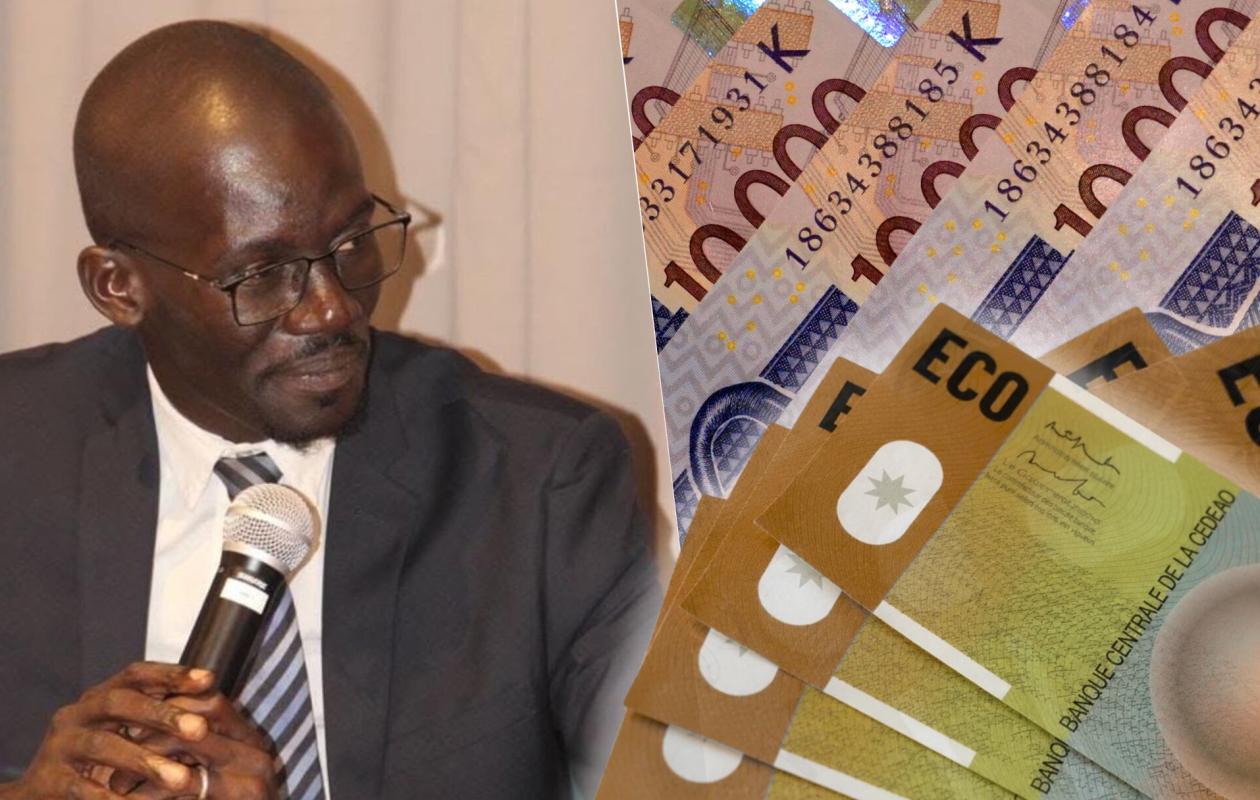
La monnaie Eco, avantages, illusions, le Sénégal est-il prêt…: Les éclairages précis de Babacar Gaye (Économiste)
At the close of its 69th summit , the Economic Community of West African States (ECOWAS) announced the gradual implementation of its single currency, the "Eco," starting in 2027. But is Senegal ready? What is its status regarding the convergence criteria? What could the Eco bring to our countries? Babacar Gaye, economist-statistician and Managing Director of Gaye & Associates Consulting, provides valuable insights in this interview with Seneweb.
ECOWAS has announced the launch of the ECO as early as 2027, with countries meeting the convergence criteria. Is such a launch feasible?
Technically yes , institutionally no , and they are not the same thing. First, we must clear up a misunderstanding that the announcement has created. The final communiqué of the 69th Summit, held in Lungi on July 19, specifies that the first phase will concern Sierra Leone, Liberia, Nigeria, Ghana, Guinea, and The Gambia—that is, the West African Monetary Zone. The ECO of 2027 is not the death of the CFA franc: it is the birth of a second West African monetary zone, alongside our own.
Three obstacles remain, and none of them are related to the timeline. The institution does not yet exist; the future common central bank has neither finalized statutes, nor decision-making rules, nor a capital allocation formula. Moreover, the summit requested that the Presidential Task Force meet before December 2026, meaning that fundamental questions remain unresolved eighteen months before the deadline. The exchange rate regime is also not yet finalized; yet without a regime, there is no conversion rate, and without a conversion rate, there is no currency. Finally, convergence is not something that is observed; it is sustained over time. A country that is compliant in 2026 and deviates in 2028 brings its indiscipline into the common currency. Banknotes can be printed in eighteen months; a credible central bank cannot be built in eighteen months. A currency cannot be decreed; it must be made credible.
Given its current aggregates, can Senegal claim to be among the states that will start as early as next year?
I respectfully correct the question: it is not framed in those terms. Senegal is not a country with a national currency applying for a monetary union; it is already a member of a treaty-based union with a central bank and a guarantee of convertibility. Senegal cannot join the ECO: it is already married. The question is not one of accession, but of the dissolution of the existing union— a legal and diplomatic act, not a statistical exercise.
Let's examine the criteria, however. Inflation stood at 0.4% year-on-year in June 2026, placing Senegal first in the region. Monetary financing of the deficit is zero by design. On the other hand, the budget deficit reached 6.44% of GDP in 2025, compared to a target of 5.37% in 2026; the criterion was not met. Foreign exchange reserves are pooled at the BCEAO (Central Bank of West African States), so the criterion is not measurable at the national level and will need to be adjusted. As for the debt, it reached 118.8% of GDP for the central government at the end of 2024, and 132% in the broader context according to the IMF, against a ceiling of 70%. Herein lies the Senegalese paradox: the best inflation in ECOWAS and the worst debt in ECOWAS.
So what will Senegal have to resolve first in order to be eligible for the ECO?
Three areas of focus, and the first is not what one might expect. First, statistical accuracy. The Court of Auditors' report of February 2025 revised the debt-to-GDP ratio from 74.4% to 99.7% for 2023, and the deficit from 4.9% to 12.3%. A convergence criterion is only as good as the statistics that measure it. In a union, mutual oversight relies entirely on shared figures: a country whose accounts have had to be revised does not simply contribute debt, it introduces doubt, and doubt is paid for collectively, as a risk premium.
Next, the rebuilding of fiscal adjustment capacity. In 2025, debt servicing absorbed 106.6% of tax revenues. A state whose debt servicing exceeds its tax revenues no longer has a fiscal policy: it has a cash reserve. The reasoning then becomes irrefutable: in a monetary union, the exchange rate is abandoned, and only the budget remains as a buffer. Senegal would therefore abandon the exchange rate instrument at the very moment when its fiscal instrument is entirely exhausted.
Finally, there is real convergence. The criteria measure the nominal; what sustainably protects a union is real productive diversification, labor mobility, and price flexibility, in the sense of Mundell, McKinnon, and Kenen. Two economies that experience the same oil shock in opposite directions do not constitute an optimal currency area: they constitute a problem.
Which convergence criteria are likely to be the most difficult for him to achieve at this stage?
The most difficult challenge, by far, is the debt. Let's do the math. Reducing the debt from 118.8% to 70% of GDP requires, with an apparent growth rate of 5.5% and nominal growth of 7%, a primary surplus of around 8.4% of GDP per year over five years, or 3.5% per year maintained over ten years. However, Senegal's primary balance was -1.8% in 2025. The gap to close exceeds five percentage points of GDP, and this must be maintained for a decade. This isn't a budgetary effort; it's a generation of austerity. And the dynamics are worsening: the average cost of debt was 3.9% at the end of 2024, while new regional debt issuances now require 7 to 8%.
Next comes the deficit. The 3% target for 2027 is achievable on paper, but the pact requires sustained compliance, which pushes the actual qualification back to 2029-2030; and this trajectory relies on a tax burden increasing from 19.3% to 23.2% in a single year. Conversely, the easiest target is inflation. But let's be clear: this performance is not the product of our economic policy; it is the mechanical result of the peg to the euro. The only criterion we are brilliantly meeting is precisely the one we owe to the peg we are being asked to abandon.
Ultimately, what could this single currency bring to the countries of the Community?
Three real benefits, two illusions. Real ones: the elimination of exchange rate risk and conversion costs, the deepening of a regional financial market covering more than four hundred million people, and the end of parallel currency markets that burden our border operators. But let's be honest: intra-ECOWAS trade does not exceed 12 to 15% of the region's trade, and the literature has revised the "Rose effect" from a tripling predicted in 2000 to a gain of 5 to 15% in subsequent studies. A single currency does not create trade: it reduces its cost. And you can hardly reduce the cost of trade that does not yet exist.
First illusion: believing that we are trading dependence for independence. Nigeria accounts for roughly 70% of the community's GDP, and in any union, someone sets the anchor. The real question isn't whether we will leave the CFA franc, but whether we will exchange a peg to the euro for a peg to Nigerian oil. I'm not saying the answer is wrong; I'm saying it hasn't been asked. Second illusion: believing that a currency produces development. The eurozone has demonstrated that a monetary union without fiscal and banking union remains a fragile construct.
What is your personal opinion on the matter?
For my part, the ECO will be neither an opportunity nor a threat: it will be a revealer. It will distinguish those who have implemented reforms from those who have merely made speeches. Monetary sovereignty is not proclaimed in a press release: it is earned through a budget.
Interview by Youssouf SANE
















Commentaires (12)
Participer à la Discussion
Règles de la communauté
💡 Astuce : Utilisez des emojis depuis votre téléphone ou le module emoji ci-dessous. Cliquez sur GIF pour ajouter un GIF animé. Collez un lien X/Twitter, TikTok ou Instagram pour l'afficher automatiquement.
Se connecter
Commentez avec votre profil, votre photo, et soyez averti des réponses.